The particular qualities and intentions of photographs tend to be swallowed up in the generalized pathos of time past. — Susan Sontag Copy Share Image
Mallarme said that everything in the world exists in order to end in a book. Today everything exists to end in a… — Susan Sontag Copy Share Image
Strictly speaking, it is doubtful that a photograph can help us understand anything. — Susan Sontag Copy Share Image
Life is not significant details, illuminated by a flash, fixed forever. Photographs are. — Susan Sontag Copy Share Image
Photography is a kind of overstatement, a heroic copulation with the material world. — Susan Sontag Copy Share Image
The possession of a camera can inspire something akin to lust. And like all credible forms of lust, it cannot be satisfied. — Susan Sontag Copy Share Image
A family's photograph album is generally about the extended family and, often, is all that remains of it. — Susan Sontag Copy Share Image
Photographs objectify: they turn an event or a person into something that can be possessed. — Susan Sontag Copy Share Image
As objects of contemplation, images of the atrocious can answer to several different needs. To steel oneself against weakness. To make oneself… — Susan Sontag Copy Share Image
Photographs may be more memorable than moving images, because they are a neat slice of time, not a flow. Each still photograph… — Susan Sontag Copy Share Image
“All photographs are memento mori. To take a photograph is to participate in another person’s (or thing’s) mortality, vulnerability, mutability. Precisely by… — Susan Sontag Copy Share Image
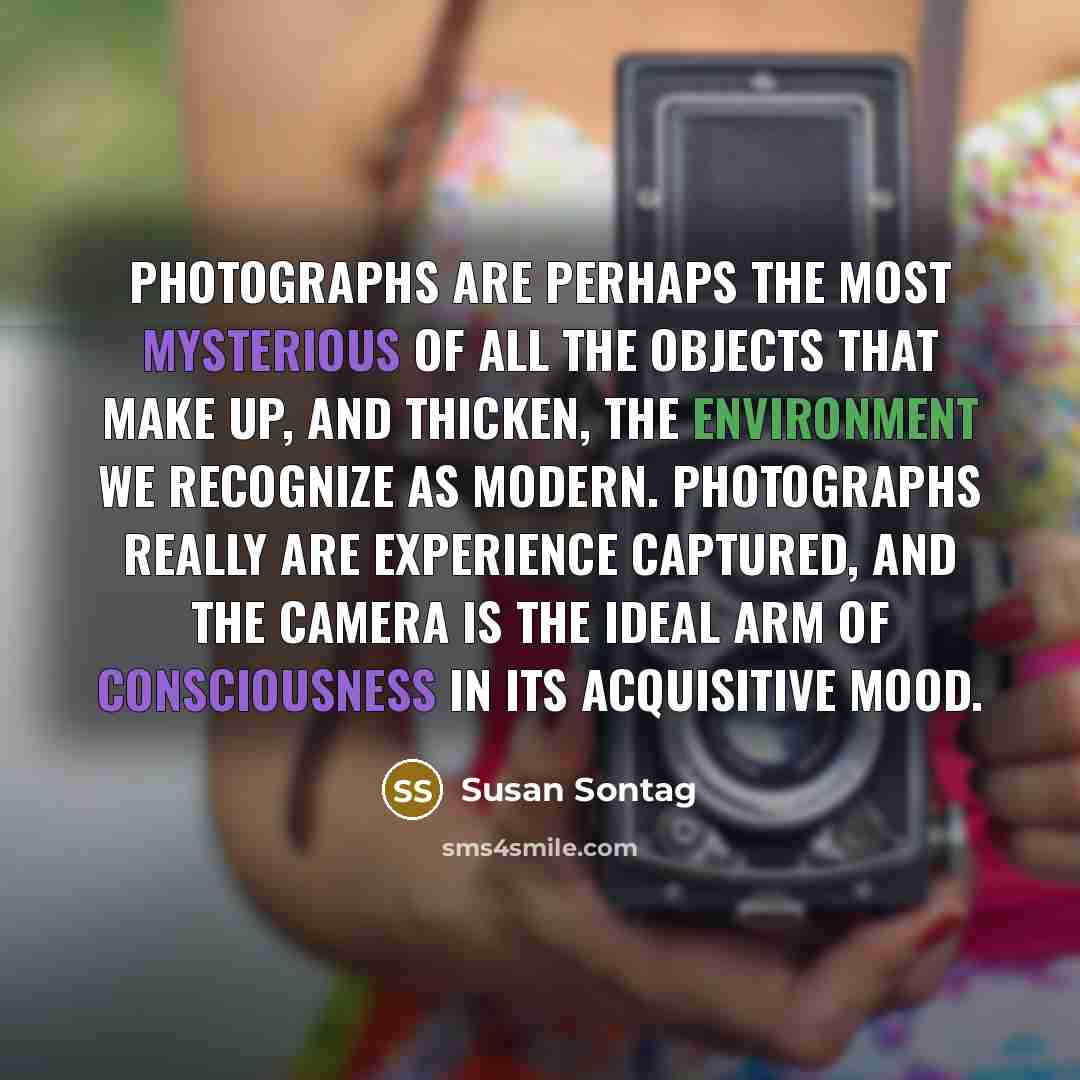
Photographs are perhaps the most mysterious of all the objects that make up, and thicken, the environment we recognize as modern. Photographs… — Susan Sontag Copy Share Image
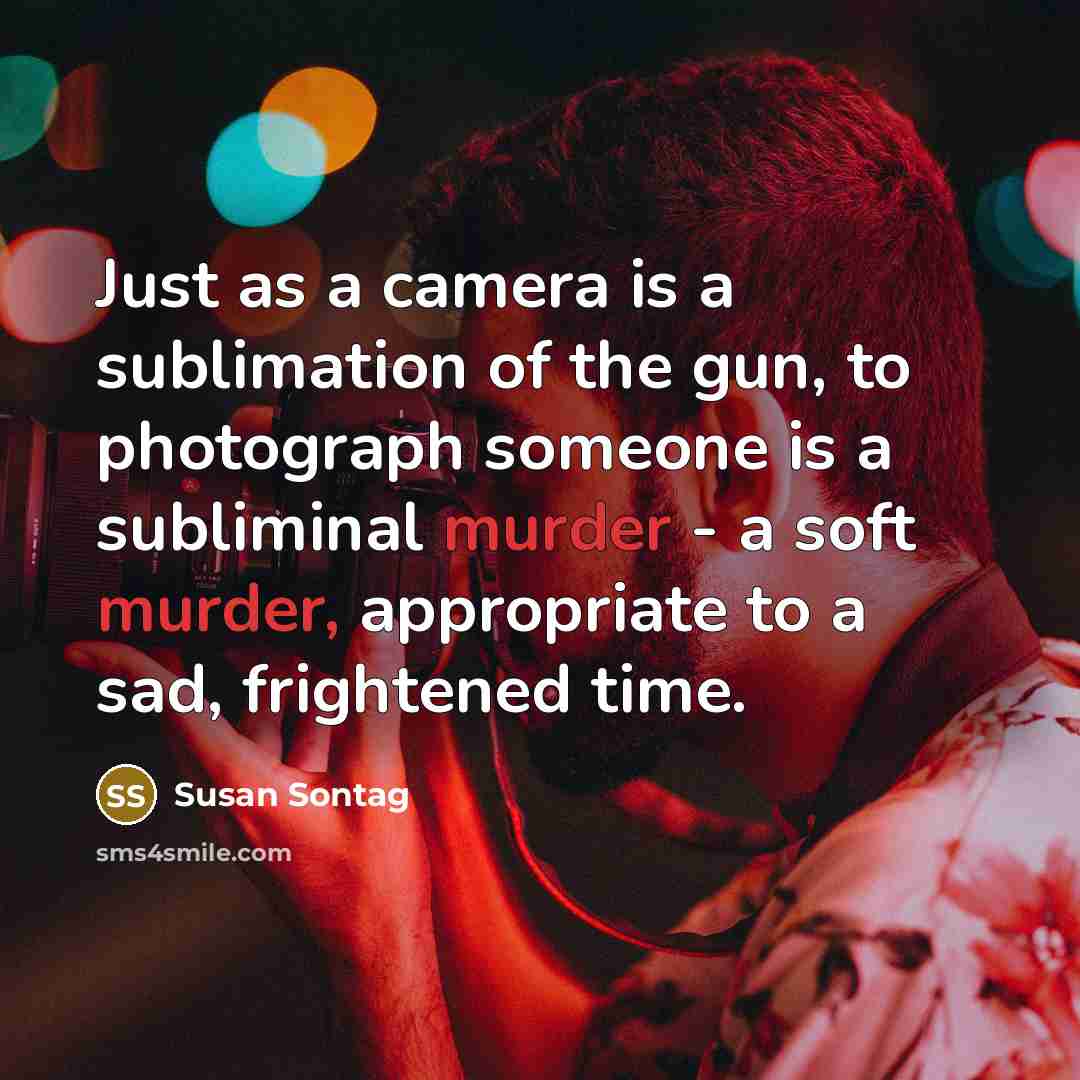
Just as a camera is a sublimation of the gun, to photograph someone is a subliminal murder - a soft murder, appropriate… — Susan Sontag Copy Share Image
The photographer's intentions do not determine the meaning of a photograph, which will have its own career, blown by the whims and… — Susan Sontag Copy Share Image
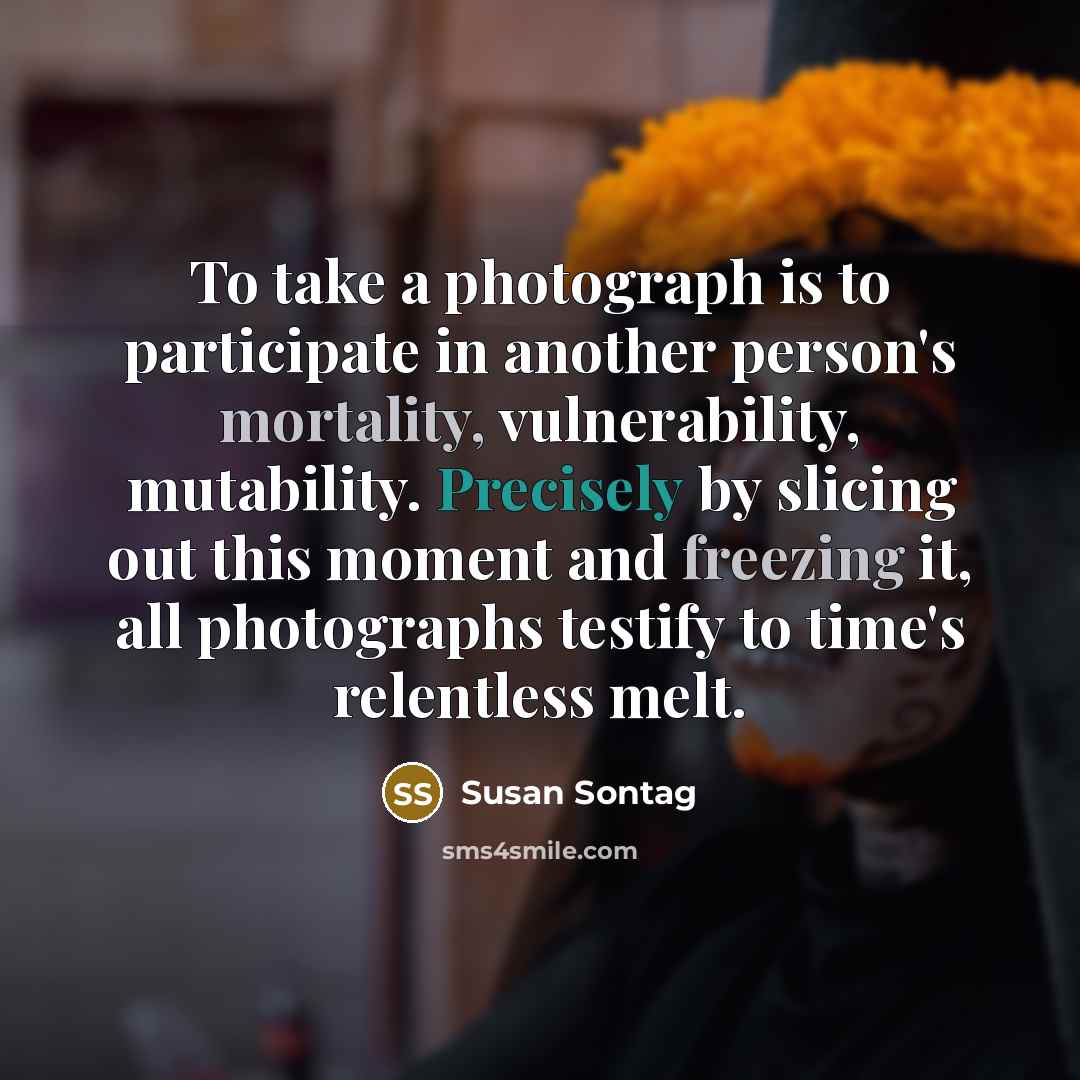
To take a photograph is to participate in another person's mortality, vulnerability, mutability. Precisely by slicing out this moment and freezing it,… — Susan Sontag Copy Share Image
The camera can be lenient; it is can also expert at being cruel. But its cruelty only produces another kind of beauty,… — Susan Sontag Copy Share Image
“The photographer is now charging real beasts, beleaguered and too rare to kill. Guns have metamorphosed into cameras in this earnest comedy,… — Susan Sontag Copy Share Image
While a painting, even one that meets photographic standards of resemblance, is never more than the stating of an interpretation, a photograph… — Susan Sontag Copy Share Image
Cameras began duplicating the world at that moment when the human landscape started to undergo a vertiginous rate of change: while an… — Susan Sontag Copy Share Image
Our very sense of situation is now articulated by the camera's interventions. The omnipresence of cameras persuasively suggests that time consists of… — Susan Sontag Copy Share Image
It is a nostalgic time right now, and photographs actively promote nostalgia. Photography is an elegiac art, a twilight art. Most subjects… — Susan Sontag Copy Share Image
Industrial societies turn their citizens into image-junkies; it is the most irresistible form of mental pollution. Poignant longings for beauty, for an… — Susan Sontag Copy Share Image
Because each photograph is only a fragment, its moral and emotional weight depends on where it is inserted. A photograph changes according… — Susan Sontag Copy Share Image
Images anesthetize. An event known through photographs certainly becomes more real than it would have been if one had never seen the… — Susan Sontag Copy Share Image
“But the very question of whether photography is or is not an art is essentially a misleading one. Although photography generates works… — Susan Sontag Copy Share Image
“That we are not totally transformed, that we can turn away, turn the page, switch the channel, does not impugn the ethical… — Susan Sontag Copy Share Image
Between two fantasy alternatives, that Holbein the Younger had lived long enough to have painted Shakespeare or that a prototype of the… — Susan Sontag Copy Share Image
“Most of Arbus's work lies within the Warhol aesthetic, that is, defines itself in relation to the twin poles of boringness and… — Susan Sontag Copy Share Image
the appetite for thinking must be regulated, as all sensible people know, for it may stifle one's life. — Susan Sontag Copy Share Image
Unfortunately, moral beauty in art - like physical beauty in a person - is extremely perishable. It is nowhere so durable as artistic or… — Susan Sontag Copy Share Image
Like the collector, the photographer is animated by a passion that, even when it appears to be for the present, is linked to a… — Susan Sontag Copy Share Image
Anthropology has always struggled with an intense, fascinated repulsion towards its subject… [The anthropologist] submits himself to the exotic to confirm his own inner… — Susan Sontag Copy Share Image
“Why not eliminate schooling between age 12-16? It’s biologically + psychologically too turbulent a time to be cooped up inside, made to sit all… — Susan Sontag Copy Share Image
To photograph people is to violate them, by seeing them as they never see themselves, by having knowledge of them that they can never… — Susan Sontag Copy Share Image
One set of messages of the society we live in is: Consume. Grow. Do what you want. Amuse yourselves. The very working of this… — Susan Sontag Copy Share Image
Currently intellectuals in Western Europe and North America are extremely demoralized and shaken by the rise of a virulent conservative tendency (which some have… — Susan Sontag Copy Share Image
With the modern diseases (once TB, now cancer) the romantic idea that the disease expresses the character is invariably extended to assert that the… — Susan Sontag Copy Share Image
As objects of contemplation, images of the atrocious can answer to several different needs. To steel oneself against weakness. To make oneself more numb.… — Susan Sontag Copy Share Image
The creative phase of an idea coincides with the period during which it insists, cantankerously, on its boundaries, on what makes it different; but… — Susan Sontag Copy Share Image

![“Anthropology has always struggled with an intense, fascinated repulsion towards its subject… [The anthropologist] submits himself to the exotic to confirm his own inner alienation as an urban intellectual.” quote by Susan Sontag](https://sms4smile.com/quotes/img-quotes/fe1/susan-sontag-332_alienation_anthropology-has-always-struggled-with-a_15322.jpg)