“gene (information -> encodes protein (form) -> enables function” — Siddhartha Mukherjee Copy Share Image
“Freaks become norms, and norms become extinct. Monster by monster, evolution advanced” — Siddhartha Mukherjee Copy Share Image
“Every genetic “illness” is a mismatch between an organism’s genome and its environment.” — Siddhartha Mukherjee Copy Share Image
“Evolution can craft perfectly adapted organisms, but not in an intentional manner: it is not just a "blind watchmaker", but also a… — Siddhartha Mukherjee Copy Share Image
“With DNA as with words, the sequence carries the meaning. Dissolve DNA into its constituent bases, and it turns into a primordial… — Siddhartha Mukherjee Copy Share Image
“It has repeated elements that appear frequently. A pesky, mysterious three-hundred-base-pair sequence called Alu appears and reappears tens of thousands of times,… — Siddhartha Mukherjee Copy Share Image
“The gene provides an organizing principle for modern biology—and it tantalizes us with the prospect of controlling our bodies and fates.” — Siddhartha Mukherjee Copy Share Image
“As I write this, organisms endowed with genomes are learning to change the heritable features of organisms endowed with genomes.” — Siddhartha Mukherjee Copy Share Image
“We now know that cells have ancient detectors that recognize viral genes and stamp them with chemical marks, like cancellation signs, to… — Siddhartha Mukherjee Copy Share Image
“There is no such thing as perfection, only the relentless, thirsty matching of an organism to its environment. That is the engine… — Siddhartha Mukherjee Copy Share Image
“In 1905, still struggling for an alternative, Bateson coined a word of his own. Genetics, he called it: the study of heredity… — Siddhartha Mukherjee Copy Share Image
“The biochemist's approach pivots on concentration: find the protein by looking where it's most likely to be concentrated, and distill it out… — Siddhartha Mukherjee Copy Share Image
“The tightness of genetic linkage, in short, was a surrogate for the physical proximity of genes on chromosomes: by measuring how often… — Siddhartha Mukherjee Copy Share Image
“The structure of the human genome can thus be likened to a sentence that reads- This…is the…str...uc…ture...,,,...of...your...(...gen...ome...)... - where the words correspond… — Siddhartha Mukherjee Copy Share Image
“Life may be chemistry, but it's a special circumstance of chemistry. Organisms exist not because of reactions that are possible, but because… — Siddhartha Mukherjee Copy Share Image
“A gene," Beadle wrote in 1945, "can be visualized as directing the final configuration of a protein molecule." This was the "action… — Siddhartha Mukherjee Copy Share Image
“Every generation of humans will produce variants and mutants; it is an inextricable part of our biology. A mutation is only “abnormal”… — Siddhartha Mukherjee Copy Share Image
“The factor VIII project, both teams knew, would challenge the outer limits of gene-cloning technology. Somatostatin had 14 amino acids; insulin had… — Siddhartha Mukherjee Copy Share Image
“In 1977, when Fred Sanger had sequenced the genome of the phiX virus, with 5,386 bases of DNA, that number represented the… — Siddhartha Mukherjee Copy Share Image
“Genes, oddly, compromise only a minuscule fraction of it. An enormous proportion-a bewildering 98 percent-is not dedicated to genes per se, but… — Siddhartha Mukherjee Copy Share Image
“The third cardinal feature of gene regulation, Monod and Jacob discovered, was that every gene had specific regulatory DNA sequences appended to… — Siddhartha Mukherjee Copy Share Image
“The double-helix has solved all three of the major challenges of genetic physiology using ingenious variations on the same theme. Mirror-image chemicals… — Siddhartha Mukherjee Copy Share Image
“To see," the poet Paul Valery once wrote, "is to forget the name of the things that one sees." To see DNA… — Siddhartha Mukherjee Copy Share Image
“Aristotle was wrong in his partitioning of male and female contributions into "material" and "message," but abstractly, he had captured one of… — Siddhartha Mukherjee Copy Share Image
“If A was tightly linked to B, and very loosely linked to C, Sturtevant reasoned, then the three genes must be positioned… — Siddhartha Mukherjee Copy Share Image
“The cloning of human genes allowed scientists to manufacture proteins-and the synthesis of proteins opened the possibility of targeting the millions of… — Siddhartha Mukherjee Copy Share Image
“The proteins create a gradient within the egg. Like sugar diffusing out of a cube in a cup of coffee, they are… — Siddhartha Mukherjee Copy Share Image
“Introns are not the exception in human genes; they are the rule. Human introns are often enormous-spanning several hundreds of thousands of… — Siddhartha Mukherjee Copy Share Image
“It is conceivable that an interplay of genes and epigenes coordinates human embryogenesis. Let us return, yet again, to Morgan's problem: the… — Siddhartha Mukherjee Copy Share Image
“It was the magnesium. The addition of the ion was critical: with the solution supplemented with magnesium, the ribosome remained glued together,… — Siddhartha Mukherjee Copy Share Image
“Working independently, Baltimore and Temin discovered an enzyme found in retroviruses that could build DNA from an RNA template. They called the… — Siddhartha Mukherjee Copy Share Image
“As an anology, consider the word structure. In bacteria, the gene is embedded in the genome in precisely that format, structure, with… — Siddhartha Mukherjee Copy Share Image
“Indeed, as predicted, when the gene encoding the hemoglobin B chain was later identified and sequenced in sickle-cell patients, there was a… — Siddhartha Mukherjee Copy Share Image
“Second, the production of RNA Messages was coordinately regulated. When the sugar source was switched to lactose, the bacteria turned on an… — Siddhartha Mukherjee Copy Share Image
“It is the impulse of science to understand nature, and the impulse of technology to try to manipulate it. Recombinant DNA had… — Siddhartha Mukherjee Copy Share Image
“Epigenetics, Waddington wrote, concerns "the interaction of genes with their environment (...) that brings their phenotype into being.” — Siddhartha Mukherjee Copy Share Image
“How can one capture genes that behave like ghosts," Weinberg wrote, "influencing cells from behind some dark curtain?” — Siddhartha Mukherjee Copy Share Image
“Mutants are necessary to maintain the essence of our selves. Our genomes has negotiated a fragile balance between counterpoised forces, pairing strand… — Siddhartha Mukherjee Copy Share Image
“Dimly, as if through a veil, geneticists were beginning to visualize patterns and themes: threads, strings, maps, crossings, broken and unbroken lines,… — Siddhartha Mukherjee Copy Share Image
Most days, I go home and I feel rejuvenated. I feel ebullient. — Siddhartha Mukherjee Copy Share Image
“A note of caution: epigenetics is also on the verge of transforming into a dangerous idea. Epigenetic modifications of genes can potentially superpose historical… — Siddhartha Mukherjee Copy Share Image
When you immerse yourself in medicine you realise that hope is not absolute. It's not that simple. — Siddhartha Mukherjee Copy Share Image
“I had a novice's hunger for history, but also a novice's inability to envision it.” — Siddhartha Mukherjee Copy Share Image
“Any extrapolation of history into the future presupposes an environment of static discovery—an oxymoron.” — Siddhartha Mukherjee Copy Share Image
“Six decades and two years, no more than a passing glance of time, separate Mendel's initial experiments on peas and the court-mandated sterilization of… — Siddhartha Mukherjee Copy Share Image
“We now know that cells have ancient detectors that recognize viral genes and stamp them with chemical marks, like cancellation signs, to prevent their… — Siddhartha Mukherjee Copy Share Image
“Familial schizophrenia (like normal human features such as intelligence and temperament) is thus highly heritable but only moderately inheritable. In other words, genes-hereditary determinants-are… — Siddhartha Mukherjee Copy Share Image
“If you prefer an “academic life” as a retreat from reality, do not go into biology. This field is for a man or woman… — Siddhartha Mukherjee Copy Share Image
“But the pigs--seventy pounds of porcine weight that did not take kindly to weekly endoscopies--did not sprout any ulcers. And testing the theory on… — Siddhartha Mukherjee Copy Share Image
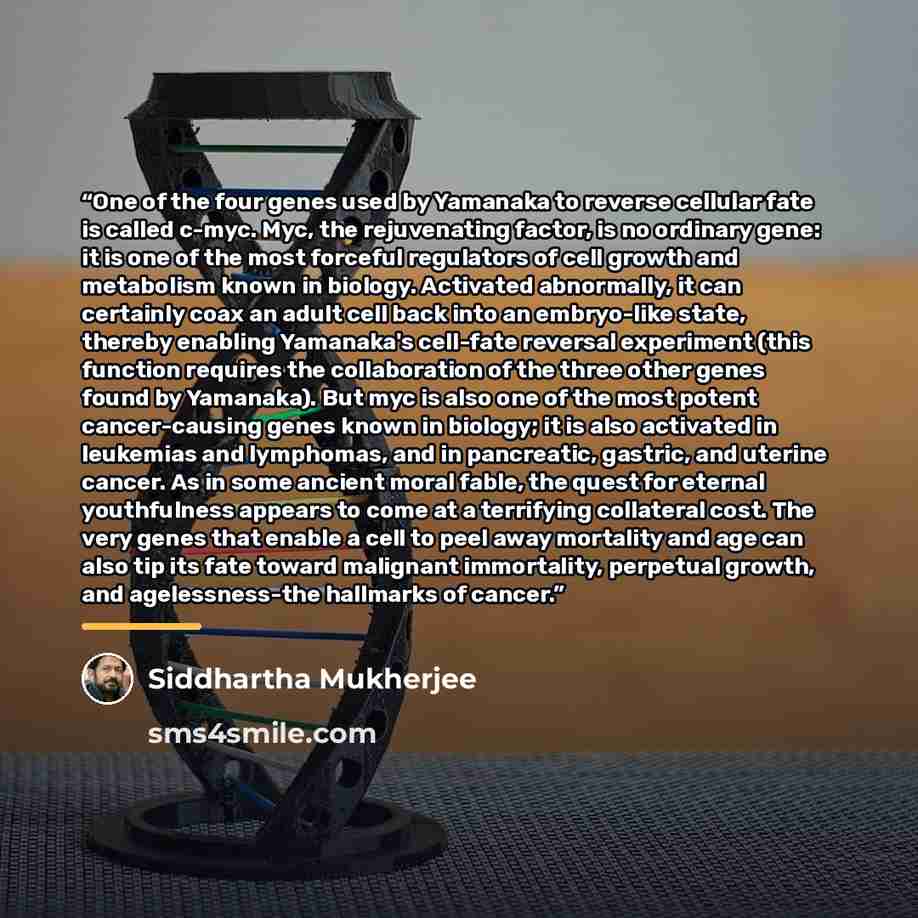
“One of the four genes used by Yamanaka to reverse cellular fate is called c-myc. Myc, the rejuvenating factor, is no ordinary gene: it… — Siddhartha Mukherjee Copy Share Image
A breast cancer might turn out to have a close resemblance to a gastric cancer. And this kind of reorganization of cancer in terms… — Siddhartha Mukherjee Copy Share Image