Evolution Quote by Siddhartha Mukherjee
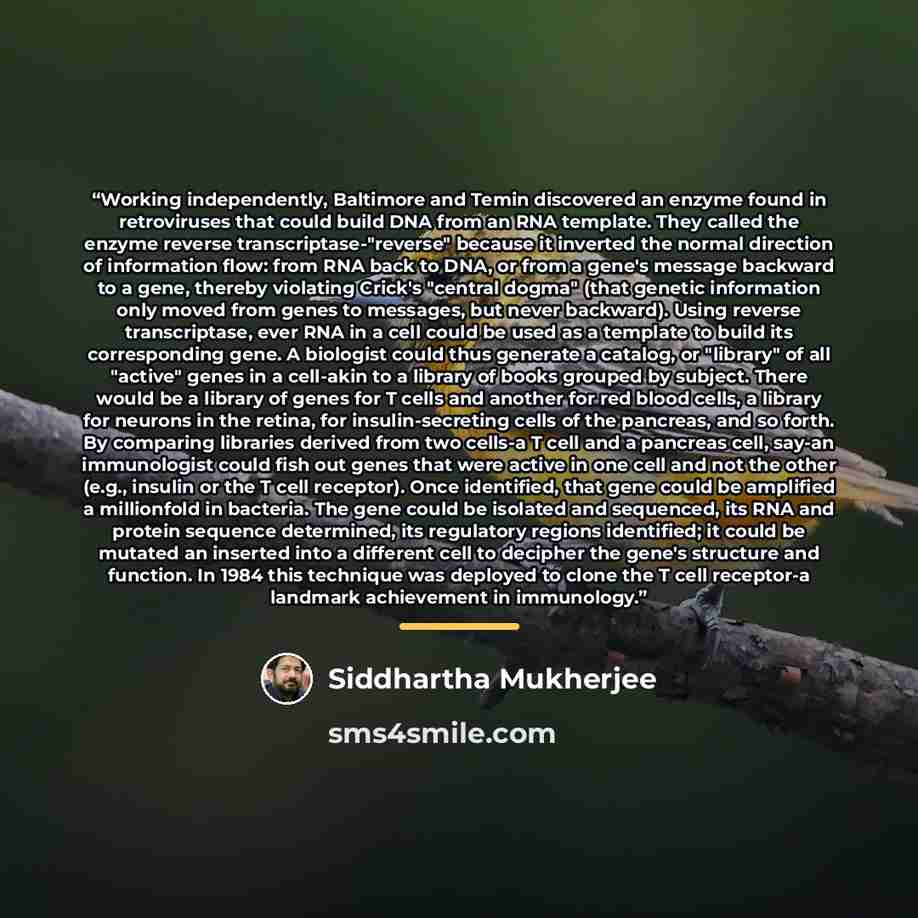
““Working independently, Baltimore and Temin discovered an enzyme found in retroviruses that could build DNA from an RNA template. They called the enzyme reverse transcriptase-"reverse" because it inverted the normal direction of information flow: from RNA back to DNA, or from a gene's message backward to a gene, thereby violating Crick's "central dogma" (that genetic information only moved from genes to messages, but never backward). Using reverse transcriptase, ever RNA in a cell could be used as a template to build its corresponding gene. A biologist could thus generate a catalog, or "library" of all "active" genes in a cell-akin to a library of books grouped by subject. There would be a library of genes for T cells and another for red blood cells, a library for neurons in the retina, for insulin-secreting cells of the pancreas, and so forth. By comparing libraries derived from two cells-a T cell and a pancreas cell, say-an immunologist could fish out genes that were active in one cell and not the other (e.g., insulin or the T cell receptor). Once identified, that gene could be amplified a millionfold in bacteria. The gene could be isolated and sequenced, its RNA and protein sequence determined, its regulatory regions identified; it could be mutated an inserted into a different cell to decipher the gene's structure and function. In 1984 this technique was deployed to clone the T cell receptor-a landmark achievement in immunology.””
About This Quote
Source Book: The Gene: An Intimate History, 2016
Describes reverse transcriptase discovery, enabling gene expression profiling and functional genomics.
In simple terms: Reverse transcriptase lets RNA become DNA for study.
Key Takeaway
Use reverse transcription to explore gene activity.
Themes
science
innovation
genomics
Mood
informative
enthusiastic
Type
scientific
educational
When to use this quote
- research labs
- medical diagnostics
- drug discovery
- educational curricula
Key Concepts
molecular biology
information flow
technology development
Questions to Reflect On
- What are the implications of gene library comparisons?
- How does this technology impact personalized medicine?
A Different Perspective
Technical challenges and ethical concerns arise with gene manipulation.





![“Perhaps no order of mammals presents us with so extraordinary a series of gradations as this [step by step, from humans to apes to monkeys to lemurs] - leading us insensibly from the crown and summit of the animal creation down to creatures, from which there is but a step, as it seems, to the…” quote by Thomas Huxley](https://sms4smile.com/quotes/img-quotes/f0b/thomas-huxley-1183_animal_perhaps-no-order-of-mammals-presents-us_3051.jpg)