Empiricism Quote by Ulrich Müller

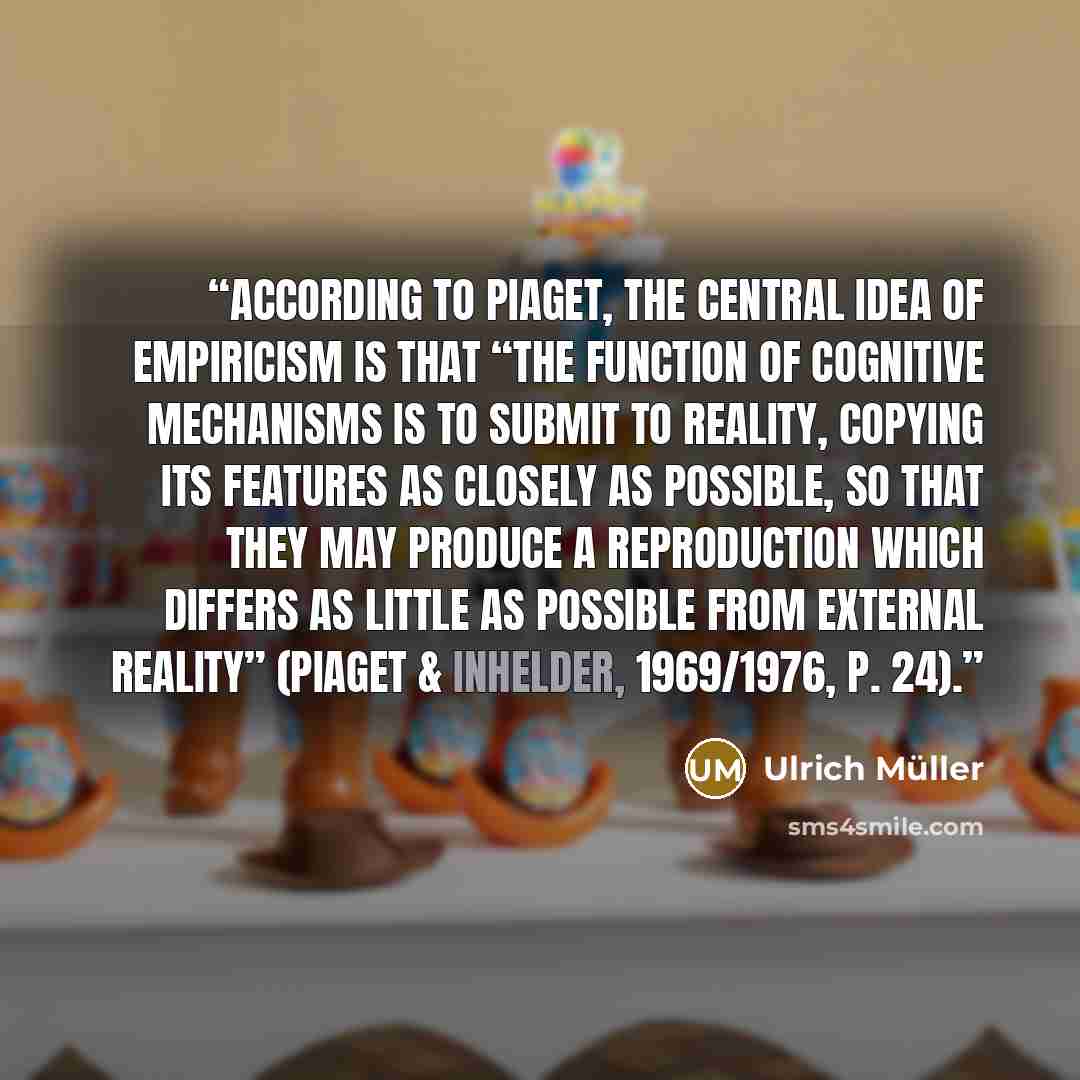
““Empiricism is not just an empirical method but also a theory of experience. Essentially, it conceives of human beings as passive and sense perception as providing replicas or copies of reality that are based on association. As key proponents of empiricism, Piaget identified Hume, Locke, and behaviorist stimulus-response theories, but he also thought that empiricism is trenchant in psychology (and, one might add, even today, see Müller & Giesbrecht, 2008). According to Piaget, empiricists misconstrue the fundamentally active relation between infant and environment as a passive, causal relation: “Even before language begins, the young infant reacts to objects not by a mechanical set of stimulus-response associations but by an integrative assimilation to schemes of action, which impress a direction on his activities and include the satisfaction of a need or an interest” (Piaget, 1965/1971, p. 131; see also OI, p. 411). Furthermore, Piaget (1970) rejected the idea that knowledge is a copy of reality. Rather, he was influenced by Kant's (1787/1929) idea that objectivity is constituted by the subject (see Chapter 3, this volume). Kant argued that our intuition (i.e., sensibility) and understanding use a priori (i.e., independent of all experience) forms and categories, which are the condition of the possibility for experiencing objectivity. Piaget subscribed to the ordering and organizing function of the mind, but he believed that the forms and categories are not a priori but undergo development as a result of the subject's interaction with the world (OI, pp. 376–395).””
About This Quote
Source Book: The Development of Knowledge in Children, Ulrich Müller, 2008
Piaget argues that knowledge is actively constructed through interaction, not passively received as copies of reality.
In simple terms: We build understanding by engaging with the world.
Key Takeaway
Engage actively to shape knowledge.
Themes
cognition
development
learning
Mood
reflective
analytical
Type
theoretical
educational
When to use this quote
- early childhood education
- psychology research
- teaching strategies
- parental interaction
Key Concepts
constructivism
active perception
schema theory
Questions to Reflect On
- How does active engagement change what we know?
- What role do schemas play in interpreting new experiences?
A Different Perspective
Passive models ignore the role of agency in learning.