Truth Seeking Quote by Thomas Gilovich
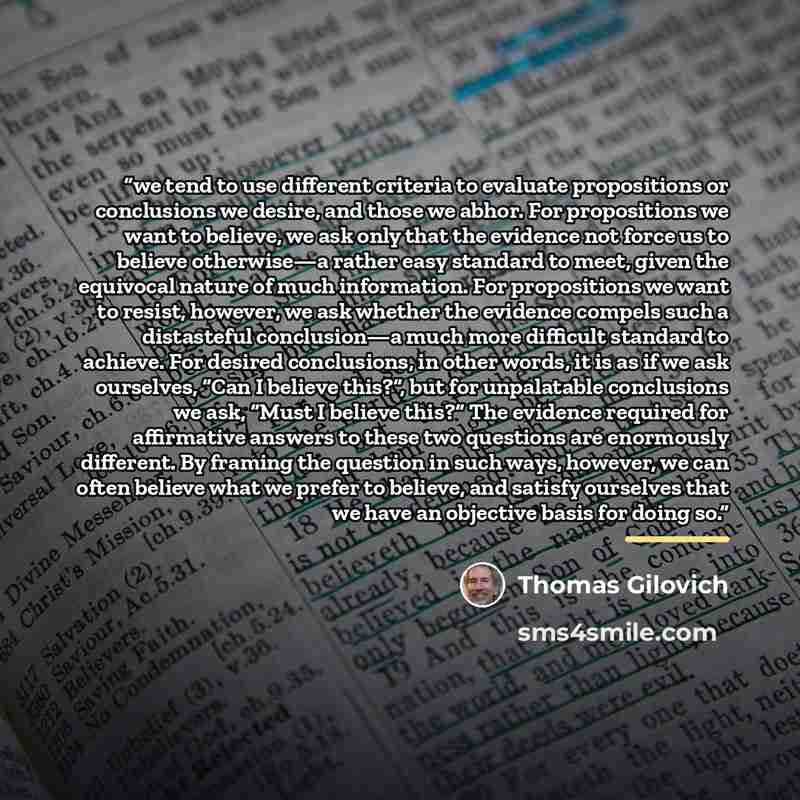
““we tend to use different criteria to evaluate propositions or conclusions we desire, and those we abhor. For propositions we want to believe, we ask only that the evidence not force us to believe otherwise—a rather easy standard to meet, given the equivocal nature of much information. For propositions we want to resist, however, we ask whether the evidence compels such a distasteful conclusion—a much more difficult standard to achieve. For desired conclusions, in other words, it is as if we ask ourselves, “Can I believe this?”, but for unpalatable conclusions we ask, “Must I believe this?” The evidence required for affirmative answers to these two questions are enormously different. By framing the question in such ways, however, we can often believe what we prefer to believe, and satisfy ourselves that we have an objective basis for doing so.””
About This Quote
Source Book: Heuristics and Biases in Judgment and Decision Making, 1995
People apply lenient evidence standards to favored ideas and stricter standards to disliked ones, allowing bias to masquerade as objectivity.
In simple terms: We accept easy evidence for what we like, demand hard proof for what we dislike.
Key Takeaway
Recognize and correct double standards in evaluating evidence.
Themes
cognition
bias
critical thinking
decision making
self-awareness
Mood
reflective
analytical
skeptical
Type
philosophical
inspirational
cautionary
When to use this quote
- political debates
- personal relationships
- media consumption
- scientific research
- legal judgments
Key Concepts
confirmation bias
motivivated reasoning
epistemic standards
Questions to Reflect On
- How do you test the rigor of evidence for both liked and disliked claims?
- What mechanisms can reduce motivated reasoning?
A Different Perspective
Bias can persist even when we think we are being objective.
![“[T]he question "What is everything?" has no meaning, even though it seems to be profound. [...] The point is, perhaps, that I am not looking for a verbal answer, just as when I ask for a kiss, I do not want a piece of paper with "A kiss" written on it. It is rather that metaphysical wonder looks…” quote by Alan W. Watts](https://sms4smile.com/quotes/img-quotes/705/alan-w-watts-9497_curiosity_t-he-question-what-is-everything-has-no_3984.jpg)