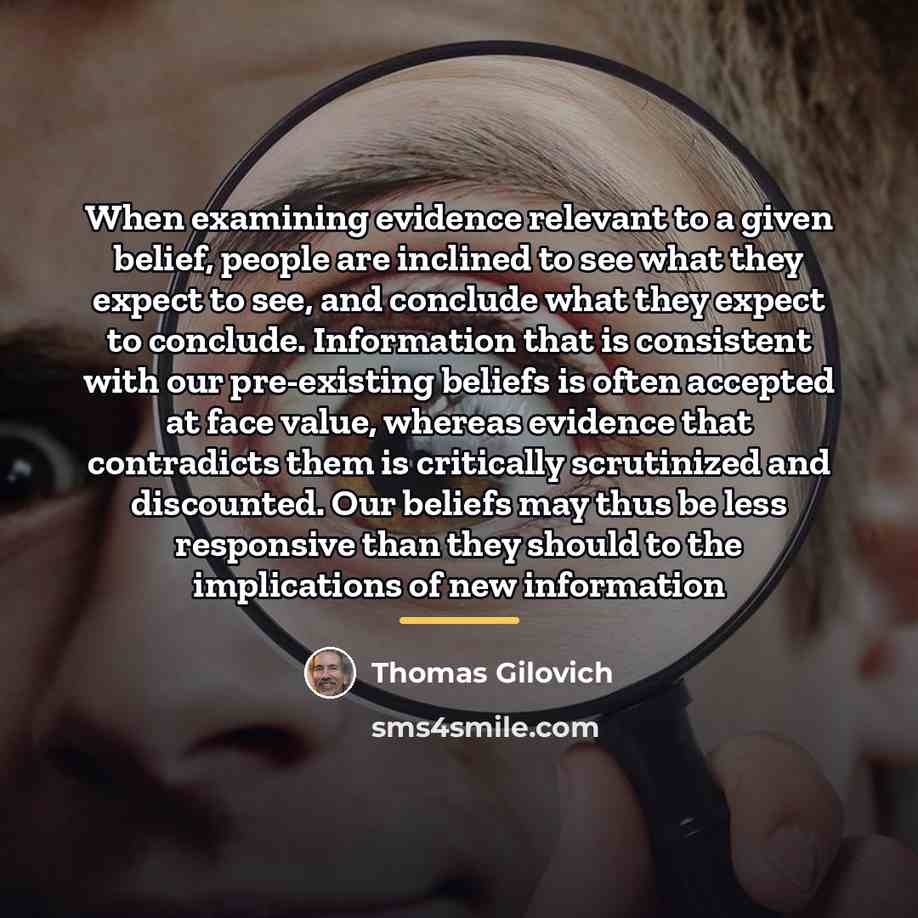
Different beliefs Quote by Thomas Gilovich

““social psychologist Ziva Kunda, who argues that people are indeed more likely to believe things they want to believe, but that their capacity to do so is constrained by objective evidence and by their ability “… to construct a justification of their desired conclusion that would persuade a dispassionate observer. They draw the desired conclusion only if they can muster up the evidence necessary to support it.”22 It is informative in this respect that people generally think of themselves as objective.* People rarely think that they hold a particular belief simply because they want to hold it, the evidence be damned. This sense of objectivity can nevertheless be illusory: Although people consider their beliefs to be closely tied to relevant evidence, they are generally unaware that the same evidence could be looked at differently, or that there is other, equally pertinent evidence to consider. As Kunda describes it, “… people do not realize that the [inferential] process is biased by their goals, that they are only accessing a subset of their relevant knowledge, that they would probably access different beliefs and [inferential] rules in the presence of different goals, and that they might even be capable of justifying opposite conclusions on different occasions.”23””
About This Quote
People claim objectivity but are biased by desires; they only seek evidence that supports preferred conclusions, ignoring alternative interpretations.
In simple terms: Self‑deception masks bias.
Key Takeaway
Motivation skews evidence selection.
Themes
cognition
bias
psychology
Mood
insightful
cautious
Type
analytical
educational
When to use this quote
- decision making
- media consumption
- scientific research
Key Concepts
motivated reasoning
confirmation bias
Practical Applications
- train to seek disconfirming evidence
Questions to Reflect On
- How can we become aware of our selective evidence gathering?
- What tools help expose hidden biases?
A Different Perspective
May underplay structural constraints on evidence access.