Christianity Quote by Thomas Allin
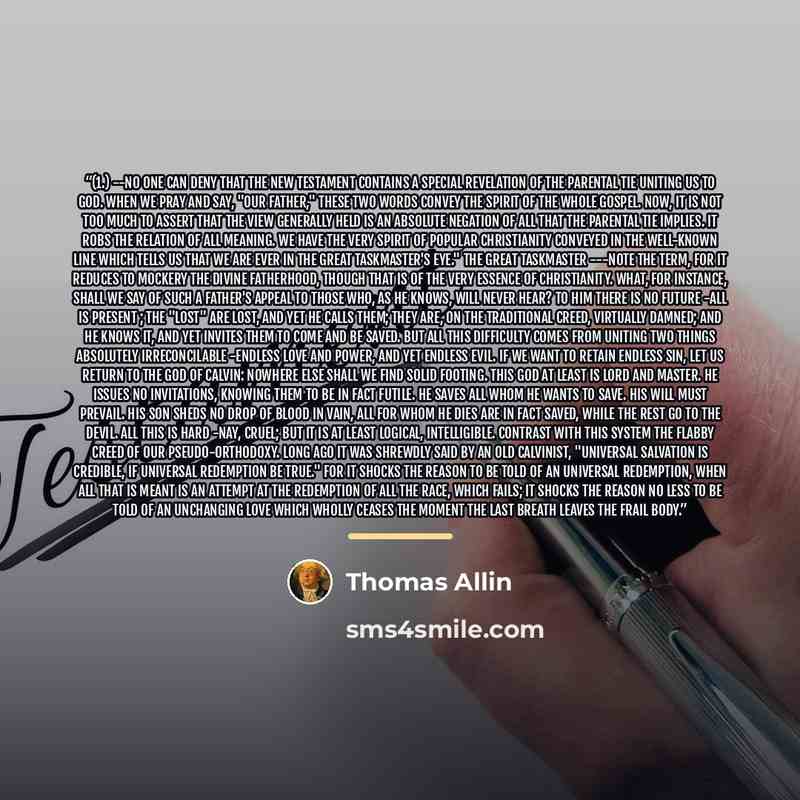
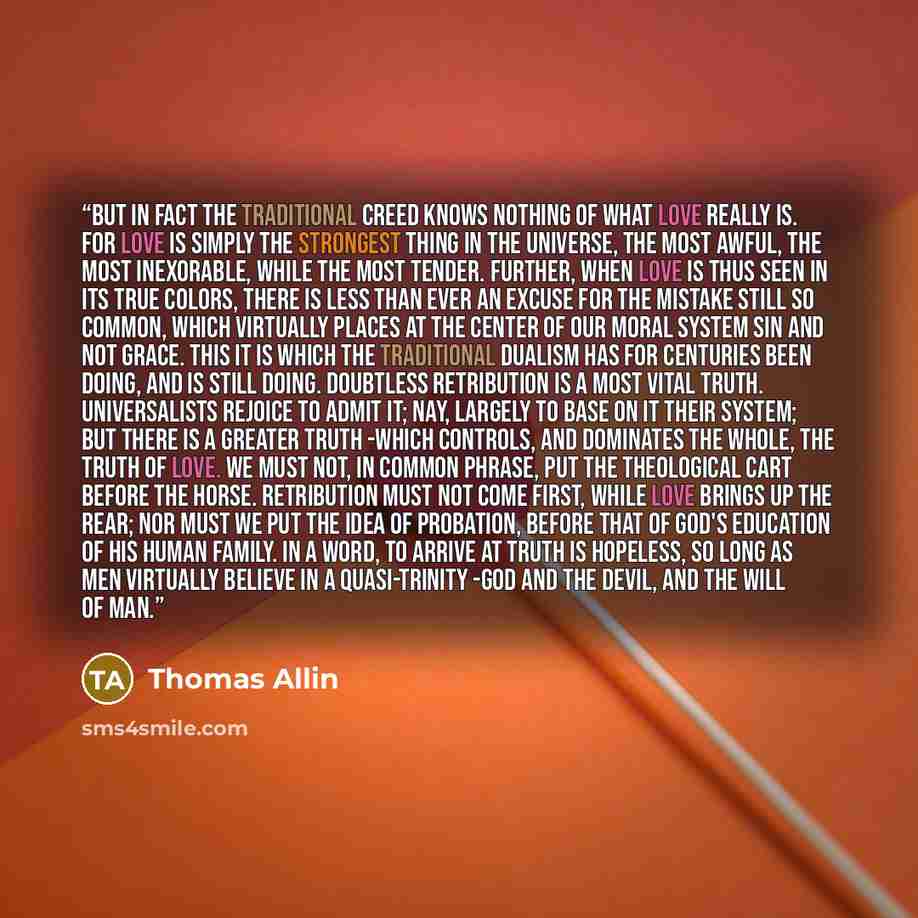
““(1.) --No one can deny that the New Testament contains a special revelation of the parental tie uniting us to God. When we pray and say, "our Father," these two words convey the spirit of the whole Gospel. Now, it is not too much to assert that the view generally held is an absolute negation of all that the parental tie implies. It robs the relation of all meaning. We have the very spirit of popular Christianity conveyed in the well-known line which tells us that we are ever in the great Taskmaster's eye." The great Taskmaster ---note the term, for it reduces to mockery the divine Fatherhood, though that is of the very essence of Christianity. What, for instance, shall we say of such a Father's appeal to those who, as He knows, will never hear? To Him there is no future -all is present ; the "lost" are lost, and yet He calls them; they are, on the traditional creed, virtually damned; and He knows it, and yet invites them to come and be saved. But all this difficulty comes from uniting two things absolutely irreconcilable -endless love and power, and yet endless evil. If we want to retain endless sin, let us return to the God of Calvin: nowhere else shall we find solid footing. This God at least is Lord and Master. He issues no invitations, knowing them to be in fact futile. He saves all whom He wants to save. His will must prevail. His Son sheds no drop of blood in vain, All for whom He dies are in fact saved, while the rest go to the devil. All this is hard -nay, cruel; but it is at least logical, intelligible. Contrast with this system the flabby creed of our pseudo-orthodoxy. Long ago it was shrewdly said by an old Calvinist, "universal salvation is credible, if universal Redemption be true." For it shocks the reason to be told of an universal Redemption, when all that is meant is an attempt at the redemption of all the race, which fails; it shocks the reason no less to be told of an unchanging love which wholly ceases the moment the last breath leaves the frail body.””
About This Quote
The passage critiques the paradox of a divine father who both loves unconditionally and condemns, highlighting tension between universal redemption and Calvinist predestination.
In simple terms: It questions how a loving God can also be selective and punitive.
Key Takeaway
Consider the balance between divine love and justice.
Themes
theology
paradox
predestination
universalism
redemption
Mood
thoughtful
critical
inquisitive
Type
theological
philosophical
controversial
When to use this quote
- Church doctrine debates
- personal faith reflection
- ethical discussions on predestination
- interfaith dialogue
- missionary work
Key Concepts
Divine love
free will
salvation
evil
justice
Questions to Reflect On
- How do you reconcile love and judgment in faith?
- Can universal redemption coexist with predestined salvation?
A Different Perspective
It assumes a binary view of God that may overlook nuanced theological interpretations.