Common good Quote by Sarah Chayes
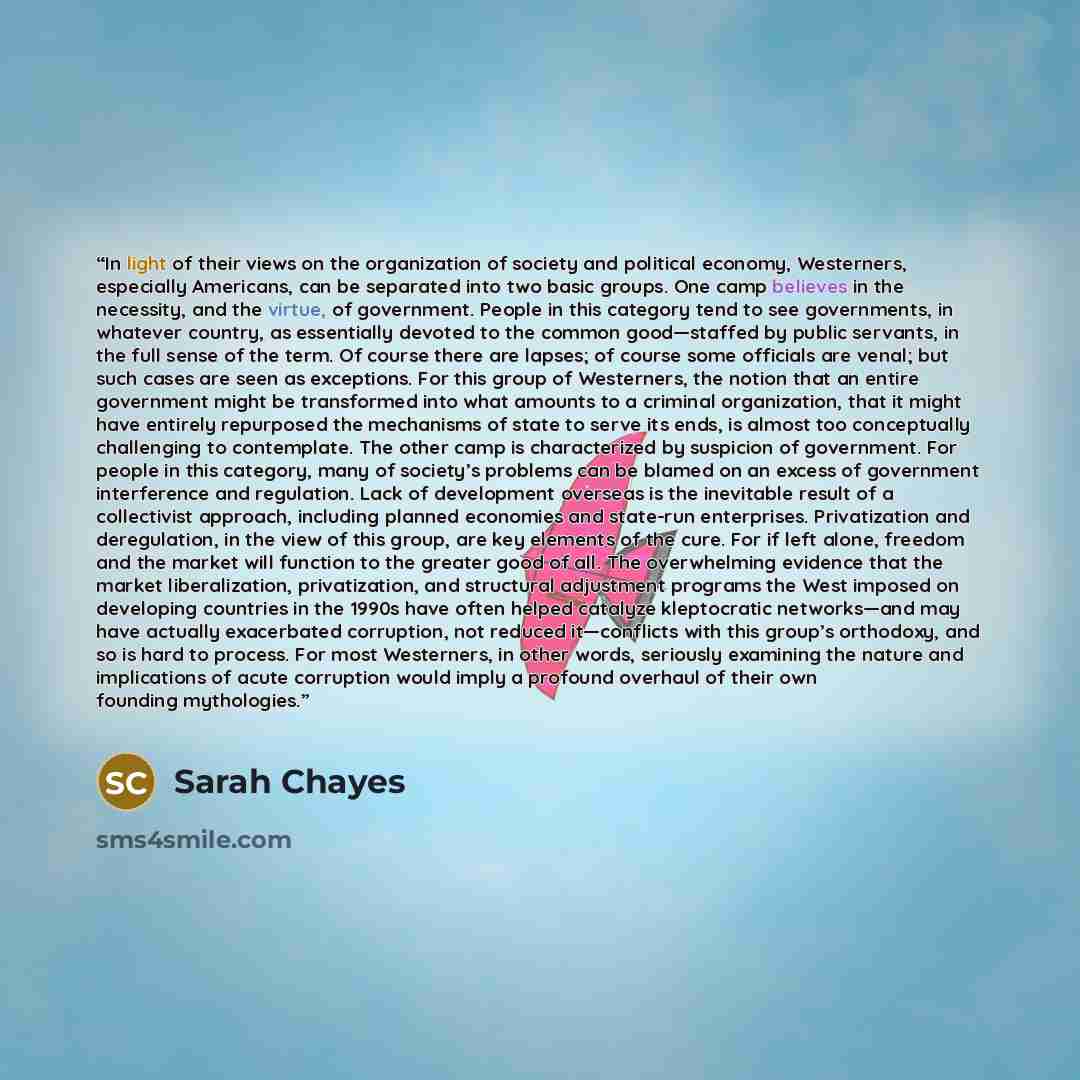
““In light of their views on the organization of society and political economy, Westerners, especially Americans, can be separated into two basic groups. One camp believes in the necessity, and the virtue, of government. People in this category tend to see governments, in whatever country, as essentially devoted to the common good—staffed by public servants, in the full sense of the term. Of course there are lapses; of course some officials are venal; but such cases are seen as exceptions. For this group of Westerners, the notion that an entire government might be transformed into what amounts to a criminal organization, that it might have entirely repurposed the mechanisms of state to serve its ends, is almost too conceptually challenging to contemplate. The other camp is characterized by suspicion of government. For people in this category, many of society’s problems can be blamed on an excess of government interference and regulation. Lack of development overseas is the inevitable result of a collectivist approach, including planned economies and state-run enterprises. Privatization and deregulation, in the view of this group, are key elements of the cure. For if left alone, freedom and the market will function to the greater good of all. The overwhelming evidence that the market liberalization, privatization, and structural adjustment programs the West imposed on developing countries in the 1990s have often helped catalyze kleptocratic networks—and may have actually exacerbated corruption, not reduced it—conflicts with this group’s orthodoxy, and so is hard to process. For most Westerners, in other words, seriously examining the nature and implications of acute corruption would imply a profound overhaul of their own founding mythologies.””
About This Quote
Source Book: "The Political Economy of Corruption" by Sarah Chayes, 2005
The quote contrasts two Western perspectives: one sees government as a public‑good institution despite flaws; the other views government as inherently corrupt, favoring market‑driven solutions, and struggles to reconcile evidence of state‑driven corruption with its worldview.
In simple terms: Two opposing views on government: one idealistic, one skeptical.
Key Takeaway
Recognize bias in your political assumptions.
Themes
politics
government
corruption
economics
ideology
Mood
critical
analytical
skeptical
Type
analytical
critical
philosophical
When to use this quote
- policy analysis
- international aid
- academic debate
- public discourse
Key Concepts
public good
state failure
market liberalization
development policy
Questions to Reflect On
- How do your beliefs about government shape your policy preferences?
- Can market reforms ever fully address entrenched corruption?
A Different Perspective
The market‑only view may overlook systemic power imbalances and the role of institutions in shaping outcomes.
![“Criticizing the “corrupt, questionable, and unqualified leaders [placed] into key positions,” the argument rested on the principle of command responsibility: “The international community has enabled and encouraged bad governance through agreement and silence, and often active partnership.” Moving…” quote by Sarah Chayes](https://sms4smile.com/quotes/img-quotes/516/sarah-chayes-35000_blind-eye_criticizing-the-corrupt-questionable-and_1309107.jpg)