Books Quote by Ronald Carter
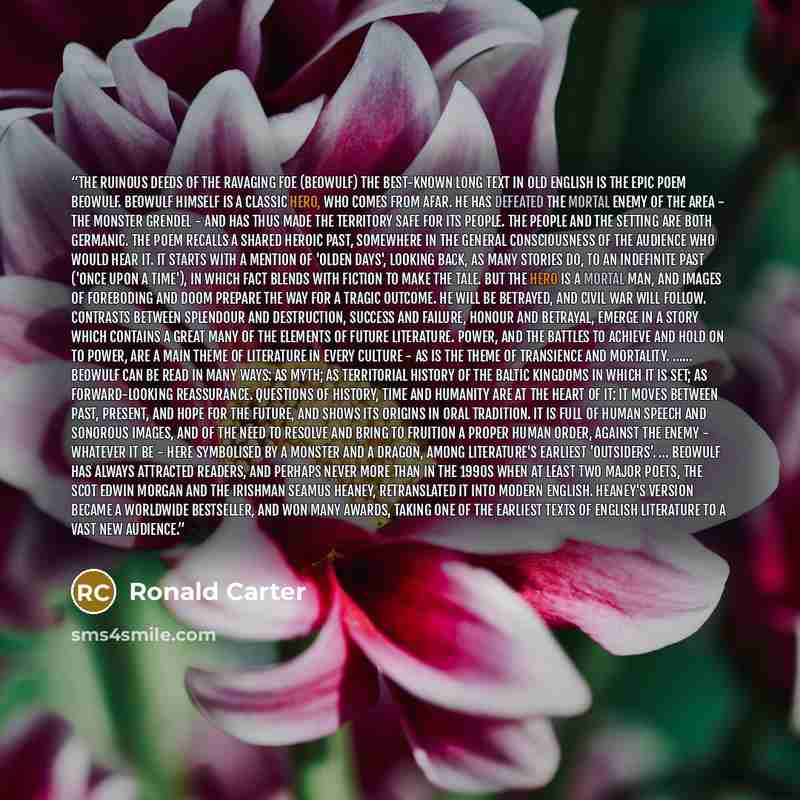
““The ruinous deeds of the ravaging foe (Beowulf) The best-known long text in Old English is the epic poem Beowulf. Beowulf himself is a classic hero, who comes from afar. He has defeated the mortal enemy of the area - the monster Grendel - and has thus made the territory safe for its people. The people and the setting are both Germanic. The poem recalls a shared heroic past, somewhere in the general consciousness of the audience who would hear it. It starts with a mention of 'olden days', looking back, as many stories do, to an indefinite past ('once upon a time'), in which fact blends with fiction to make the tale. But the hero is a mortal man, and images of foreboding and doom prepare the way for a tragic outcome. He will be betrayed, and civil war will follow. Contrasts between splendour and destruction, success and failure, honour and betrayal, emerge in a story which contains a great many of the elements of future literature. Power, and the battles to achieve and hold on to power, are a main theme of literature in every culture - as is the theme of transience and mortality. …… Beowulf can be read in many ways: as myth; as territorial history of the Baltic kingdoms in which it is set; as forward-looking reassurance. Questions of history, time and humanity are at the heart of it: it moves between past, present, and hope for the future, and shows its origins in oral tradition. It is full of human speech and sonorous images, and of the need to resolve and bring to fruition a proper human order, against the enemy - whatever it be - here symbolised by a monster and a dragon, among literature's earliest 'outsiders'. … Beowulf has always attracted readers, and perhaps never more than in the 1990s when at least two major poets, the Scot Edwin Morgan and the Irishman Seamus Heaney, retranslated it into modern English. Heaney's version became a worldwide bestseller, and won many awards, taking one of the earliest texts of English literature to a vast new audience.””
About This Quote
Source Poem: Beowulf, unknown author, c. 8th‑11th century
The epic reflects on heroic deeds, the fleeting nature of glory, and the struggle for lasting order against chaotic forces.
In simple terms: Heroic deeds confront mortality and power struggles.
Key Takeaway
Recognize the limits of power and value lasting legacy.
Themes
heroism
mortality
power
legacy
order
Mood
reflective
somber
inspirational
Type
literary
philosophical
historical
When to use this quote
- leadership challenges
- cultural heritage preservation
- personal legacy building
- conflict resolution
Key Concepts
epic literature
oral tradition
mythic symbolism
Questions to Reflect On
- How do you balance personal ambition with communal responsibility?
- What does lasting legacy mean in your life?
A Different Perspective
The poem’s glorification of violence can obscure its nuanced critique of power.