Compassion Quote by Rod Serling
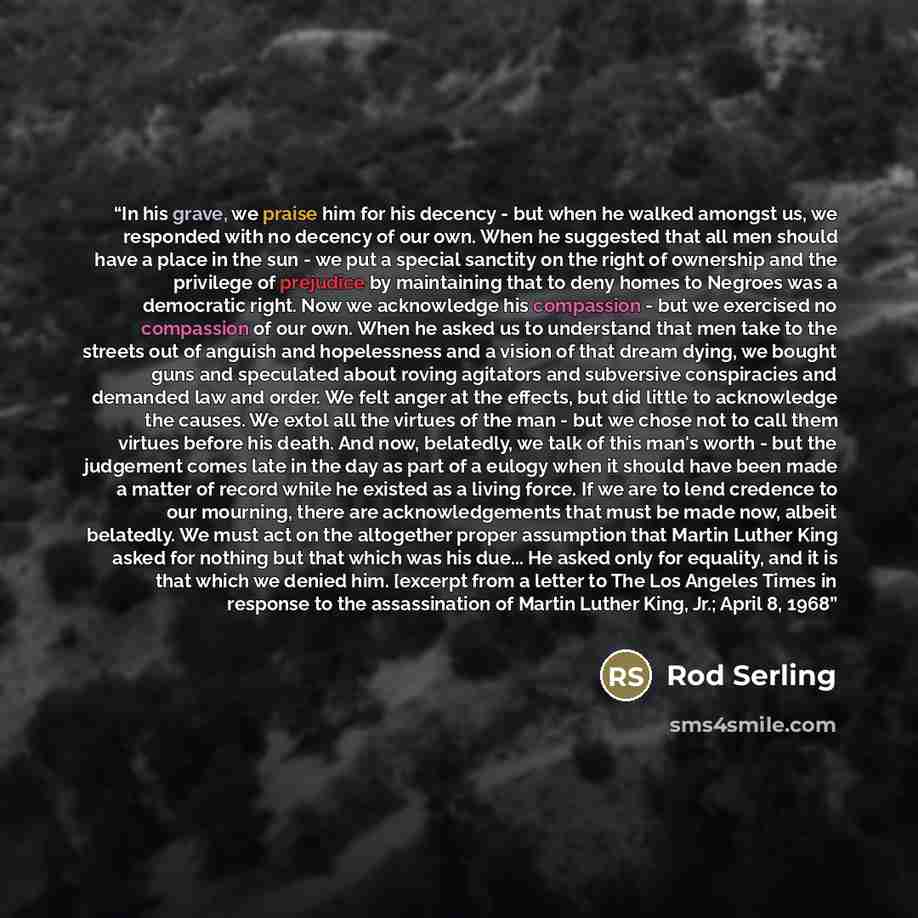
““In his grave, we praise him for his decency - but when he walked amongst us, we responded with no decency of our own. When he suggested that all men should have a place in the sun - we put a special sanctity on the right of ownership and the privilege of prejudice by maintaining that to deny homes to Negroes was a democratic right. Now we acknowledge his compassion - but we exercised no compassion of our own. When he asked us to understand that men take to the streets out of anguish and hopelessness and a vision of that dream dying, we bought guns and speculated about roving agitators and subversive conspiracies and demanded law and order. We felt anger at the effects, but did little to acknowledge the causes. We extol all the virtues of the man - but we chose not to call them virtues before his death. And now, belatedly, we talk of this man's worth - but the judgement comes late in the day as part of a eulogy when it should have been made a matter of record while he existed as a living force. If we are to lend credence to our mourning, there are acknowledgements that must be made now, albeit belatedly. We must act on the altogether proper assumption that Martin Luther King asked for nothing but that which was his due... He asked only for equality, and it is that which we denied him. [excerpt from a letter to The Los Angeles Times in response to the assassination of Martin Luther King, Jr.; April 8, 1968””
About This Quote
Source Letter to The Los Angeles Times, April 8 1968
A critique of societal hypocrisy that praises a leader after his death while neglecting his teachings during his life.
In simple terms: Society praises after loss but ignores needed actions.
Key Takeaway
Act on the principles you claim to value now.
Themes
justice
hypocrisy
civil rights
Mood
somber
urgent
Type
historical
activist
When to use this quote
- policy reform
- community activism
- education
- public discourse
Key Concepts
social responsibility
historical reflection
Questions to Reflect On
- What actions can we take today to honor his vision?
- How do we prevent posthumous praise from replacing real change?
A Different Perspective
The quote reflects on systemic racism and delayed moral action.