Books Quote by Robert Burton
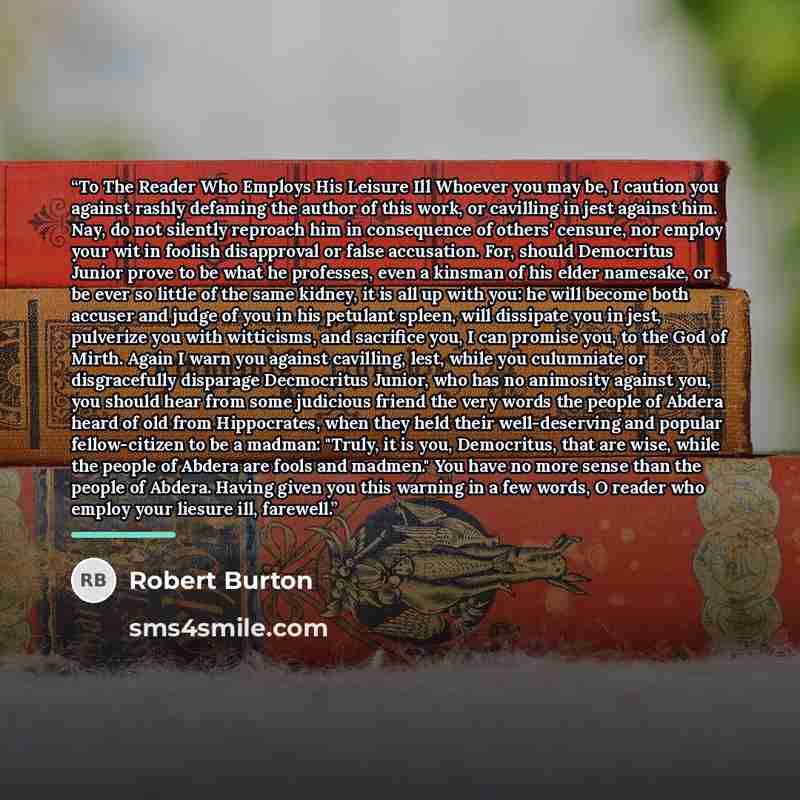
““To The Reader Who Employs His Leisure Ill Whoever you may be, I caution you against rashly defaming the author of this work, or cavilling in jest against him. Nay, do not silently reproach him in consequence of others' censure, nor employ your wit in foolish disapproval or false accusation. For, should Democritus Junior prove to be what he professes, even a kinsman of his elder namesake, or be ever so little of the same kidney, it is all up with you: he will become both accuser and judge of you in his petulant spleen, will dissipate you in jest, pulverize you with witticisms, and sacrifice you, I can promise you, to the God of Mirth. Again I warn you against cavilling, lest, while you culumniate or disgracefully disparage Decmocritus Junior, who has no animosity against you, you should hear from some judicious friend the very words the people of Abdera heard of old from Hippocrates, when they held their well-deserving and popular fellow-citizen to be a madman: "Truly, it is you, Democritus, that are wise, while the people of Abdera are fools and madmen." You have no more sense than the people of Abdera. Having given you this warning in a few words, O reader who employ your liesure ill, farewell.””
About This Quote
The author warns readers against frivolous criticism, suggesting that reckless attacks can backfire, turning the critic into both judge and victim of ridicule.
In simple terms: Harsh criticism can rebound on the critic.
Key Takeaway
Thoughtless mockery invites retaliation.
Themes
criticism
humor
reputation
intellectual humility
Mood
wry
cautionary
Type
satirical
cautionary
When to use this quote
- online comment sections
- academic peer review
- literary satire
Key Concepts
social dynamics
self‑fulfilling prophecy
Practical Applications
- practice measured critique
- consider the author's perspective
Questions to Reflect On
- What distinguishes constructive critique from spiteful mockery?
- How can we safeguard against becoming the target of our own criticism?
A Different Perspective
The warning may overgeneralize; some criticism is constructive and necessary.

















![“[E]very man hath liberty to write, but few ability. Heretofore learning was graced by judicious scholars, but now noble sciences are vilified by base and illiterate scribblers, that either write for vain-glory, need, to get money, or as Parasites to flatter and collogue with some great men, they…” quote by Robert Burton](https://sms4smile.com/quotes/img-quotes/792/robert-burton-10069_books_e-very-man-hath-liberty-to-write-but-few_213260.jpg)