Genocide Quote by Richard J. Evans
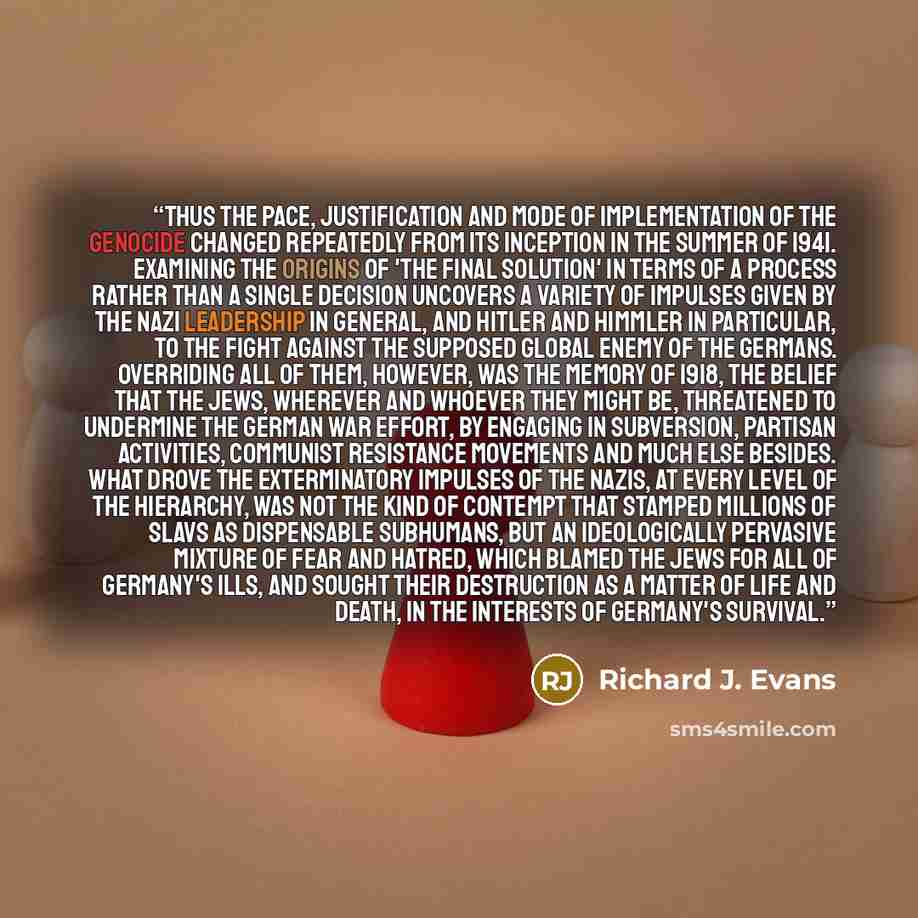
““Thus the pace, justification and mode of implementation of the genocide changed repeatedly from its inception in the summer of 1941. Examining the origins of 'the final solution' in terms of a process rather than a single decision uncovers a variety of impulses given by the Nazi leadership in general, and Hitler and Himmler in particular, to the fight against the supposed global enemy of the Germans. Overriding all of them, however, was the memory of 1918, the belief that the Jews, wherever and whoever they might be, threatened to undermine the German war effort, by engaging in subversion, partisan activities, Communist resistance movements and much else besides. What drove the exterminatory impulses of the Nazis, at every level of the hierarchy, was not the kind of contempt that stamped millions of Slavs as dispensable subhumans, but an ideologically pervasive mixture of fear and hatred, which blamed the Jews for all of Germany's ills, and sought their destruction as a matter of life and death, in the interests of Germany's survival.””
About This Quote
Source Book: The Third Reich at War by Richard J. Evans, 2008
The Holocaust evolved through shifting policies driven by Nazi fear and hatred of Jews, rooted in WWI trauma and belief they threatened Germany’s survival.
In simple terms: Nazi genocide grew from fear and hatred of Jews, seen as existential threat.
Key Takeaway
Recognize how fear can morph into extreme violence.
Themes
history
genocide
ideology
war
memory
Mood
somber
analytical
urgent
Type
historical
educational
critical
When to use this quote
- academic research
- museum education
- human rights training
- policy analysis
Key Concepts
anti‑semitism
totalitarianism
collective trauma
propaganda
Questions to Reflect On
- How did ordinary citizens justify participation?
- What mechanisms allowed policy shifts without public backlash?
A Different Perspective
The analysis may understate individual agency and the role of broader societal complicity.





![“What’s the difference between India and Germany?’ went one popular joke reported in the spring of 1943. ‘In India, one person [Gandhi] starves for everybody, in Germany everybody starves for one person [Hitler].’307” quote by Richard J. Evans](https://sms4smile.com/quotes/img-quotes/18c/richard-j-evans-35875_india-person_what-s-the-difference-between-india-and_2730075.jpg)
![“His order [Hitler's] to stand firm not only created clarity about what the army was doing but also had some effect in improving morale. On the other hand, the rigidity with which he now implemented it began to have an effect on the smaller-scale tactical withdrawals that the desperate situation…” quote by Richard J. Evans](https://sms4smile.com/quotes/img-quotes/6b3/richard-j-evans-35875_christmas-eve_his-order-hitler-s-to-stand-firm-not-onl_2781625.jpg)