Death Quote by Herman Melville
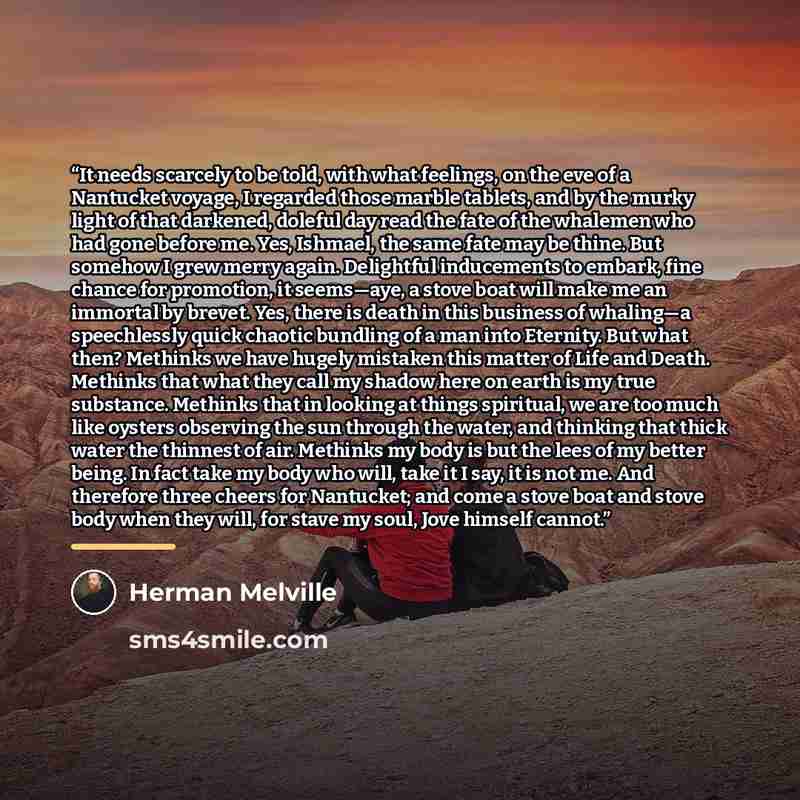
““It needs scarcely to be told, with what feelings, on the eve of a Nantucket voyage, I regarded those marble tablets, and by the murky light of that darkened, doleful day read the fate of the whalemen who had gone before me. Yes, Ishmael, the same fate may be thine. But somehow I grew merry again. Delightful inducements to embark, fine chance for promotion, it seems—aye, a stove boat will make me an immortal by brevet. Yes, there is death in this business of whaling—a speechlessly quick chaotic bundling of a man into Eternity. But what then? Methinks we have hugely mistaken this matter of Life and Death. Methinks that what they call my shadow here on earth is my true substance. Methinks that in looking at things spiritual, we are too much like oysters observing the sun through the water, and thinking that thick water the thinnest of air. Methinks my body is but the lees of my better being. In fact take my body who will, take it I say, it is not me. And therefore three cheers for Nantucket; and come a stove boat and stove body when they will, for stave my soul, Jove himself cannot.””
About This Quote
Source Novel: Moby‑Dick by Herman Melville, 1851
The narrator reflects on mortality, the soul’s primacy over the body, and the paradox of seeking glory in a dangerous trade.
In simple terms: Life’s meaning lies beyond physical existence; the soul endures.
Key Takeaway
Recognize the soul’s importance over material pursuits.
Themes
mortality
spirituality
ambition
existentialism
Mood
contemplative
melancholic
Type
philosophical
literary
existential
When to use this quote
- whaling voyages
- career choices
- risk‑taking decisions
- personal crises
Key Concepts
dualism
nihilism
transcendence
Questions to Reflect On
- What does it mean to prioritize spirit over body?
- How do you reconcile ambition with mortality?
A Different Perspective
The metaphor of “stove boat” may obscure practical realities of survival.