Autonomy Quote by Paul Tough
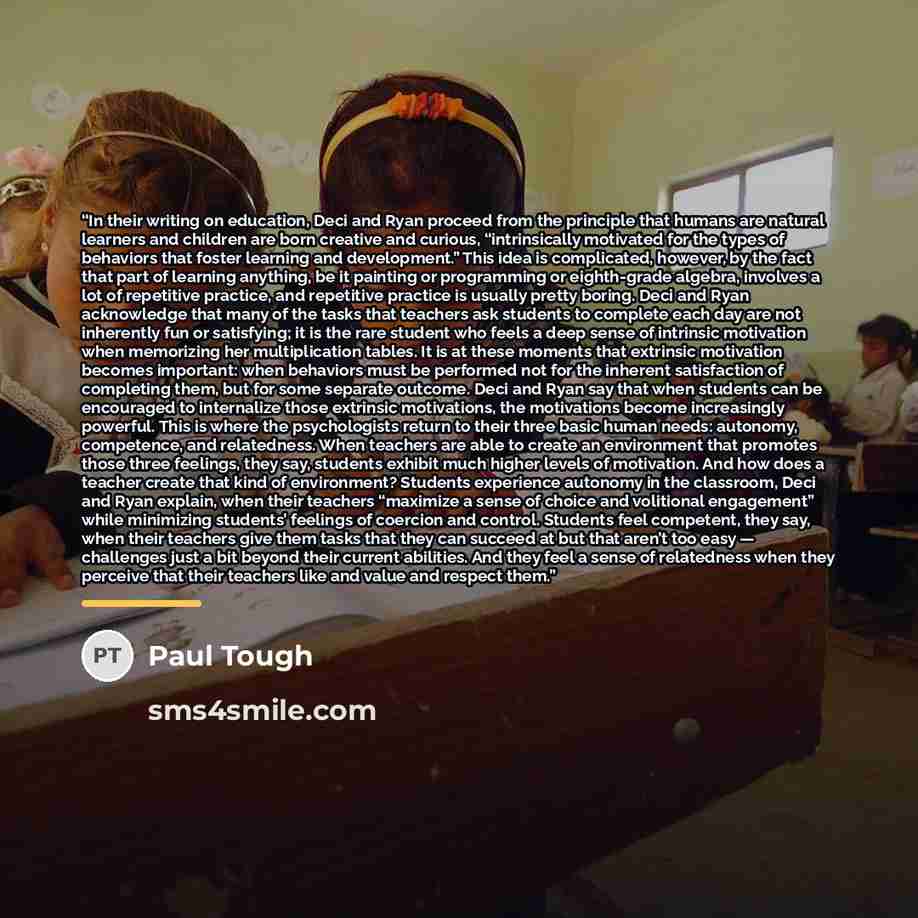
““In their writing on education, Deci and Ryan proceed from the principle that humans are natural learners and children are born creative and curious, “intrinsically motivated for the types of behaviors that foster learning and development.” This idea is complicated, however, by the fact that part of learning anything, be it painting or programming or eighth-grade algebra, involves a lot of repetitive practice, and repetitive practice is usually pretty boring. Deci and Ryan acknowledge that many of the tasks that teachers ask students to complete each day are not inherently fun or satisfying; it is the rare student who feels a deep sense of intrinsic motivation when memorizing her multiplication tables. It is at these moments that extrinsic motivation becomes important: when behaviors must be performed not for the inherent satisfaction of completing them, but for some separate outcome. Deci and Ryan say that when students can be encouraged to internalize those extrinsic motivations, the motivations become increasingly powerful. This is where the psychologists return to their three basic human needs: autonomy, competence, and relatedness. When teachers are able to create an environment that promotes those three feelings, they say, students exhibit much higher levels of motivation. And how does a teacher create that kind of environment? Students experience autonomy in the classroom, Deci and Ryan explain, when their teachers “maximize a sense of choice and volitional engagement” while minimizing students’ feelings of coercion and control. Students feel competent, they say, when their teachers give them tasks that they can succeed at but that aren’t too easy — challenges just a bit beyond their current abilities. And they feel a sense of relatedness when they perceive that their teachers like and value and respect them.””
About This Quote
Source Book: “How Children Succeed” by Paul Tough, 2012
Students thrive when classrooms nurture autonomy, competence, and relatedness, turning extrinsic rewards into internal motivation.
In simple terms: Supportive environments boost intrinsic drive.
Key Takeaway
Create choice‑rich, challenging, respectful learning spaces.
Themes
motivation
education
psychology
needs
Mood
inspirational
practical
Type
educational
psychological
When to use this quote
- classroom design
- lesson planning
- teacher training
Key Concepts
self‑determination theory
intrinsic vs extrinsic
growth mindset
Questions to Reflect On
- How can teachers balance freedom with guidance?
- What practices foster relatedness in diverse classrooms?
A Different Perspective
Overemphasis on autonomy can cause chaos without structure.