Quote by Oliver Sacks Download Open image ““But who was more tragic, or who was more damned—the man who knew it, or the man who did not?”” — Oliver Sacks ★ ★ ★ ★ ★ 4.4 out of 5 (4 ratings) Copy quoteShare
“Tragic no matter what gets said, no matter who says it, no matter to whom, Born tragic.” — Michael F. Moore Copy Share Image
“... the damned had been given that insight which makes hardship so easy to bear — the absolute and certain knowledge that things could be worse.” — Terry Pratchett Copy Share Image
“Didn’t anyone who changed things ultimately lead some people—perhaps many people—to death, grief, torment?” — Greg Bear Copy Share Image
“When He died in the Wounded World He died not for men, but for each man. If each man had been the only man… — C. S. Lewis Copy Share Image
“The tragic element in modern man, not ignore the meaning of his life, but it bothers him less and less. ” — Vaclav Havel Copy Share Image
“The one who dies has it easy, you know. The one who's left behind is the one who truly suffers.” — D.T. Dyllin Copy Share Image
“Despite men's suffering, despite the blood and wrath, despite the dead who can never be replaced, the unjust wounds, and the wild bullets, we… — Albert Camus Copy Share Image
“A lesser man would count his blessings and move on, while a greater man would take action against his enemies. It seemed he was… — Mitchell Hogan Copy Share Image
It did not matter, after all. He was only one man. One man's fate is not important. "If it is not, what is?" He… — Ursula K. Le Guin Copy Share Image
“The feelings are similar, in some ways, to those one has in Rome or Athens, but quite different in other ways, because this culture… — Oliver Sacks Copy Share Image
But the saddest difference between them was that Zazetsky, as Luria said, 'fought to regain his lost faculties with the indomitable tenacity of the… — Oliver Sacks Copy Share Image
Music can lift us out of depression or move us to tears - it is a remedy, a tonic, orange juice for the ears. — Oliver Sacks Copy Share Image
“We have five senses in which we glory and which we recognise and celebrate, senses that constitute the sensible world for us. But there… — Oliver Sacks Copy Share Image
“But it must be said from the outset that a disease is never a mere loss or excess— that there is always a reaction,… — Oliver Sacks Copy Share Image
There is no one part of the brain which recognizes or responds emotionally to music. Instead, there are many different parts responding to different… — Oliver Sacks Copy Share Image
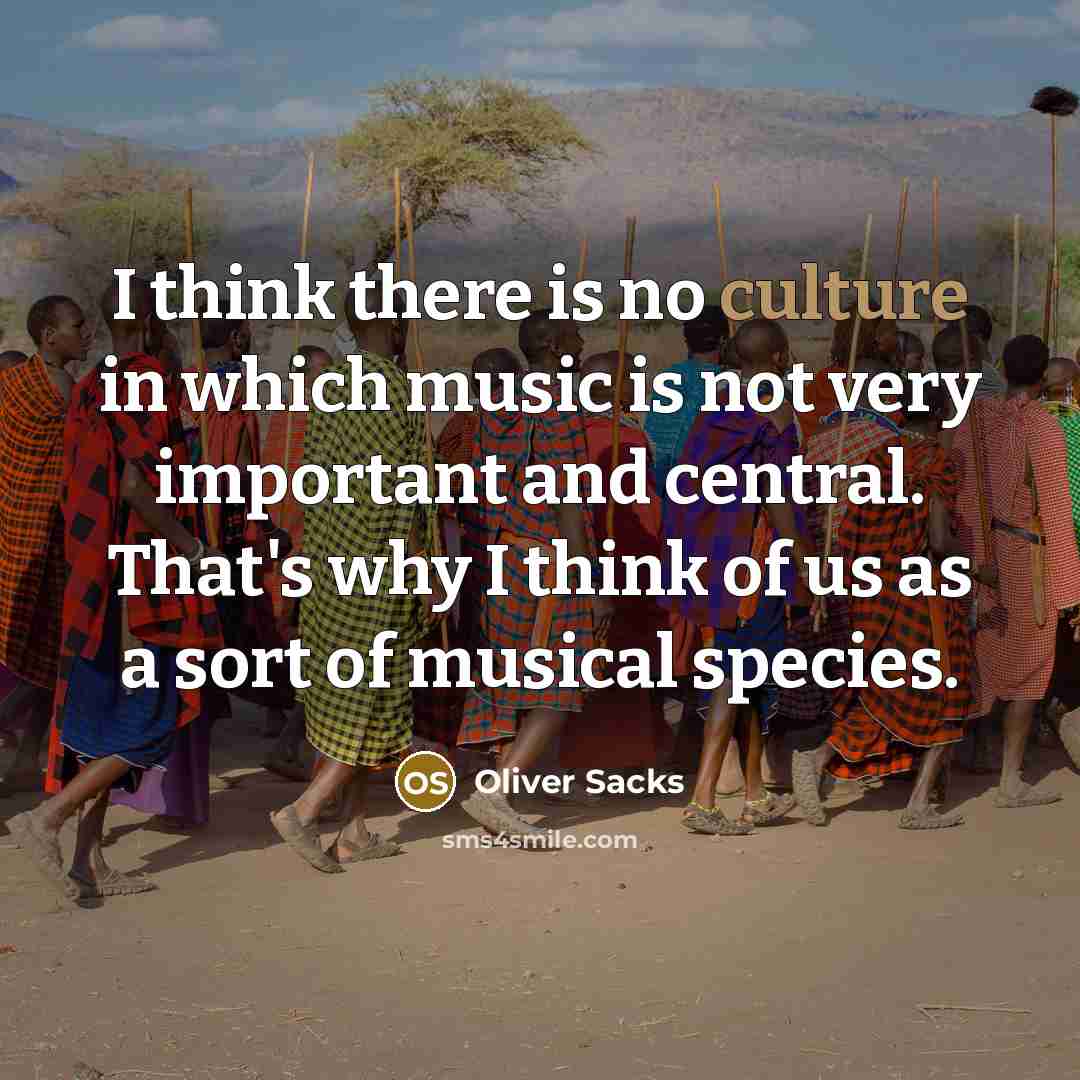
I think there is no culture in which music is not very important and central. That's why I think of us as a sort… — Oliver Sacks Copy Share Image
Who cared if there was really any Being to pray to? What mattered was the sense of giving thanks and praise, the feeling of… — Oliver Sacks Copy Share Image
“unconscious motives may sometimes ally themselves to physiological propensities, of how one cannot abstract an ailment or its treatment from the whole pattern, the… — Oliver Sacks Copy Share Image
“We have, each of us, a life-story, an inner narrative — whose continuity, whose sense, is our lives. It might be said that each… — Oliver Sacks Copy Share Image
I regard music therapy as a tool of great power in many neurological disorders -- Parkinson's and Alzheimer's -- because of its unique capacity… — Oliver Sacks Copy Share Image
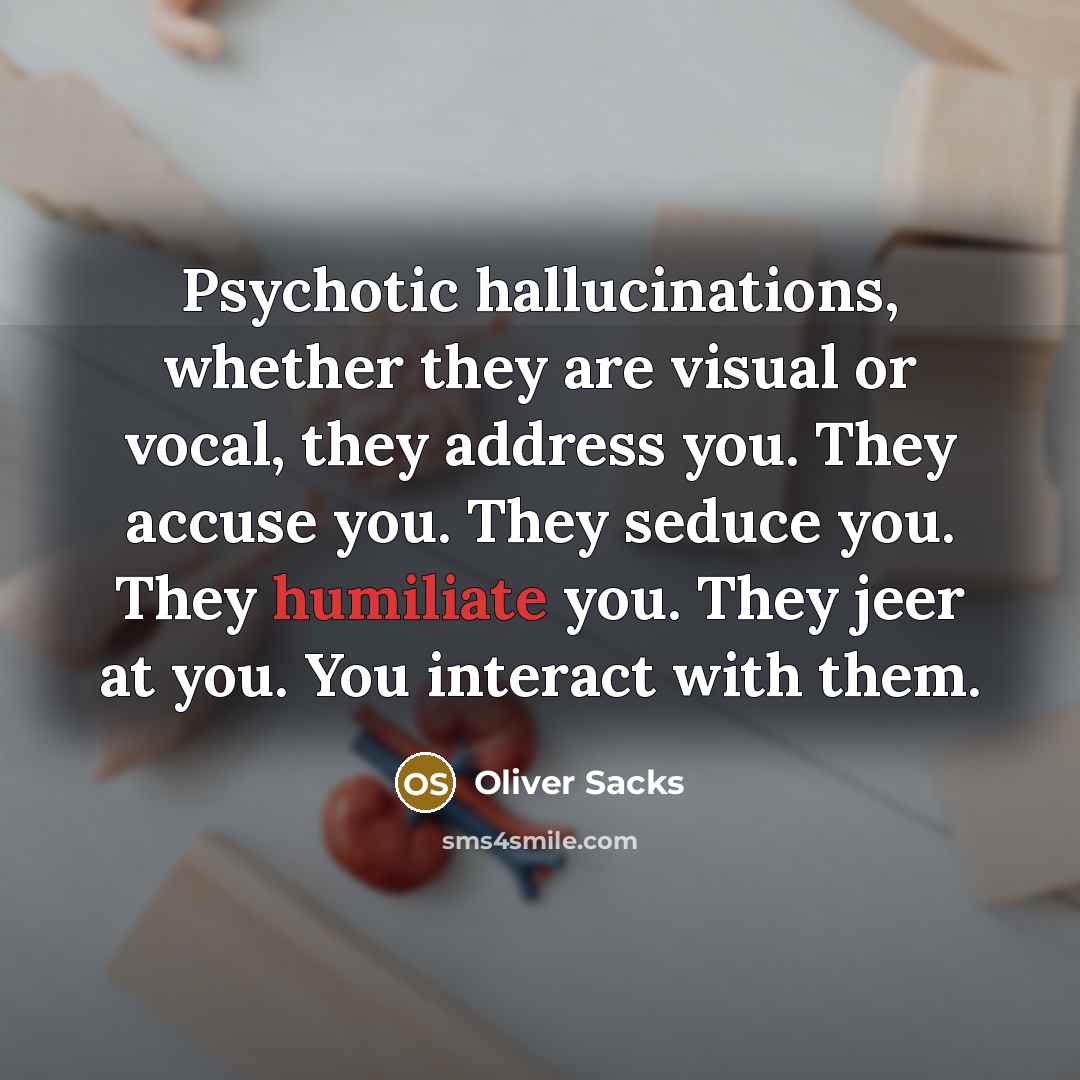
Psychotic hallucinations, whether they are visual or vocal, they address you. They accuse you. They seduce you. They humiliate you. They jeer at you.… — Oliver Sacks Copy Share Image