We speak not only to tell other people what we think, but to tell ourselves what we think. Speech is a part… — Oliver Sacks Copy Share Image
In general, people are afraid to acknowledge hallucinations because they immediately see them as a sign of something awful happening to the… — Oliver Sacks Copy Share Image
People will make a life in their own terms, whether they are deaf or colorblind or autistic or whatever. And their world… — Oliver Sacks Copy Share Image
The power of music and the plasticity of the brain go together very strikingly, especially in young people. — Oliver Sacks Copy Share Image
The past which is not recoverable in any other way is embedded, as if in amber, in the music, and people can… — Oliver Sacks Copy Share Image
The rhythm of music is very, very important for people with Parkinson's. But it's also very important with other sorts of patients,… — Oliver Sacks Copy Share Image
“Some people with Tourette's have flinging tics- sudden, seemingly motiveless urges or compulsions to throw objects… (I see somewhat similar flinging behaviors-… — Oliver Sacks Copy Share Image
There will be no one like us when we are gone, but then there is no one like anyone else, ever. When… — Oliver Sacks Copy Share Image
Even when other powers have been lost and people may not even be able to understand language, they will nearly always recognize… — Oliver Sacks Copy Share Image
For 'wellness', naturally, is no cause for complaint - people relish it, they enjoy it, they are at the furthest pole from… — Oliver Sacks Copy Share Image
Eccentricity is like having an accent. It's what "other" people have. — Oliver Sacks Copy Share Image
I rejoice when I meet gifted young people... I feel the future is in good hands. — Oliver Sacks Copy Share Image
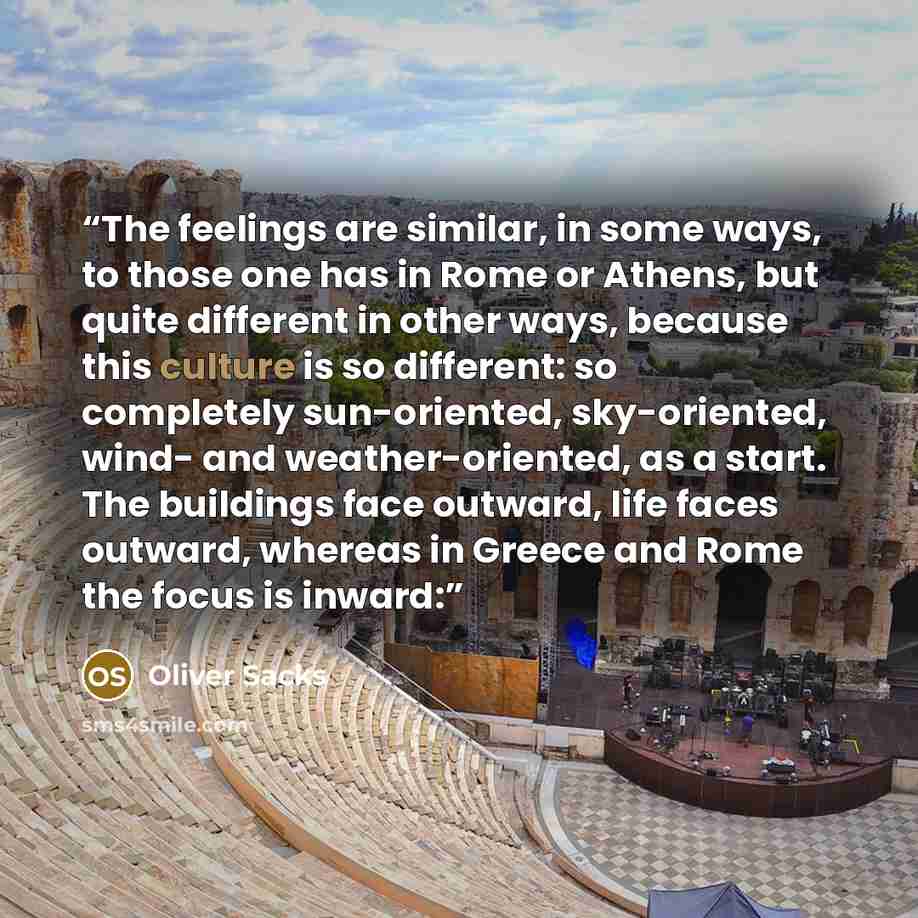
“The feelings are similar, in some ways, to those one has in Rome or Athens, but quite different in other ways, because this culture… — Oliver Sacks Copy Share Image
But the saddest difference between them was that Zazetsky, as Luria said, 'fought to regain his lost faculties with the indomitable tenacity of the… — Oliver Sacks Copy Share Image
Music can lift us out of depression or move us to tears - it is a remedy, a tonic, orange juice for the ears. — Oliver Sacks Copy Share Image
“We have five senses in which we glory and which we recognise and celebrate, senses that constitute the sensible world for us. But there… — Oliver Sacks Copy Share Image
“But it must be said from the outset that a disease is never a mere loss or excess— that there is always a reaction,… — Oliver Sacks Copy Share Image
There is no one part of the brain which recognizes or responds emotionally to music. Instead, there are many different parts responding to different… — Oliver Sacks Copy Share Image
I think there is no culture in which music is not very important and central. That's why I think of us as a sort… — Oliver Sacks Copy Share Image
Who cared if there was really any Being to pray to? What mattered was the sense of giving thanks and praise, the feeling of… — Oliver Sacks Copy Share Image
“unconscious motives may sometimes ally themselves to physiological propensities, of how one cannot abstract an ailment or its treatment from the whole pattern, the… — Oliver Sacks Copy Share Image
“We have, each of us, a life-story, an inner narrative — whose continuity, whose sense, is our lives. It might be said that each… — Oliver Sacks Copy Share Image
I regard music therapy as a tool of great power in many neurological disorders -- Parkinson's and Alzheimer's -- because of its unique capacity… — Oliver Sacks Copy Share Image
Psychotic hallucinations, whether they are visual or vocal, they address you. They accuse you. They seduce you. They humiliate you. They jeer at you.… — Oliver Sacks Copy Share Image