Brave man Quote by Neil Gaiman
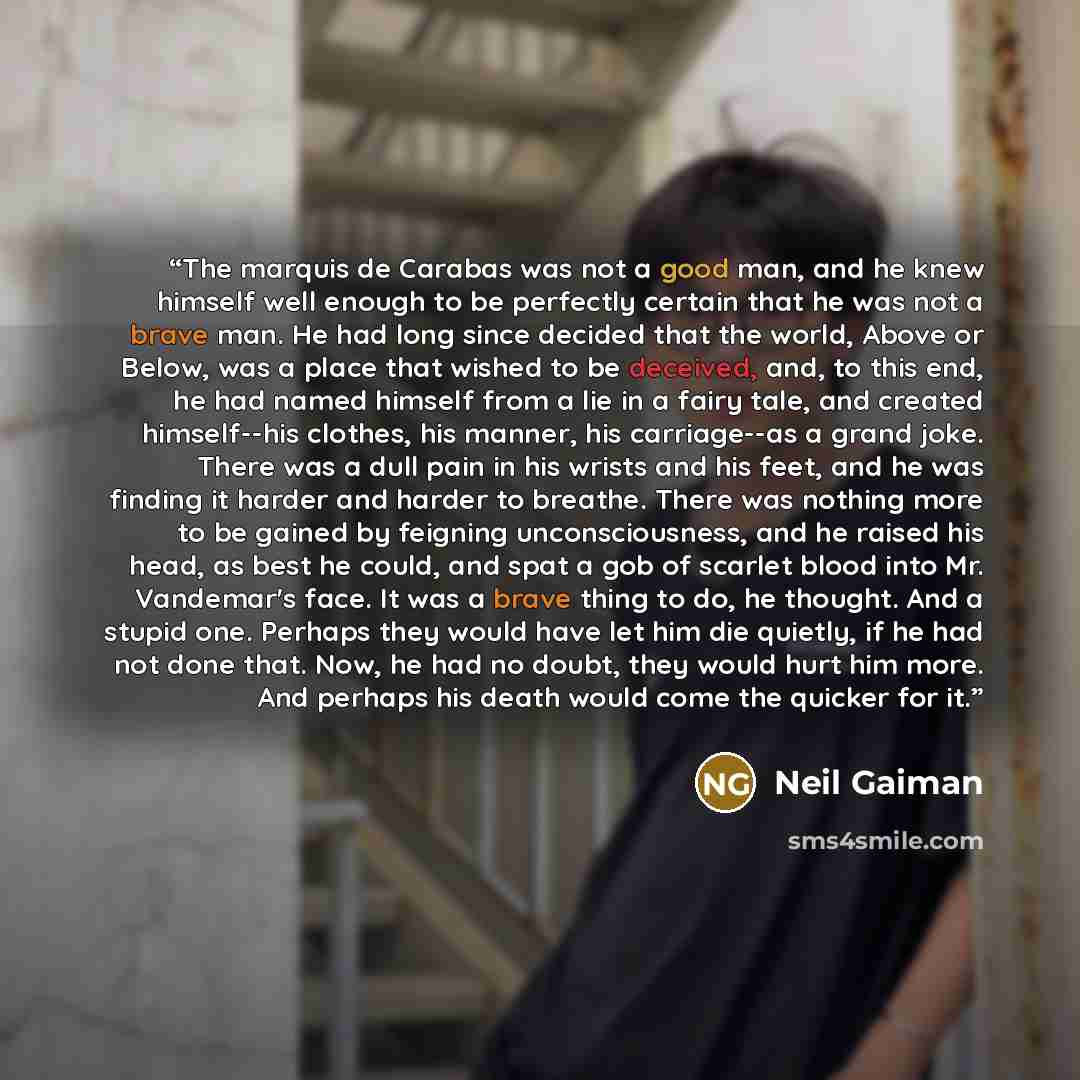
““The marquis de Carabas was not a good man, and he knew himself well enough to be perfectly certain that he was not a brave man. He had long since decided that the world, Above or Below, was a place that wished to be deceived, and, to this end, he had named himself from a lie in a fairy tale, and created himself--his clothes, his manner, his carriage--as a grand joke. There was a dull pain in his wrists and his feet, and he was finding it harder and harder to breathe. There was nothing more to be gained by feigning unconsciousness, and he raised his head, as best he could, and spat a gob of scarlet blood into Mr. Vandemar's face. It was a brave thing to do, he thought. And a stupid one. Perhaps they would have let him die quietly, if he had not done that. Now, he had no doubt, they would hurt him more. And perhaps his death would come the quicker for it.””
About This Quote
A self-aware antihero embraces deception as identity, confronting mortality with a reckless, paradoxical act of defiance.
In simple terms: Self‑deception as armor, fatal bravado.
Key Takeaway
Identity can be a performance that both shields and endangers.
Themes
identity
mortality
deception
bravado
paradox
Mood
defiant
melancholic
darkly humorous
Type
narrative monologue
philosophical reflection
When to use this quote
- facing imminent death
- confronting a tyrant
- revealing true self
- choosing a final act
Key Concepts
self‑awareness
existential futility
social masquerade
Practical Applications
- literary analysis of antihero archetype
- psychological study of self‑presentation
Questions to Reflect On
- What does it mean to choose a final, reckless gesture?
- How does self‑deception shape one's destiny?
A Different Perspective
The act may be seen as futile, offering no real change to his fate.

![“[T]hey could not help being amused every time another little human believed itself the center of its world, as each of us does.” quote by Neil Gaiman](https://sms4smile.com/quotes/img-quotes/19e/neil-gaiman-29_quote_t-hey-could-not-help-being-amused-every_4551.jpg)