Great mother Quote by Monica Sjoo
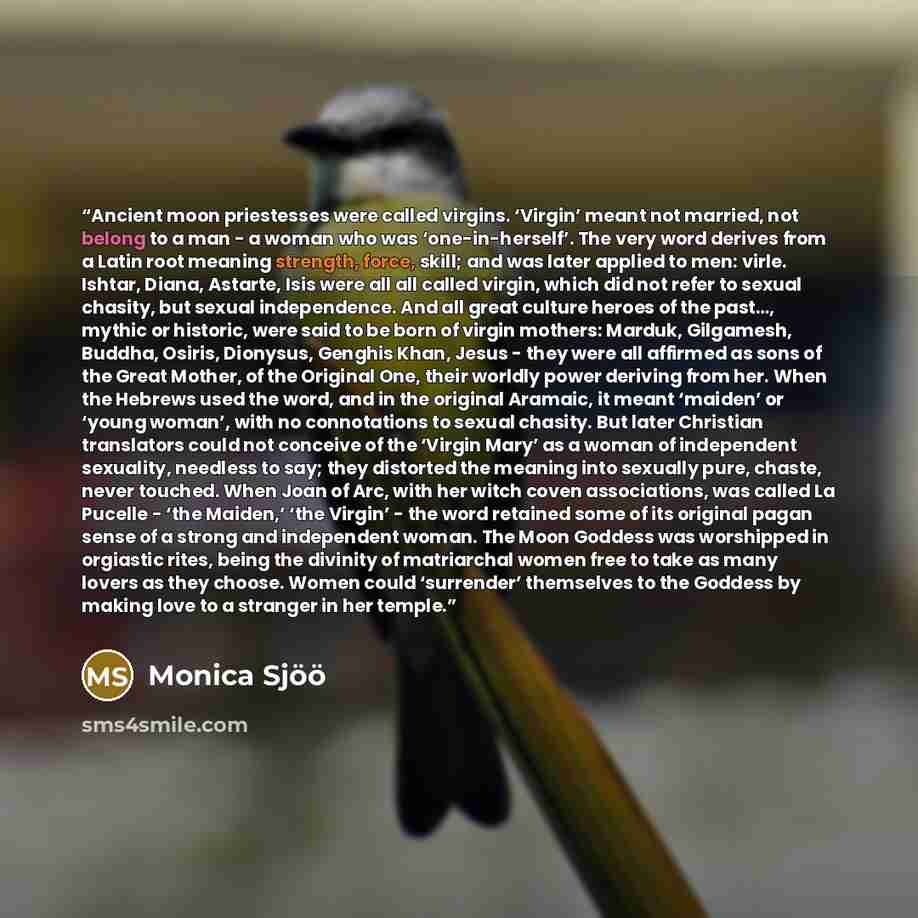
““Ancient moon priestesses were called virgins. ‘Virgin’ meant not married, not belong to a man - a woman who was ‘one-in-herself’. The very word derives from a Latin root meaning strength, force, skill; and was later applied to men: virle. Ishtar, Diana, Astarte, Isis were all all called virgin, which did not refer to sexual chasity, but sexual independence. And all great culture heroes of the past…, mythic or historic, were said to be born of virgin mothers: Marduk, Gilgamesh, Buddha, Osiris, Dionysus, Genghis Khan, Jesus - they were all affirmed as sons of the Great Mother, of the Original One, their worldly power deriving from her. When the Hebrews used the word, and in the original Aramaic, it meant ‘maiden’ or ‘young woman’, with no connotations to sexual chasity. But later Christian translators could not conceive of the ‘Virgin Mary’ as a woman of independent sexuality, needless to say; they distorted the meaning into sexually pure, chaste, never touched. When Joan of Arc, with her witch coven associations, was called La Pucelle - ‘the Maiden,’ ‘the Virgin’ - the word retained some of its original pagan sense of a strong and independent woman. The Moon Goddess was worshipped in orgiastic rites, being the divinity of matriarchal women free to take as many lovers as they choose. Women could ‘surrender’ themselves to the Goddess by making love to a stranger in her temple.””
About This Quote
The term “virgin” historically signified a woman’s independence and strength, not sexual purity; later religious reinterpretations altered its meaning to imply chastity, obscuring its original matriarchal connotations.
In simple terms: Virgin originally meant independent strong woman, later changed to chaste.
Key Takeaway
Recognize how language reshapes cultural perceptions of gender.
Themes
gender
language
history
religion
mythology
Mood
critical
reflective
Type
analytical
historical
When to use this quote
- academic study
- religious discourse
- gender activism
- cultural criticism
Key Concepts
matriarchy
semantic shift
sexual autonomy
Questions to Reflect On
- How does redefining “virgin” affect women's empowerment?
- What other terms have been similarly transformed?
A Different Perspective
The reinterpretation can be seen as a loss of female agency in historical narratives.





![“Here is a guy who's supposed to be the Genghis Khan of the church, the pro-choice people hate him, and I don't know about his labor background so I figured there must be more to him, and there is. I wrote a book about [John Cardinal O'Connor].” quote by Nat Hentoff](https://sms4smile.com/quotes/img-quotes/de5/nat-hentoff-1615_backgrounds_here-is-a-guy-who-s-supposed-to-be-the-g_761069.jpg)