Ask yourself Quote by Maggie Nelson
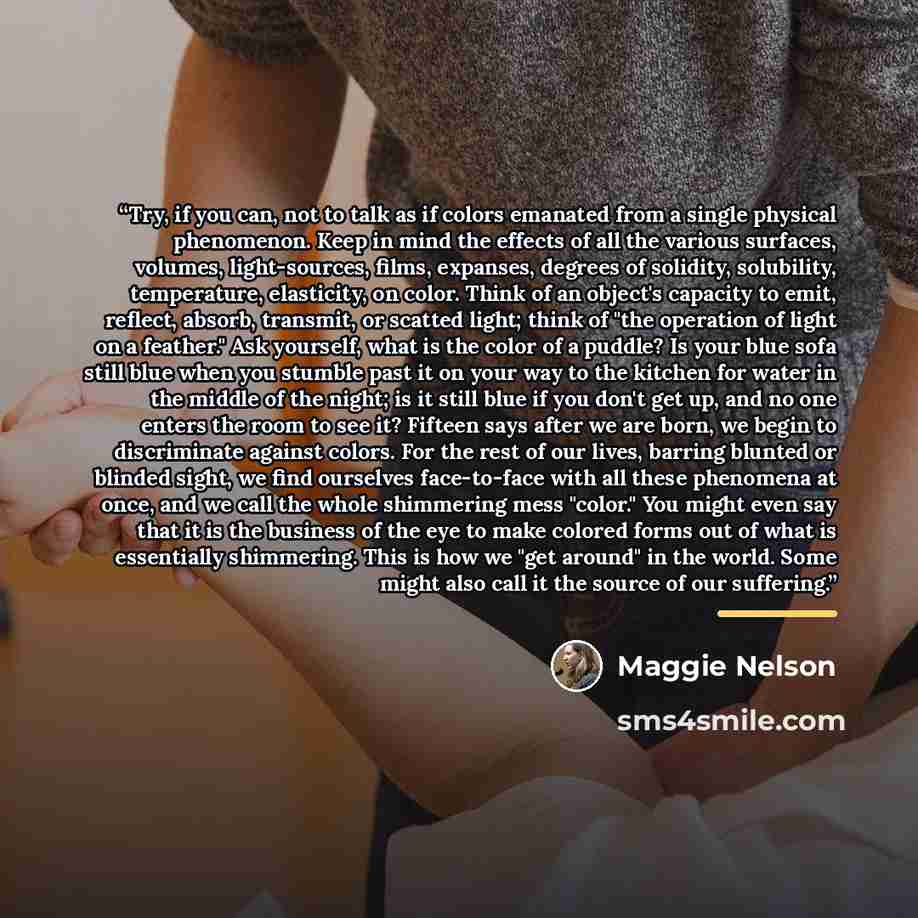
““Try, if you can, not to talk as if colors emanated from a single physical phenomenon. Keep in mind the effects of all the various surfaces, volumes, light-sources, films, expanses, degrees of solidity, solubility, temperature, elasticity, on color. Think of an object's capacity to emit, reflect, absorb, transmit, or scatted light; think of "the operation of light on a feather." Ask yourself, what is the color of a puddle? Is your blue sofa still blue when you stumble past it on your way to the kitchen for water in the middle of the night; is it still blue if you don't get up, and no one enters the room to see it? Fifteen says after we are born, we begin to discriminate against colors. For the rest of our lives, barring blunted or blinded sight, we find ourselves face-to-face with all these phenomena at once, and we call the whole shimmering mess "color." You might even say that it is the business of the eye to make colored forms out of what is essentially shimmering. This is how we "get around" in the world. Some might also call it the source of our suffering.””
About This Quote
Source Book: The Argonauts by Maggie Nelson, 2015
Color perception is a complex interaction of light, material, and observer, not a simple property of objects.
In simple terms: Seeing color depends on many factors, not just the object itself.
Key Takeaway
Recognize that perception is shaped by context and the mind.
Themes
perception
science
philosophy
art
subjectivity
Mood
contemplative
curious
Type
philosophical
observational
When to use this quote
- painting
- design
- lighting design
- visual arts
- everyday observation
Key Concepts
Phenomenology
optics
psychology
relativism
Questions to Reflect On
- How does context change what you perceive as color?
- Can you notice how lighting alters your experience of everyday objects?
A Different Perspective
Our brains simplify this complexity, which can lead to misunderstandings.