Animal liberation Quote by Lisa Kemmerer
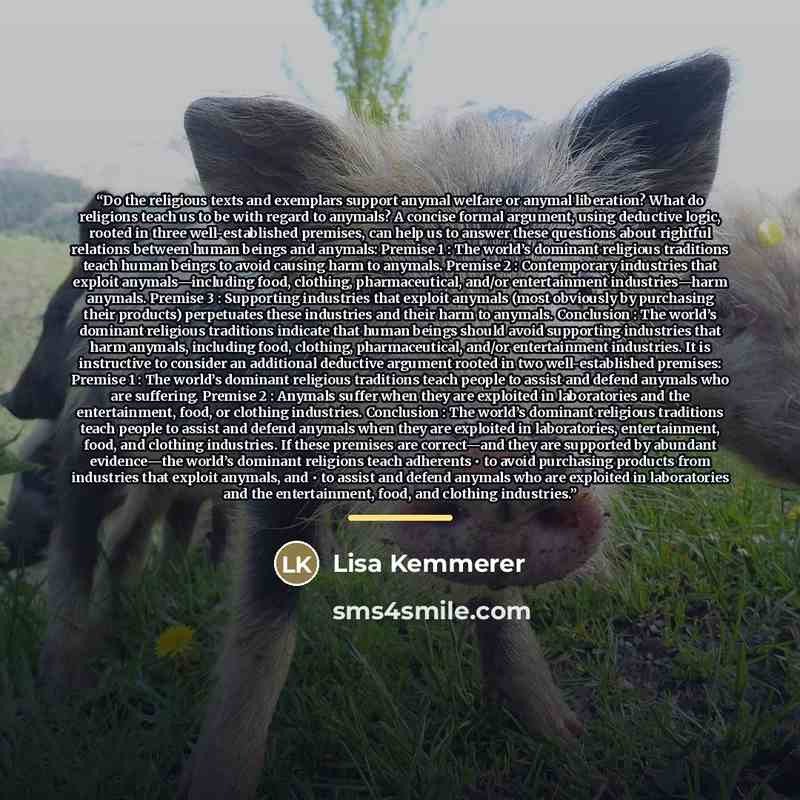
““Do the religious texts and exemplars support anymal welfare or anymal liberation? What do religions teach us to be with regard to anymals? A concise formal argument, using deductive logic, rooted in three well-established premises, can help us to answer these questions about rightful relations between human beings and anymals: Premise 1 : The world’s dominant religious traditions teach human beings to avoid causing harm to anymals. Premise 2 : Contemporary industries that exploit anymals—including food, clothing, pharmaceutical, and/or entertainment industries—harm anymals. Premise 3 : Supporting industries that exploit anymals (most obviously by purchasing their products) perpetuates these industries and their harm to anymals. Conclusion : The world’s dominant religious traditions indicate that human beings should avoid supporting industries that harm anymals, including food, clothing, pharmaceutical, and/or entertainment industries. It is instructive to consider an additional deductive argument rooted in two well-established premises: Premise 1 : The world’s dominant religious traditions teach people to assist and defend anymals who are suffering. Premise 2 : Anymals suffer when they are exploited in laboratories and the entertainment, food, or clothing industries. Conclusion : The world’s dominant religious traditions teach people to assist and defend anymals when they are exploited in laboratories, entertainment, food, and clothing industries. If these premises are correct—and they are supported by abundant evidence—the world’s dominant religions teach adherents • to avoid purchasing products from industries that exploit anymals, and • to assist and defend anymals who are exploited in laboratories and the entertainment, food, and clothing industries.””
About This Quote
The argument claims major religions advise against harming animals and support defending them, so consumers should avoid animal‑exploiting products and protect suffering animals.
In simple terms: Religions oppose animal harm and urge protection, so avoid exploitative products and help suffering animals.
Key Takeaway
Choose cruelty‑free options and advocate for animal welfare.
Themes
ethics
animal rights
religion
consumer behavior
Mood
reflective
determined
hopeful
Type
philosophical
activist
When to use this quote
- shopping for food, clothing, or medicine
- supporting animal advocacy groups
- voting on animal welfare legislation
Key Concepts
moral philosophy
deductive reasoning
religious ethics
Questions to Reflect On
- How do you reconcile religious teachings that allow animal use with modern animal welfare concerns?
- What practical steps can you take to align your consumption with these ethical conclusions?
A Different Perspective
Some religious traditions also permit animal use for food or ritual, complicating a blanket prohibition.