Catholicism Quote by Liam O'Flaherty
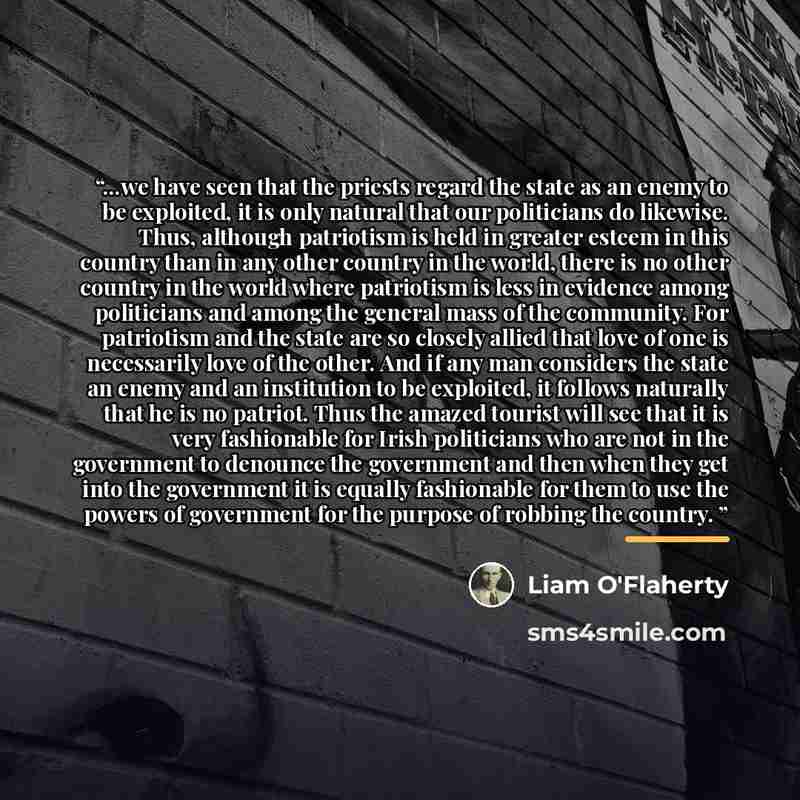
““In fact, properly speaking, no parish priest has any convictions on politics. At the back of his mind, he regards the state as an enemy that has usurped the temporal power of the Pope. Being an enemy, the state must be exploited as much as possible and without any qualms of conscience. Because of this innate and perhaps unconscious hostility to the state as an institution, the parish priest cannot see that it is the duty of a citizen to endeavour to make political life as morally clean as possible. He cannot see that the community as a whole must always come into the forefront of every citizen's political consciousness and that personal interests must be sacrificed to the interests of the nation. No. The parish priest regards himself as the commander of his parish, which he is holding for His Majesty the Pope. Between himself and the Pope there is the Bishop, acting, so to speak, as the Divisional Commander. As far as the Civil Power is concerned, it is a semi-hostile force which must be kept in check, kept in tow, intrigued against and exploited, until that glorious day when the Vicar of Christ again is restored to his proper position as the ruler of the earth and the wearer of the Imperial crown. This point of view helps the parish priest to adopt a very cold-blooded attitude towards Irish politics. He is merely either for or against the government. If he has a relative in a government position, he is in favour of the government. If he has a relative who wants a position and cannot get it, then he is against the government. But his support of the government is very precarious and he makes many visits to Dublin and creeps up back stairs into ministerial offices, cajoling and threatening. He is most commonly seen making a cautious approach to the Education Office, where he has all sorts of complaints to lodge and all sorts of suggestions to make. Every book recommended by the education authorities for the schools is examined by him, and if he finds a single idea in any of them that might be likely to inspire thought of passion, then he is up in arms at once. Like an army of black beetles on the march, he and his countless brothers invade Dublin and lay siege to the official responsible. Woe to that man.””
About This Quote
Source Novel: The Informer, 1925
The priest’s political hostility stems from a belief that secular power threatens religious authority, leading to conflicted civic duties.
In simple terms: Priest sees state as enemy, conflicts with civic duty.
Key Takeaway
Recognize tension between religious loyalty and civic responsibility.
Themes
religion
politics
conflict
authority
Mood
critical
reflective
Type
philosophical
inspirational
When to use this quote
- political activism
- community leadership
- policy advocacy
- interfaith dialogue
Key Concepts
secularism
institutional power
ethical duty
Questions to Reflect On
- How can religious leaders engage politics responsibly?
- What balances loyalty to faith and civic duty?
A Different Perspective
May oversimplify complex church-state relations.