Acquire Quote by Leonard Read
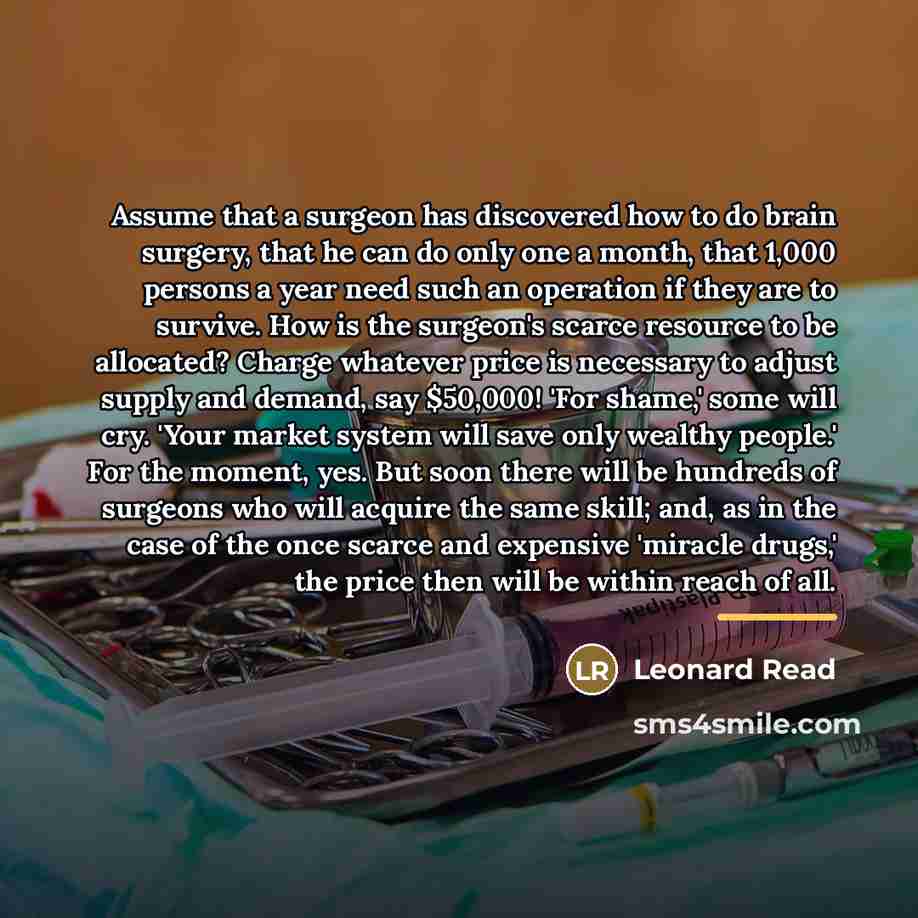
“Assume that a surgeon has discovered how to do brain surgery, that he can do only one a month, that 1,000 persons a year need such an operation if they are to survive. How is the surgeon's scarce resource to be allocated? Charge whatever price is necessary to adjust supply and demand, say $50,000! 'For shame,' some will cry. 'Your market system will save only wealthy people.' For the moment, yes. But soon there will be hundreds of surgeons who will acquire the same skill; and, as in the case of the once scarce and expensive 'miracle drugs,' the price then will be within reach of all.”
About This Quote
Source Essay: Economics in One Lesson, 1960
The surgeon’s limited capacity creates scarcity; market pricing allocates scarce services to those who can pay, incentivizing supply expansion and eventual affordability.
In simple terms: Scarcity leads to high price, which spurs more surgeons and lower prices later.
Key Takeaway
Use price signals to encourage more providers.
Themes
scarcity
market
healthcare
incentives
Mood
concerned
analytical
Type
ethical
economic
When to use this quote
- hospital budgeting
- policy debate
- insurance negotiations
- ethical discussions
Key Concepts
economics
resource allocation
price mechanism
Questions to Reflect On
- How can we ensure access for the poor during the transition?
- What role should government play in early stages?
A Different Perspective
Assumes market will self-correct without addressing equity concerns.









![“The solution to this problem [welfare-statism] must take a positive form: the restoration of a faith in what free men can accomplish.” quote by Leonard Read](https://sms4smile.com/quotes/img-quotes/456/leonard-read-14543_accomplish_the-solution-to-this-problem-welfare-sta_46640.jpg)



![“[S]tatism is but socialized dishonesty; it is feathering the nests of some with feathers coercively plucked from others - on the grand scale. There is no moral difference between the act of a pickpocket and the progressive income tax or any other social program.” quote by Leonard Read](https://sms4smile.com/quotes/img-quotes/a3e/leonard-read-14543_corruption_s-tatism-is-but-socialized-dishonesty-it_511252.jpg)

![“If the State does not acquire supremacy over [vast private] enterprises, it becomes their puppet, and they become the real State.” quote by Bertrand Russell](https://sms4smile.com/quotes/img-quotes/bad/bertrand-russell-69_acquire_if-the-state-does-not-acquire-supremacy_1379.jpg)