Time Quote by James P. Womack
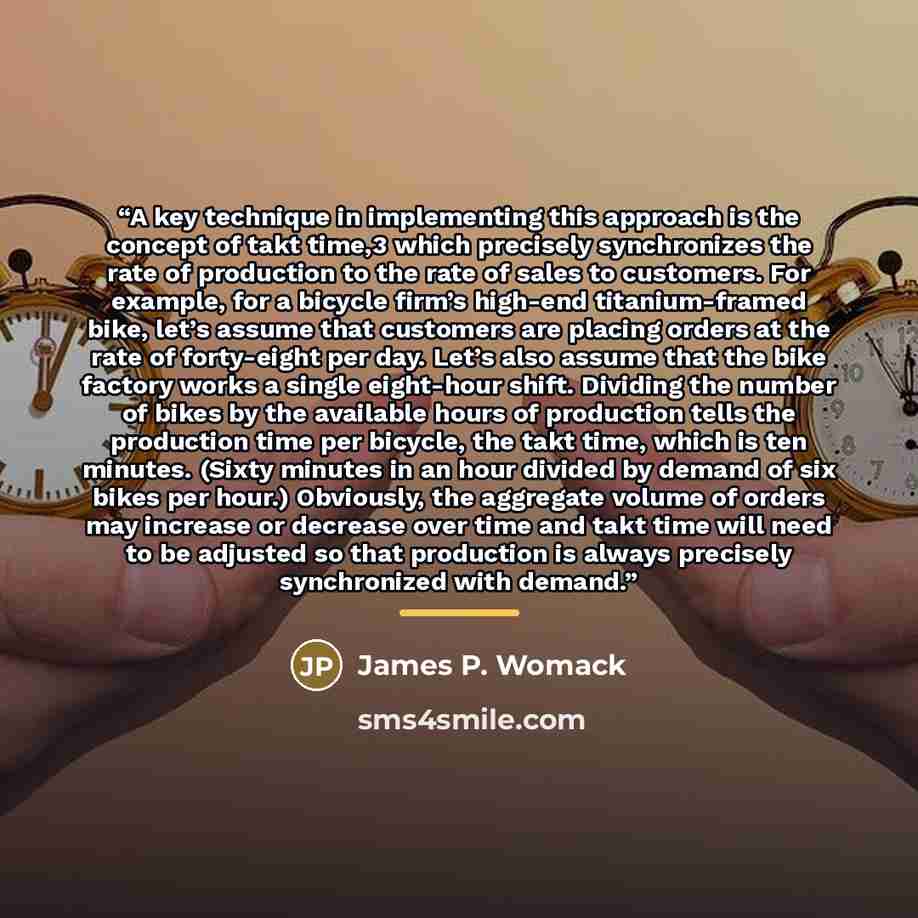
““A key technique in implementing this approach is the concept of takt time,3 which precisely synchronizes the rate of production to the rate of sales to customers. For example, for a bicycle firm’s high-end titanium-framed bike, let’s assume that customers are placing orders at the rate of forty-eight per day. Let’s also assume that the bike factory works a single eight-hour shift. Dividing the number of bikes by the available hours of production tells the production time per bicycle, the takt time, which is ten minutes. (Sixty minutes in an hour divided by demand of six bikes per hour.) Obviously, the aggregate volume of orders may increase or decrease over time and takt time will need to be adjusted so that production is always precisely synchronized with demand.””
About This Quote
Source Book: “The Machine That Changed the World” (1990) or related lean manufacturing text
Takt time aligns production speed with customer demand, ensuring each unit is made just as fast as it will be sold, preventing over‑ or under‑production.
In simple terms: Match production to demand.
Key Takeaway
Use takt time to balance supply and demand.
Themes
operations
lean manufacturing
efficiency
process control
Mood
analytical
practical
Type
instructional
technical
When to use this quote
- factory scheduling
- inventory management
- production planning
Key Concepts
takt time
flow
capacity planning
Questions to Reflect On
- How often should you review takt time?
- What tools help keep production synced with demand?
A Different Perspective
Takt time must be constantly recalculated as demand fluctuates.