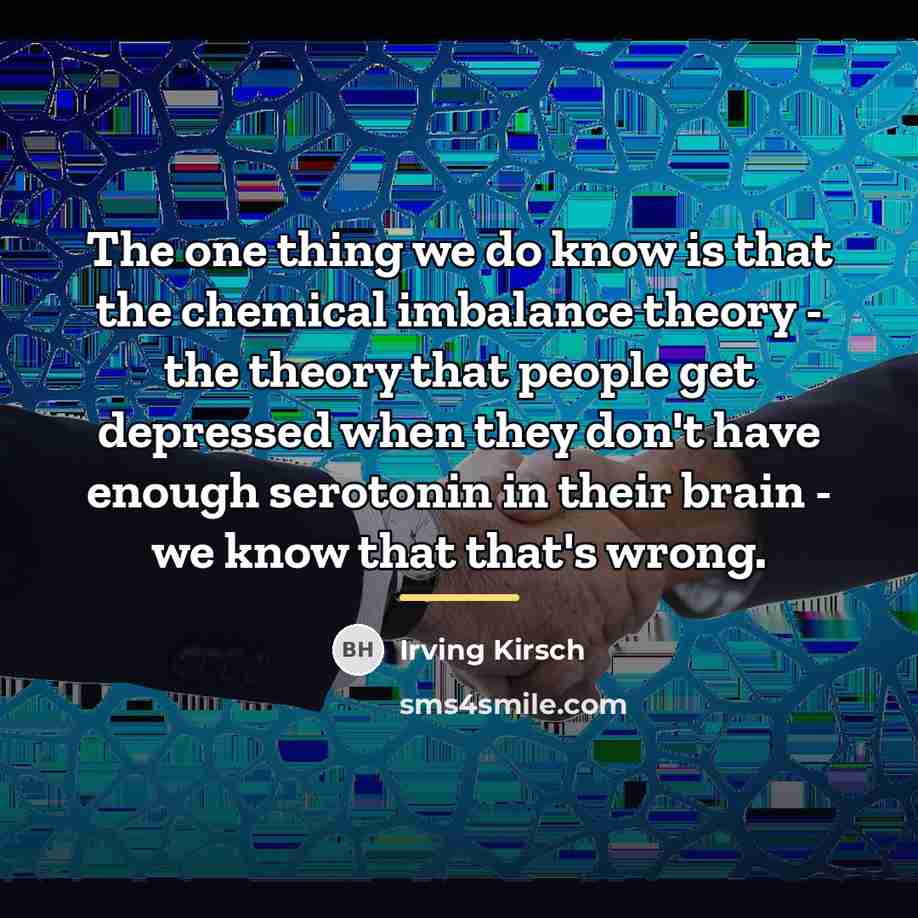
Antidepressants Quote by Irving Kirsch

““Depression, we are told over and over again, is a brain disease, a chemical imbalance that can be adjusted by antidepressant medication. In an informational brochure issued to inform the public about depression, the US National Institute for Mental Health tells people that 'depressive illnesses are disorders of the brain' and adds that 'important neurotransmitters - chemicals that brain cells use to communicate - appear to be out of balance'. This view is so widespread that it was even proffered by the editors of PLoS [Public Library of Science] Medicine in their summary that accompanied our article. 'Depression,' they wrote, 'is a serious medical illness caused by imbalances in the brain chemicals that regulate mood', and they went on to say that antidepressants are supposed to work by correcting these imbalances. The editors wrote their comment on chemical imbalances as if it were an established fact, and this is also how it is presented by drug companies. Actually, it is not. Instead, even its proponents have to admit that it is a controversial hypothesis that has not yet been proven. Not only is the chemical-imbalance hypothesis unproven, but I will argue that it is about as close as a theory gets in science to being dis-proven by the evidence.””
About This Quote
Source Article: “The Chemical Imbalance Myth” in Psychology Today, 2020
The brain‑chemical imbalance explanation for depression is unproven and likely inaccurate, despite widespread promotion.
In simple terms: Chemical imbalance claim lacks solid evidence.
Key Takeaway
Question the chemical imbalance narrative.
Themes
mental health
science
skepticism
media
pharmaceuticals
Mood
critical
inquisitive
Type
scientific
educational
When to use this quote
- clinical assessment
- patient education
- policy advocacy
- research design
Key Concepts
critical thinking
evidence based practice
medical ethics
Questions to Reflect On
- What alternative models of depression could be explored?
- How can clinicians balance skepticism with patient care?
A Different Perspective
Overreliance on this view may limit treatment options.