Epistemology Quote by Immanuel Kant
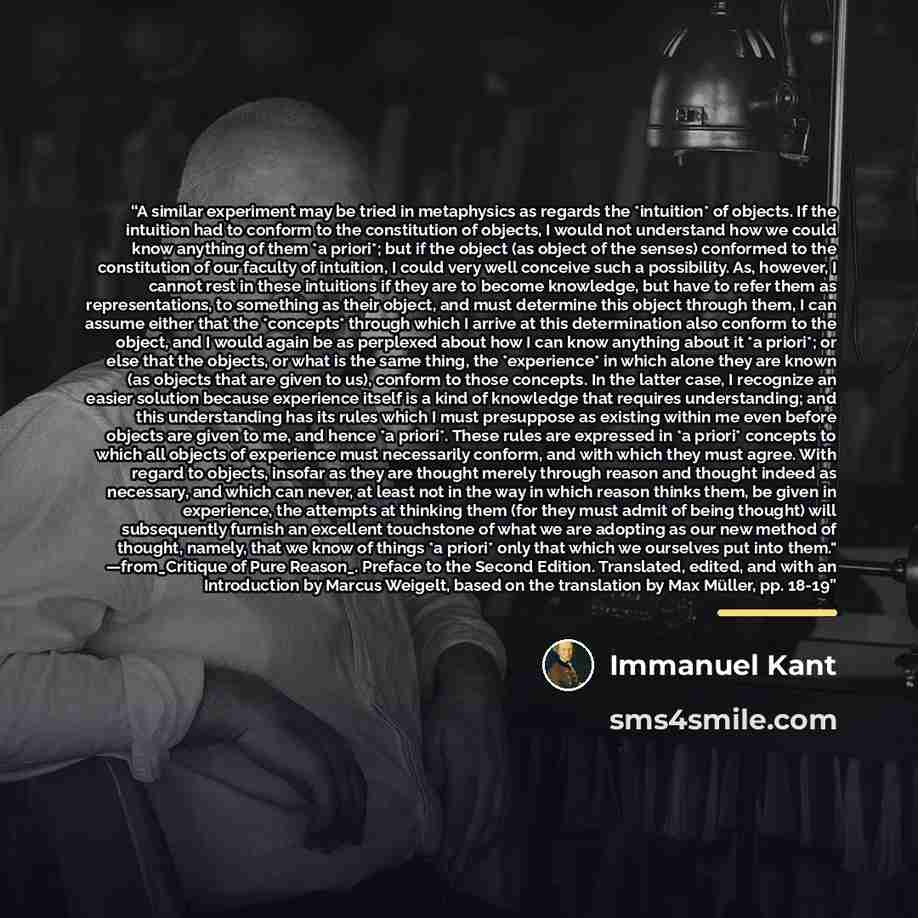
““A similar experiment may be tried in metaphysics as regards the *intuition* of objects. If the intuition had to conform to the constitution of objects, I would not understand how we could know anything of them *a priori*; but if the object (as object of the senses) conformed to the constitution of our faculty of intuition, I could very well conceive such a possibility. As, however, I cannot rest in these intuitions if they are to become knowledge, but have to refer them as representations, to something as their object, and must determine this object through them, I can assume either that the *concepts* through which I arrive at this determination also conform to the object, and I would again be as perplexed about how I can know anything about it *a priori*; or else that the objects, or what is the same thing, the *experience* in which alone they are known (as objects that are given to us), conform to those concepts. In the latter case, I recognize an easier solution because experience itself is a kind of knowledge that requires understanding; and this understanding has its rules which I must presuppose as existing within me even before objects are given to me, and hence *a priori*. These rules are expressed in *a priori* concepts to which all objects of experience must necessarily conform, and with which they must agree. With regard to objects, insofar as they are thought merely through reason and thought indeed as necessary, and which can never, at least not in the way in which reason thinks them, be given in experience, the attempts at thinking them (for they must admit of being thought) will subsequently furnish an excellent touchstone of what we are adopting as our new method of thought, namely, that we know of things *a priori* only that which we ourselves put into them." ―from_Critique of Pure Reason_. Preface to the Second Edition. Translated, edited, and with an Introduction by Marcus Weigelt, based on the translation by Max Müller, pp. 18-19””
About This Quote
Source Preface: Critique of Pure Reason, 2nd Edition, translated by Marcus Weigelt
Kant argues that knowledge arises from the interaction of innate concepts and sensory experience, not solely from either.
In simple terms: Knowledge blends mind’s concepts with experience.
Key Takeaway
Recognize both innate ideas and sensory input.
Themes
epistemology
metaphysics
philosophy
Mood
analytical
thoughtful
Type
theoretical
explanatory
When to use this quote
- education
- scientific research
- personal reflection
Key Concepts
a priori concepts
intuition
experience
Questions to Reflect On
- How do innate concepts shape perception?
- Can experience alone yield true knowledge?
A Different Perspective
Relying only on intuition may lead to unfounded assumptions.