Apperception Quote by Immanuel Kant
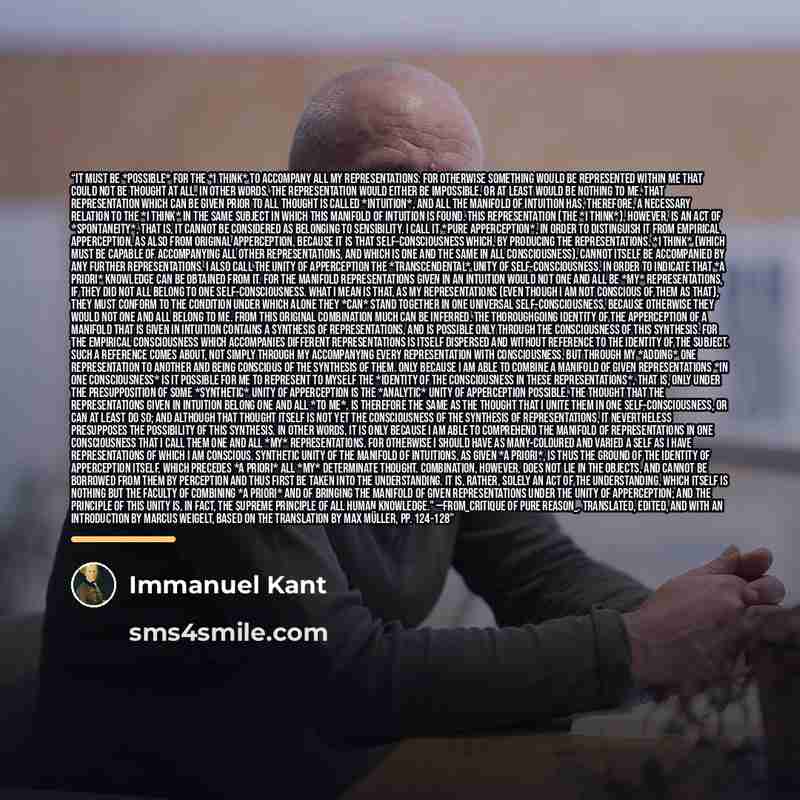
““It is true, no doubt, that this principle of the necessary unity of apperception is itself an identical and therefore an analytic proposition; but it shows, nevertheless, the necessity of a synthesis of the manifold given in an intuition, a synthesis without which it would be impossible to think the thoroughgoing identity of self-consciousness. For through the *I*, as a simple representation, nothing manifold is given; only in intuition, which is distinct from this representation, can a manifold be given, and then, through *combination*, be thought in one consciousness. An understanding in which through self-consciousness all the manifold would be given at the same time would be one that *intuits*; our understanding can do nothing but *think*, and must seek intuition in the senses. I am conscious, therefore, of the identical self with respect to the manifold of the representations that are given to me in an intuition, because I call them one and all *my* representations, as constituting *one* intuition. This means that I am conscious *a priori* of a necessary synthesis of them, which is called the original synthetic unity of apperception, and under which all representations given to me must stand, but under which they must also be brought by means of a synthesis.” —from_Critique of Pure Reason_. Translated, edited, and with an Introduction by Marcus Weigelt, based on the translation by Max Müller, pp. 128-129””
About This Quote
Source Book: Critique of Pure Reason, 1781, Kant’s Transcendental Philosophy
Self‑consciousness requires synthesis of sensory manifold into a unified intuition; understanding alone cannot achieve this.
In simple terms: Self‑consciousness needs synthesis of senses; thought alone insufficient.
Key Takeaway
Seek unity of perception through reflective synthesis.
Themes
epistemology
consciousness
synthetic unity
apperception
Mood
inquisitive
philosophical
Type
theoretical
introspective
When to use this quote
- philosophical education
- meditative practice
- creative problem solving
- scientific modeling
- artistic composition
Key Concepts
transcendental idealism
mind‑body problem
cognitive integration
Questions to Reflect On
- How does synthesis shape personal identity?
- Can we achieve unity without intuition?
A Different Perspective
The concept presumes a pre‑existing unified self, which may be contested.