1967 Quote by Hannah Arendt
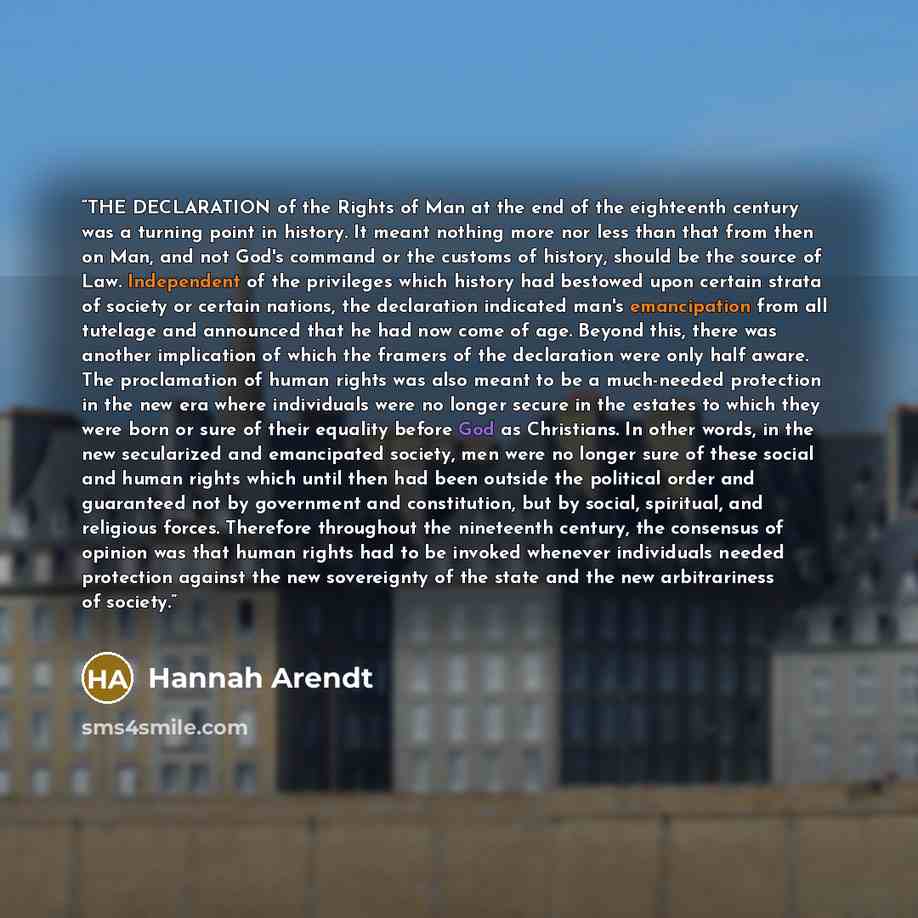
““THE DECLARATION of the Rights of Man at the end of the eighteenth century was a turning point in history. It meant nothing more nor less than that from then on Man, and not God's command or the customs of history, should be the source of Law. Independent of the privileges which history had bestowed upon certain strata of society or certain nations, the declaration indicated man's emancipation from all tutelage and announced that he had now come of age. Beyond this, there was another implication of which the framers of the declaration were only half aware. The proclamation of human rights was also meant to be a much-needed protection in the new era where individuals were no longer secure in the estates to which they were born or sure of their equality before God as Christians. In other words, in the new secularized and emancipated society, men were no longer sure of these social and human rights which until then had been outside the political order and guaranteed not by government and constitution, but by social, spiritual, and religious forces. Therefore throughout the nineteenth century, the consensus of opinion was that human rights had to be invoked whenever individuals needed protection against the new sovereignty of the state and the new arbitrariness of society.””
About This Quote
Source Book: The Human Condition, Hannah Arendt, 1958
The Declaration of Human Rights shifted lawmaking from divine or traditional authority to human agency, promising protection but also exposing new vulnerabilities in a secular world.
In simple terms: Rights moved from God to people, offering freedom but new risks.
Key Takeaway
Guard rights while adapting to modern challenges.
Themes
rights
secularism
law
human agency
vulnerability
Mood
critical
analytical
Type
historical
philosophical
When to use this quote
- civil liberties activism
- legal reform
- education curricula
Key Concepts
political theory
history
social contract
Questions to Reflect On
- How can societies protect rights against state overreach?
- What role do cultural values play in enforcing rights?
A Different Perspective
Rights can be contested or ignored by powerful interests.