Man's chief moral deficiency appears to be not his indiscretions but his reticence. — Hannah Arendt Copy Share Image
Men in plural […] can experience meaningfulness only because they can talk with and make sense to each other and themselves. — Hannah Arendt Copy Share Image
The conviction that everything that happens on earth must be comprehensible to man can lead to interpreting history by commonplaces. — Hannah Arendt Copy Share Image
When evil is allowed to compete with good, evil has an emotional populist appeal that wins out unless good men and women… — Hannah Arendt Copy Share Image
If men were ever to lose the appetite for meaning we call thinking, they would lose the capacity for asking all the… — Hannah Arendt Copy Share Image
Thought ... is still possible, and no doubt actual, wherever men live under the conditions of political freedom. Unfortunately ... no other… — Hannah Arendt Copy Share Image
For no matter what learned scientists may say, race is, politically speaking, not the beginning of humanity but its end, not the… — Hannah Arendt Copy Share Image
Men who no longer can make sure of the reality which they feel and experience through talking about it and sharing it… — Hannah Arendt Copy Share Image
Could the activity of thinking as such, the habit of examining whatever happens to come to pass or to attract attention, regardless… — Hannah Arendt Copy Share Image
Men always want to be terribly influential, but I see that as somewhat external. Do I imagine myself being influential? No. I… — Hannah Arendt Copy Share Image
The totalitarian attempt at global conquest and total domination has been the destructive way out of all impasses. Its victory may coincide… — Hannah Arendt Copy Share Image
Slavery's crime against humanity did not begin when one people defeated and enslaved its enemies (though of course this was bad enough),… — Hannah Arendt Copy Share Image
Predictions of the future are never anything but projections of present automatic processes and procedures, that is, of occurrences that are likely… — Hannah Arendt Copy Share Image
The human condition comprehends more than the condition under which life has been given to man. Men are conditioned beings because everything… — Hannah Arendt Copy Share Image
If the world is to contain a public space, it cannot be erected for one generation and planned for the living only;… — Hannah Arendt Copy Share Image
Even in the darkest of times we have the right to expect some illumination, and ... such illumination may well come less… — Hannah Arendt Copy Share Image
Just as the law in civilized countries assumes that the voice of conscience tells everybody, "Thou shalt not kill," even though man's… — Hannah Arendt Copy Share Image
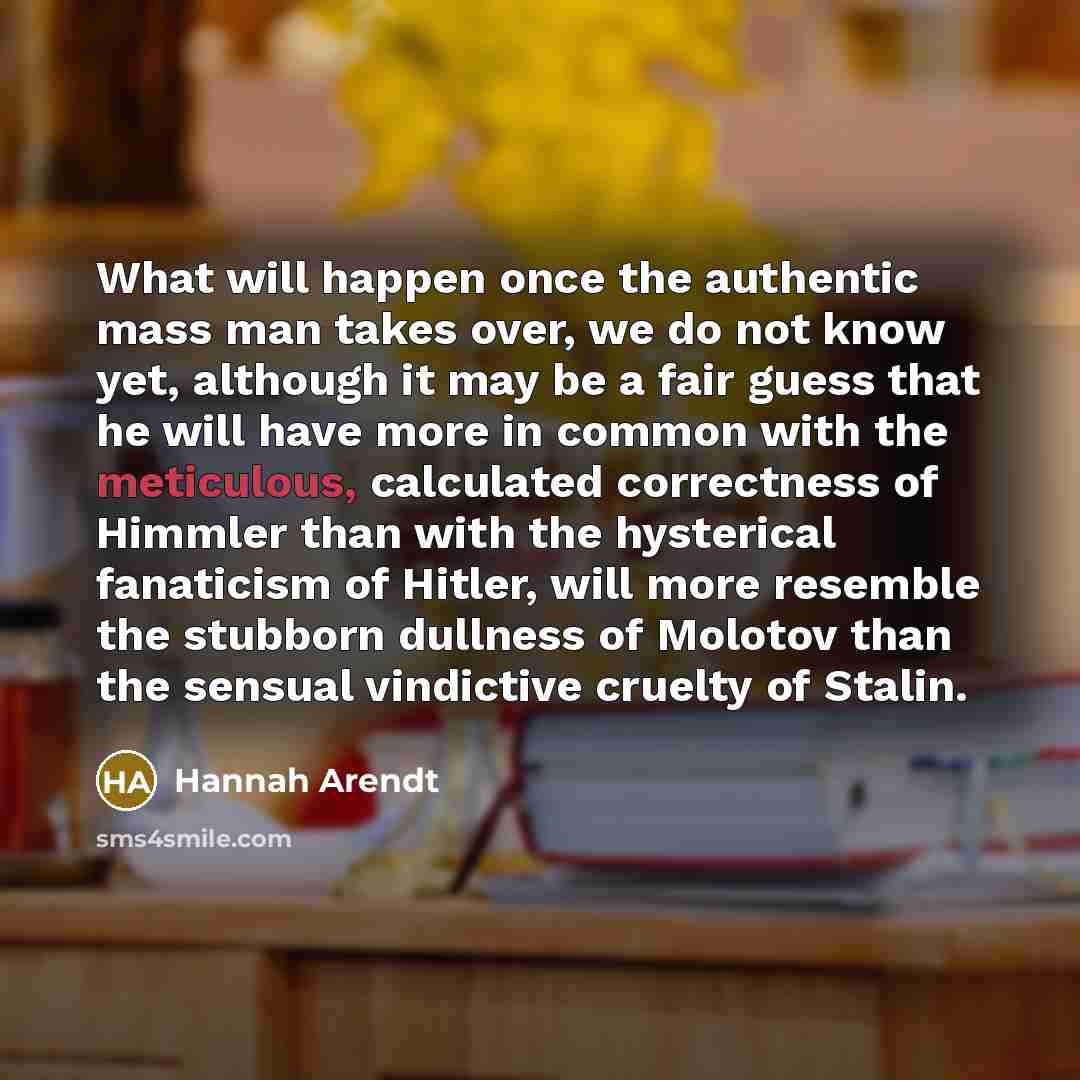
What will happen once the authentic mass man takes over, we do not know yet, although it may be a fair guess… — Hannah Arendt Copy Share Image
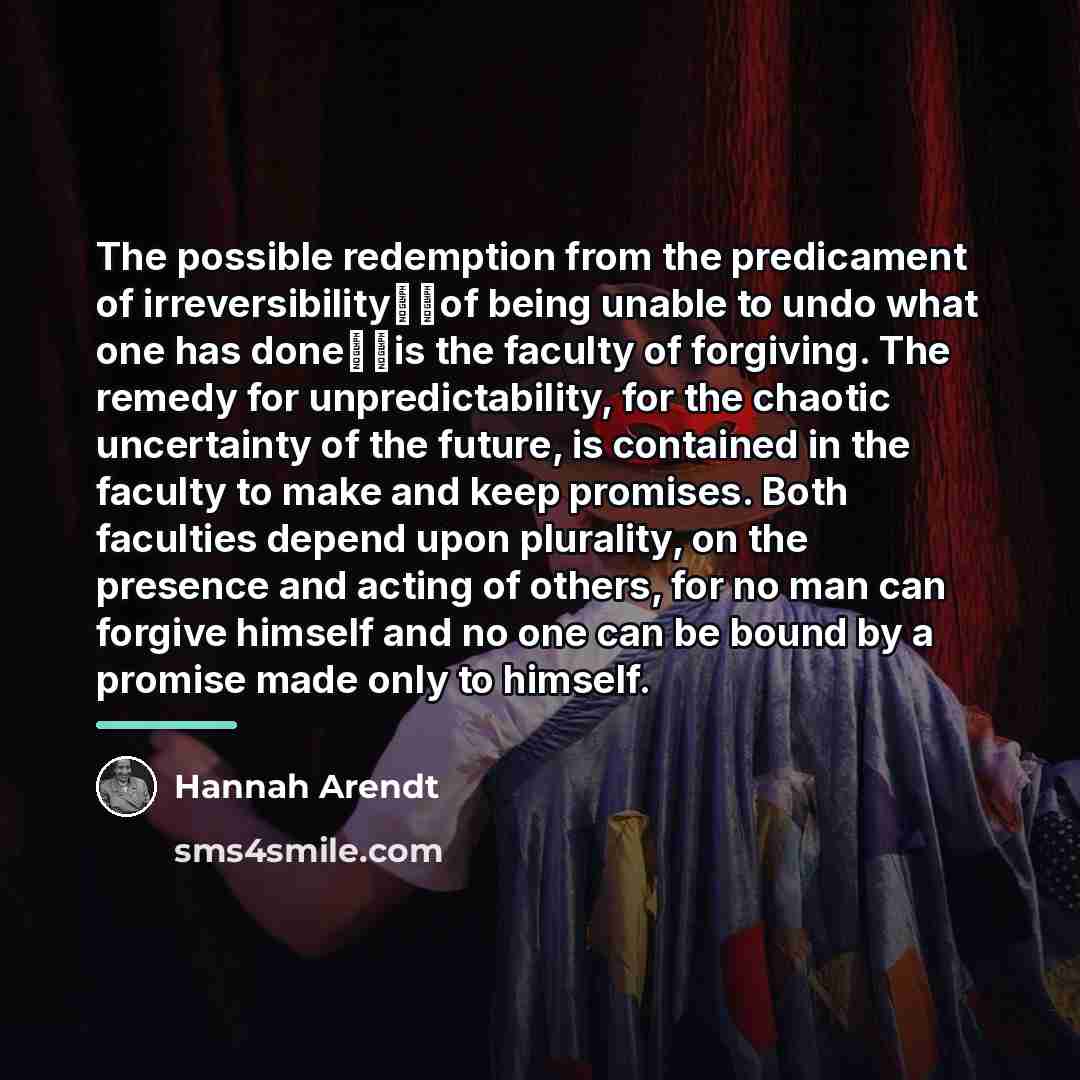
The possible redemption from the predicament of irreversibility──of being unable to undo what one has done──is the faculty of forgiving. The remedy… — Hannah Arendt Copy Share Image
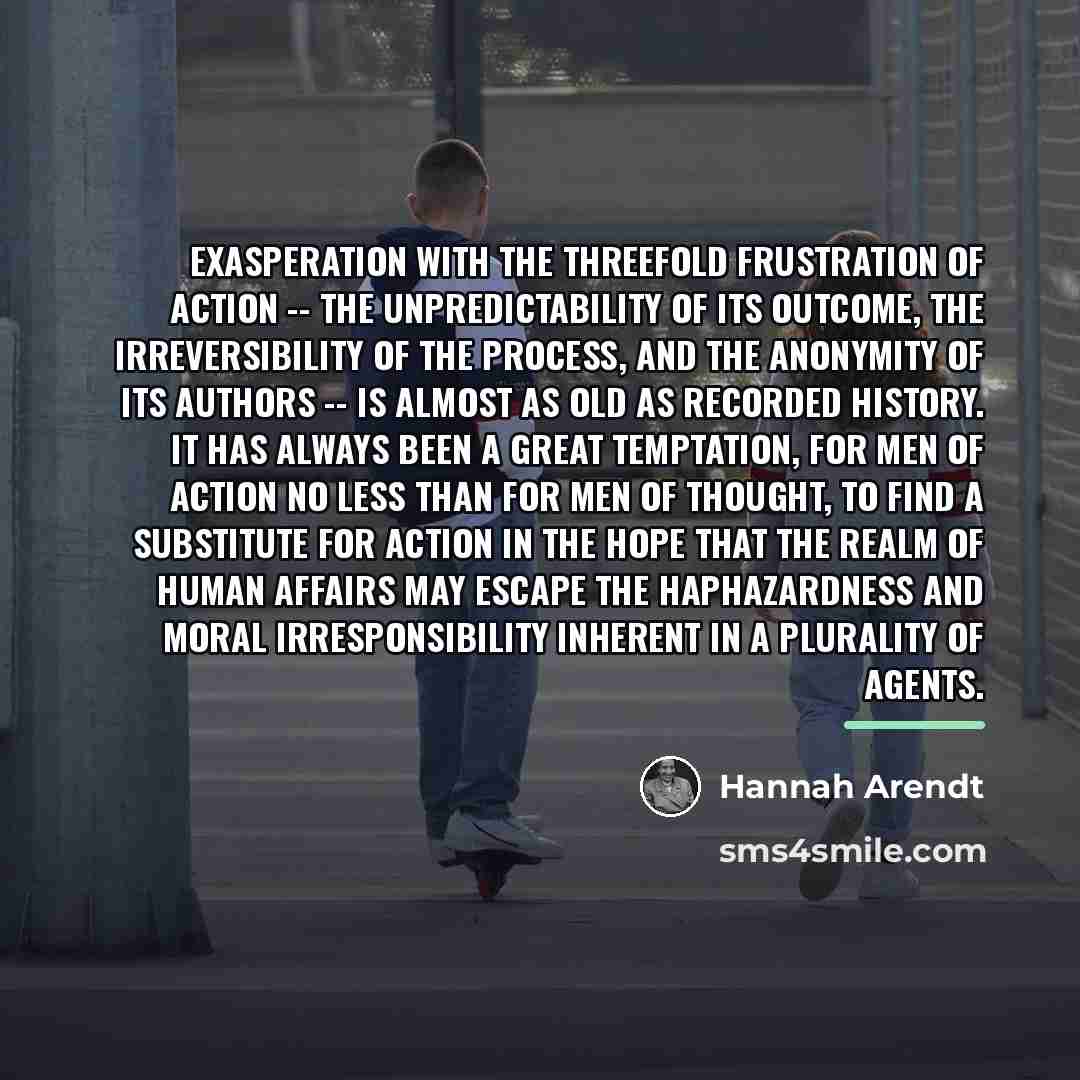
Exasperation with the threefold frustration of action -- the unpredictability of its outcome, the irreversibility of the process, and the anonymity of… — Hannah Arendt Copy Share Image
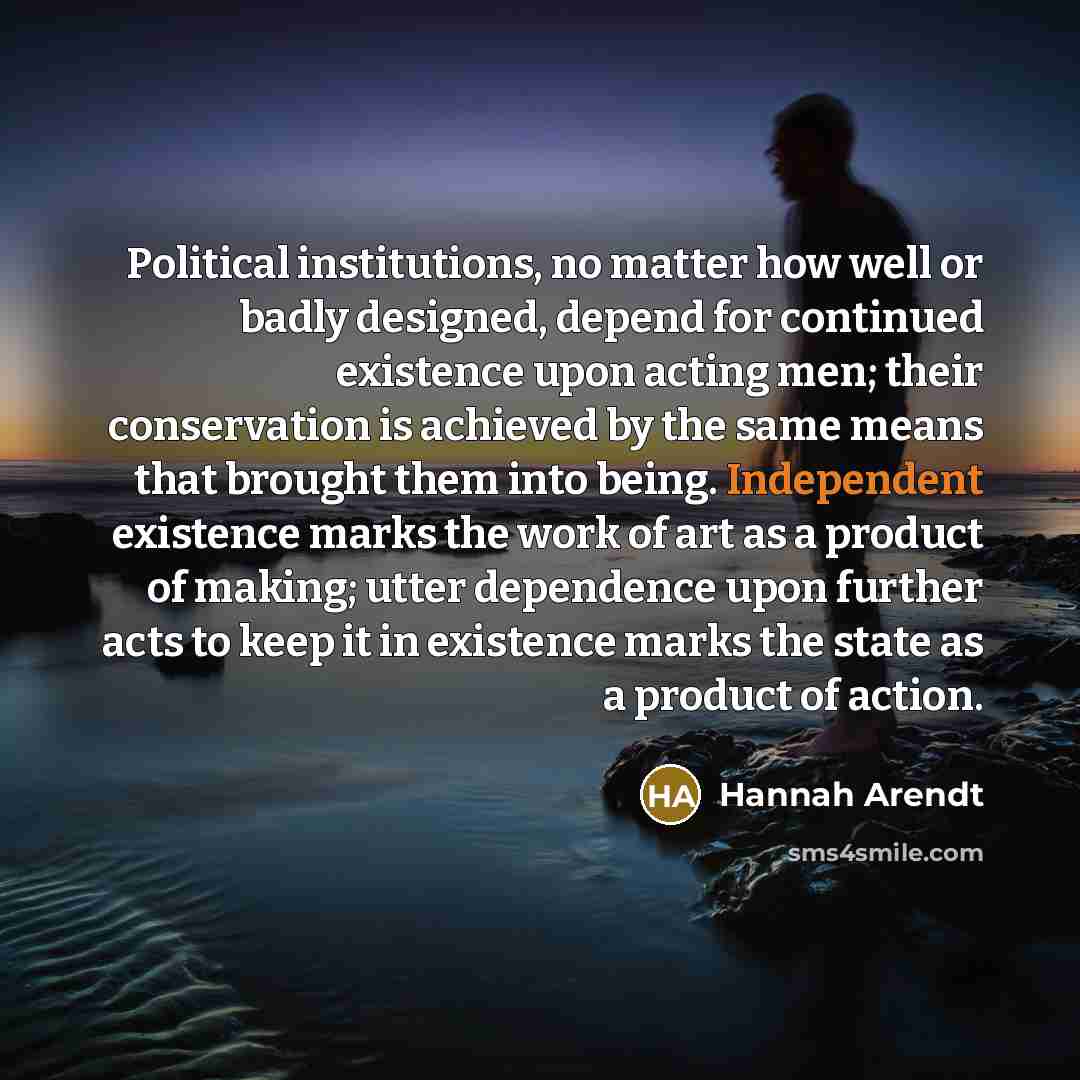
Political institutions, no matter how well or badly designed, depend for continued existence upon acting men; their conservation is achieved by the… — Hannah Arendt Copy Share Image
While strength is the natural quality of an individual seen in isolation, power springs up between men when they act together and… — Hannah Arendt Copy Share Image
Men, forever tempted to lift the veil of the future-with the aid of computers or horoscopes or the intestines of sacrificial animals-have… — Hannah Arendt Copy Share Image
... we may remember what the Romansthought a cultivated person ought to be: one who knows how to choose his company among… — Hannah Arendt Copy Share Image
The ultimate end of human acts is eudaimonia, happiness in the sense of living well, which all men desire; all acts are… — Hannah Arendt Copy Share Image
What I cannot live with may not bother another man's conscience. The result is that conscience will stand against conscience. — Hannah Arendt Copy Share Image
Every organization of men, be it social or political, ultimately relies on man's capacity for making promises and keeping them. — Hannah Arendt Copy Share Image
... whatever men do or know or experience can make sense only to the extent that it can be spoken about. There… — Hannah Arendt Copy Share Image
This inability to think created the possibility for many ordinary men to commit evil deeds on a gigantic scale, the like of… — Hannah Arendt Copy Share Image
Without being bound to the fulfillment of promises, we would never be able to keep our identities; we would be condemned to… — Hannah Arendt Copy Share Image
Politically speaking, tribal nationalism [patriotism] always insists that its own people are surrounded by 'a world of enemies' - 'one against all'… — Hannah Arendt Copy Share Image
The essence of totalitarian government, and perhaps the nature of every bureaucracy, is to make functionaries and mere cogs in the administrative… — Hannah Arendt Copy Share Image
in addition to the conditions under which life is given to man on earth, and partly out of them, men constantly create… — Hannah Arendt Copy Share Image
“It means, first, that everything that appears in public can be seen and heard by everybody and has the widest possible publicity. For us,… — Hannah Arendt Copy Share Image
Without being forgiven, released from the consequences of what we have done, our capacity to act would, as it were, be confined to one… — Hannah Arendt Copy Share Image
What really distinguishes this generation in all countries from earlier generations ... is its determination to act, its joy in action, the assurance of… — Hannah Arendt Copy Share Image
The practice of violence, like all action, changes the world, but the most probable change is a more violent world. — Hannah Arendt Copy Share Image
“Nationalism always preserved this initial intimate loyalty to the government and never quite lost its function of preserving a precarious balance between nation and… — Hannah Arendt Copy Share Image
There is all the difference in the world between the criminal's avoiding the public eye and the civil disobedience's taking the law into his… — Hannah Arendt Copy Share Image
“What imperialists actually wanted was expansion of political power without the foundation of the body politic. Imperialist expansion had been touched off by a… — Hannah Arendt Copy Share Image
the greater the bureaucratization of public life, the greater will be the attraction of violence. In a fully developed bureaucracy there is nobody left… — Hannah Arendt Copy Share Image
Death not merely ends life, it also bestows upon it a silent completeness, snatched from the hazardous flux to which all things human are… — Hannah Arendt Copy Share Image
Only crime and the criminal, it is true, confront us with the perplexity of radical evil; but only the hypocrite is really rotten to… — Hannah Arendt Copy Share Image
We have almost succeeded in leveling all human activities to the common denominator of securing the necessities of life and providing for their abundance. — Hannah Arendt Copy Share Image
![“Men in plural […] can experience meaningfulness only because they can talk with and make sense to each other and themselves.” quote by Hannah Arendt](https://sms4smile.com/quotes/img-quotes/31f/hannah-arendt-610_make-sense_men-in-plural-can-experience-meaningfuln_248332.jpg)






![“Politically speaking, tribal nationalism [patriotism] always insists that its own people are surrounded by 'a world of enemies' - 'one against all' - and that a fundamental difference exists between this people and all others. It claims its people to be unique, individual, incompatible with all…” quote by Hannah Arendt](https://sms4smile.com/quotes/img-quotes/9c2/hannah-arendt-610_claims_politically-speaking-tribal-nationalism_2904535.jpg)