Happiness Quote by George Eliot
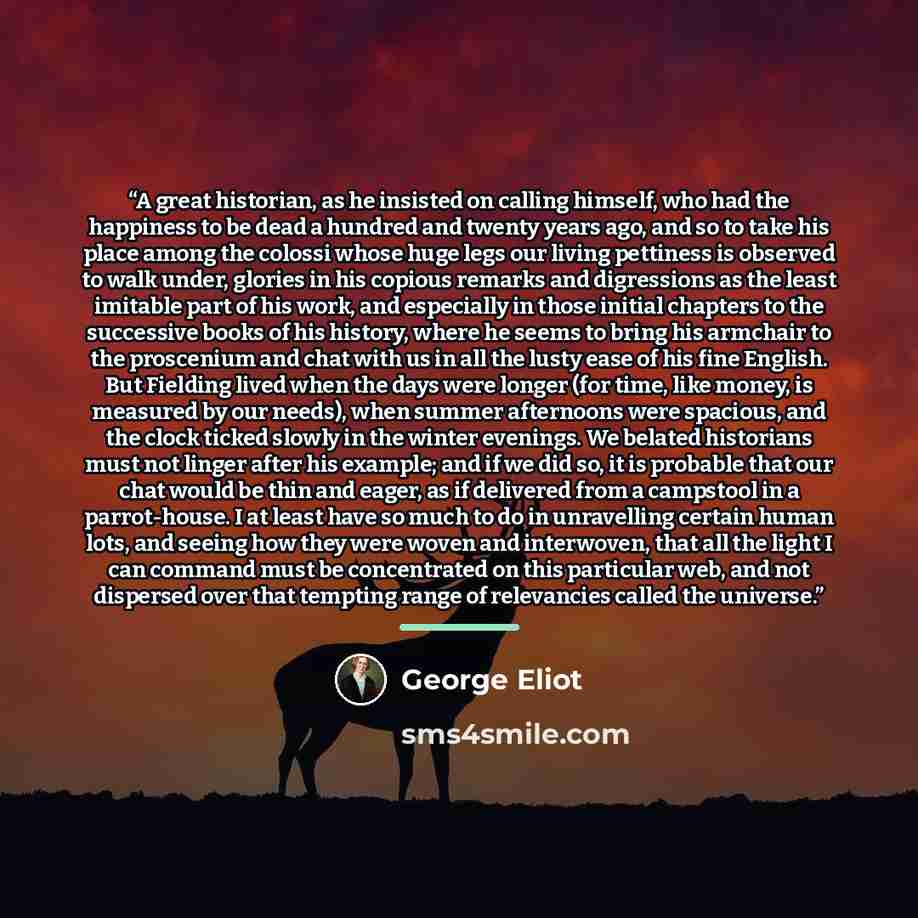
““A great historian, as he insisted on calling himself, who had the happiness to be dead a hundred and twenty years ago, and so to take his place among the colossi whose huge legs our living pettiness is observed to walk under, glories in his copious remarks and digressions as the least imitable part of his work, and especially in those initial chapters to the successive books of his history, where he seems to bring his armchair to the proscenium and chat with us in all the lusty ease of his fine English. But Fielding lived when the days were longer (for time, like money, is measured by our needs), when summer afternoons were spacious, and the clock ticked slowly in the winter evenings. We belated historians must not linger after his example; and if we did so, it is probable that our chat would be thin and eager, as if delivered from a campstool in a parrot-house. I at least have so much to do in unravelling certain human lots, and seeing how they were woven and interwoven, that all the light I can command must be concentrated on this particular web, and not dispersed over that tempting range of relevancies called the universe.””
About This Quote
Source Novel: Middlemarch by George Eliot, 1871
The author reflects on the distance between past great historians and present ones, urging focus on specific, relevant work rather than broad, unfocused inquiry.
In simple terms: Focus on specific work, not endless breadth.
Key Takeaway
Concentrate on your own research area.
Themes
history
focus
discipline
Mood
reflective
scholarly
Type
analytical
philosophical
When to use this quote
- academic research
- writing
- teaching
- public scholarship
Key Concepts
historical analysis
intellectual humility
Questions to Reflect On
- How can you narrow your scope without losing relevance?
- What specific “web” will you study?
A Different Perspective
Broad ambition can dilute depth and clarity.
















![“[W]e must learn to accommodate ourselves to the discovery that some of those cunningly-fashioned instruments called human souls have only a very limited range of music, and will not vibrate in the least under a touch that fills others with tremulous rapture or quivering agony.” quote by George Eliot](https://sms4smile.com/quotes/img-quotes/9be/george-eliot-84_agony_w-e-must-learn-to-accommodate-ourselves_12409.jpg)