Death Quote by Cynthia Mestad Johnson
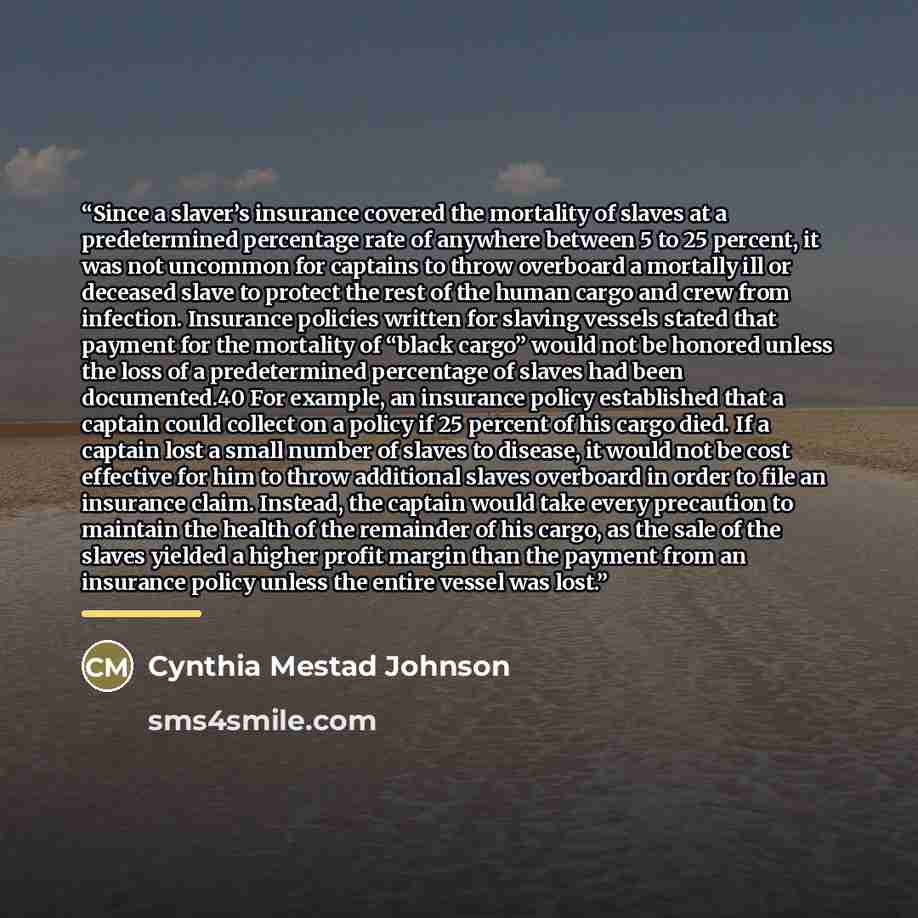
““Since a slaver’s insurance covered the mortality of slaves at a predetermined percentage rate of anywhere between 5 to 25 percent, it was not uncommon for captains to throw overboard a mortally ill or deceased slave to protect the rest of the human cargo and crew from infection. Insurance policies written for slaving vessels stated that payment for the mortality of “black cargo” would not be honored unless the loss of a predetermined percentage of slaves had been documented.40 For example, an insurance policy established that a captain could collect on a policy if 25 percent of his cargo died. If a captain lost a small number of slaves to disease, it would not be cost effective for him to throw additional slaves overboard in order to file an insurance claim. Instead, the captain would take every precaution to maintain the health of the remainder of his cargo, as the sale of the slaves yielded a higher profit margin than the payment from an insurance policy unless the entire vessel was lost.””
About This Quote
Insurance policies in slavery incentivized preserving slave health over profit from deaths.
In simple terms: Insurance shaped slave treatment decisions.
Key Takeaway
Understand how incentives drive ethical outcomes.
Themes
history
ethics
economics
Mood
critical
educational
Type
historical
ethical
When to use this quote
- historical analysis
- policy review
- educational curricula
Key Concepts
incentive structures
human rights
Questions to Reflect On
- What modern parallels exist for profit-driven ethics?
- How can policies be designed to protect vulnerable lives?
A Different Perspective
The description may lack broader context of systemic cruelty.