Death Quote by Charles Dickens
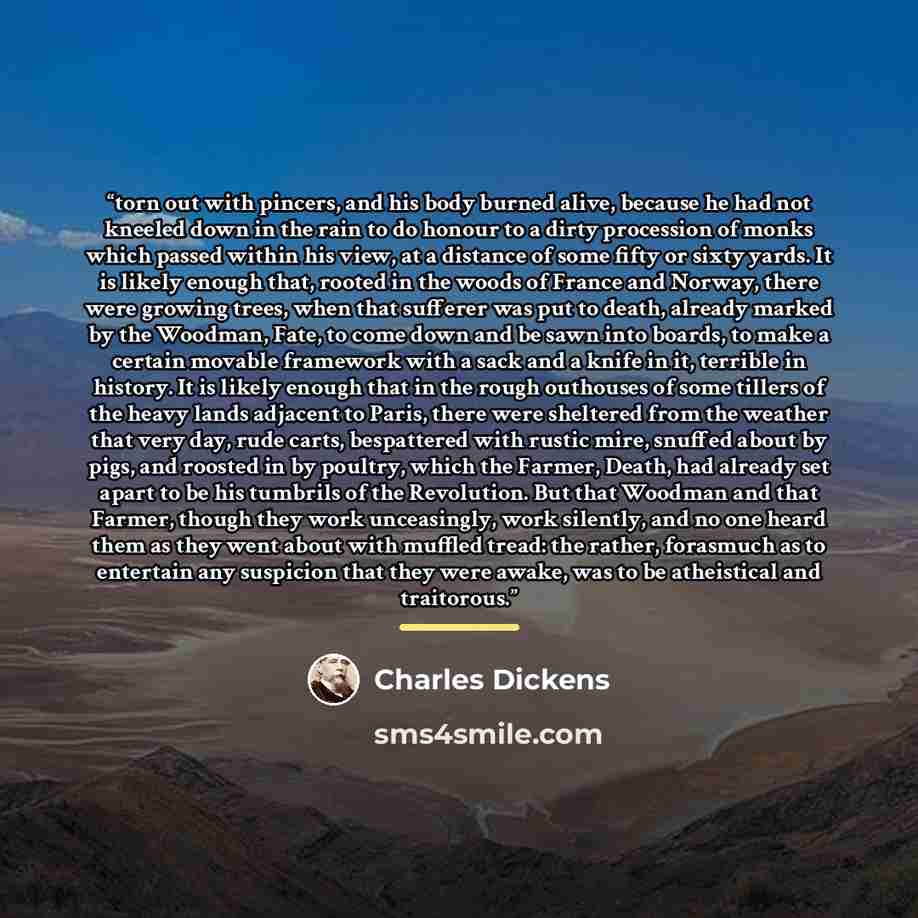
““torn out with pincers, and his body burned alive, because he had not kneeled down in the rain to do honour to a dirty procession of monks which passed within his view, at a distance of some fifty or sixty yards. It is likely enough that, rooted in the woods of France and Norway, there were growing trees, when that sufferer was put to death, already marked by the Woodman, Fate, to come down and be sawn into boards, to make a certain movable framework with a sack and a knife in it, terrible in history. It is likely enough that in the rough outhouses of some tillers of the heavy lands adjacent to Paris, there were sheltered from the weather that very day, rude carts, bespattered with rustic mire, snuffed about by pigs, and roosted in by poultry, which the Farmer, Death, had already set apart to be his tumbrils of the Revolution. But that Woodman and that Farmer, though they work unceasingly, work silently, and no one heard them as they went about with muffled tread: the rather, forasmuch as to entertain any suspicion that they were awake, was to be atheistical and traitorous.””
About This Quote
Source Novel: A Tale of Two Cities, Charles Dickens, 1859
The passage depicts the relentless, unseen forces of fate and death that shape human suffering, suggesting that ordinary events conceal deeper, inevitable tragedies.
In simple terms: Fate and death work quietly, unnoticed, causing suffering.
Key Takeaway
Recognize hidden forces shaping outcomes.
Themes
fate
death
revolution
silence
inevitability
Mood
somber
reflective
Type
literary
philosophical
When to use this quote
- war
- political upheaval
- personal loss
- social injustice
Key Concepts
determinism
social critique
historical allegory
Questions to Reflect On
- How do unseen forces influence your life?
- Can we act against inevitable outcomes?
A Different Perspective
The metaphor may over‑emphasize inevitability, ignoring human agency.


![“...a companion had seemed unnecessary fuel when her body still burned at the core, waiting to ignite. But now, with the wind blowing icicles through her [Kit] veins, it felt like she, too, was in the grave. All her nuclear energy had been snuffed like a match between the night's icy fingers.” quote by Vicki Pettersson](https://sms4smile.com/quotes/img-quotes/d5f/vicki-pettersson-10826_nuclear-energy_a-companion-had-seemed-unnecessary-fuel_2380228.jpg)