James-joyce Quote by Carola Giedion-Welcker
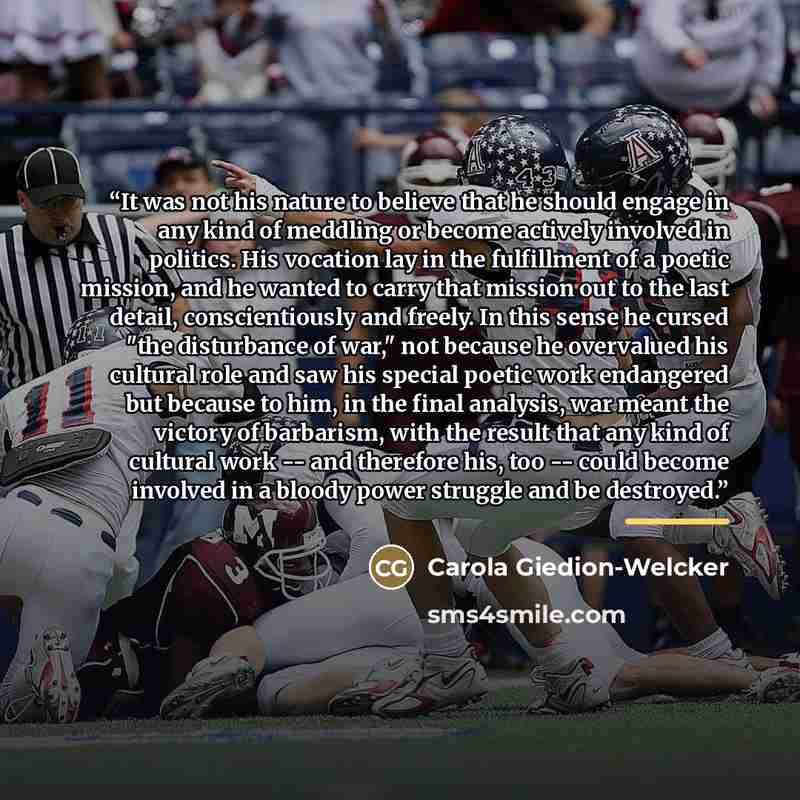
““It was not his nature to believe that he should engage in any kind of meddling or become actively involved in politics. His vocation lay in the fulfillment of a poetic mission, and he wanted to carry that mission out to the last detail, conscientiously and freely. In this sense he cursed "the disturbance of war," not because he overvalued his cultural role and saw his special poetic work endangered but because to him, in the final analysis, war meant the victory of barbarism, with the result that any kind of cultural work -- and therefore his, too -- could become involved in a bloody power struggle and be destroyed.””
About This Quote
A poet rejects political involvement, seeing war as barbarism that threatens cultural work, and condemns the violence that engulfs art.
In simple terms: Poet opposes war, fearing cultural destruction.
Key Takeaway
Protect cultural work from war.
Themes
art
politics
war
cultural integrity
peace
Mood
reflective
serious
philosophical
Type
James-joyce:0
Nature:0
Politics:1
Power struggle:1
War Meant:0
Analysis War:0
Disturbance War:0
Struggle Destroyed:0
Cursed Disturbance:0
When to use this quote
- cultural policy
- artistic expression
- war reporting
Key Concepts
philosophy
history
ethics
Questions to Reflect On
- How can artists stay apolitical in turbulent times?
- What responsibilities do creators have during conflict?
A Different Perspective
Art can be politicized despite intent.
![“A man [Joyce] whose earliest stories appeared next to the manure prices in the Irish Homestead knew that columns of prose, like columns of shit, could both recultivate the earth.” quote by Declan Kiberd](https://sms4smile.com/quotes/img-quotes/cfe/declan-kiberd-65721_fiction_a-man-joyce-whose-earliest-stories-appea_615934.jpg)
![“The book [Joyce's "Ulysses"] can just as well be read backwards, for it has no back and no front, no top and no bottom. Everything could easily have happened before, or might have happened afterwards. You can read any of the conversations just as pleasurably backwards, for you don't miss the point…” quote by C.G. Jung](https://sms4smile.com/quotes/img-quotes/2b3/c-g-jung-2163_books_the-book-joyce-s-ulysses-can-just-as-wel_2541350.jpg)
![“It [Joyce's "Ulysses"] plays on the reader's sympathies to his own undoing unless sleep kindly intervenes and puts a stop to this drain of energy. Arrived at page 135, after making several heroic efforts to get at the book, to "do it justice", as the phrase goes, I fell at last into profound…” quote by C.G. Jung](https://sms4smile.com/quotes/img-quotes/094/c-g-jung-2163_books_it-joyce-s-ulysses-plays-on-the-reader-s_2131160.jpg)