Children Quote by Anneli Rufus
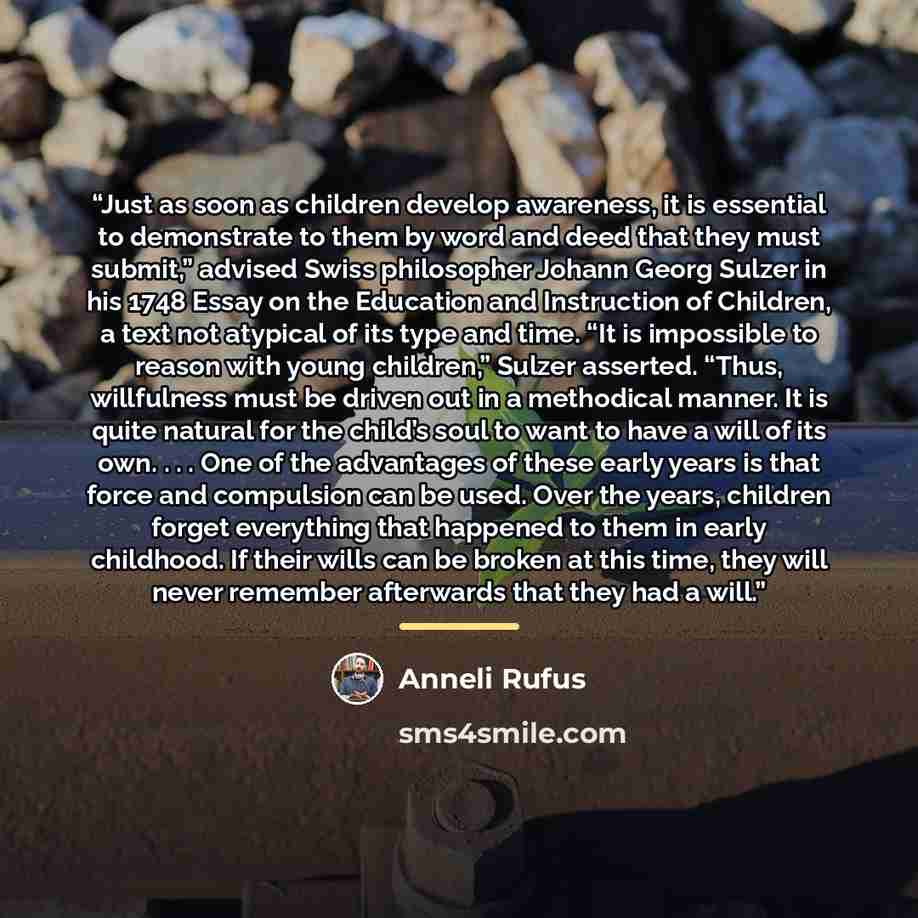
““Just as soon as children develop awareness, it is essential to demonstrate to them by word and deed that they must submit,” advised Swiss philosopher Johann Georg Sulzer in his 1748 Essay on the Education and Instruction of Children, a text not atypical of its type and time. “It is impossible to reason with young children,” Sulzer asserted. “Thus, willfulness must be driven out in a methodical manner. It is quite natural for the child’s soul to want to have a will of its own. . . . One of the advantages of these early years is that force and compulsion can be used. Over the years, children forget everything that happened to them in early childhood. If their wills can be broken at this time, they will never remember afterwards that they had a will.””
About This Quote
Source Essay: Education and Instruction of Children by Johann Georg Sulzer, 1748
Early childhood is seen as a period where authority can shape a child's will, using force to instill obedience, but this may suppress autonomy and have lasting psychological effects.
In simple terms: Children are taught obedience early, often through harsh methods, which can harm their independence.
Key Takeaway
Consider nurturing autonomy rather than imposing will.
Themes
parenting
authority
child development
discipline
psychology
Mood
concerned
thoughtful
questioning
Type
philosophical
ethical
reflective
When to use this quote
- early education
- parental guidance
- disciplinary methods
- childhood trauma
- ethical debates
Key Concepts
behavioral conditioning
autonomy
ethical parenting
Questions to Reflect On
- Is it ethical to use compulsion on children?
- How can we balance guidance with respect for a child’s agency?
A Different Perspective
Forceful obedience can damage trust and self‑esteem.