Gandhi Quote by Aldous Huxley
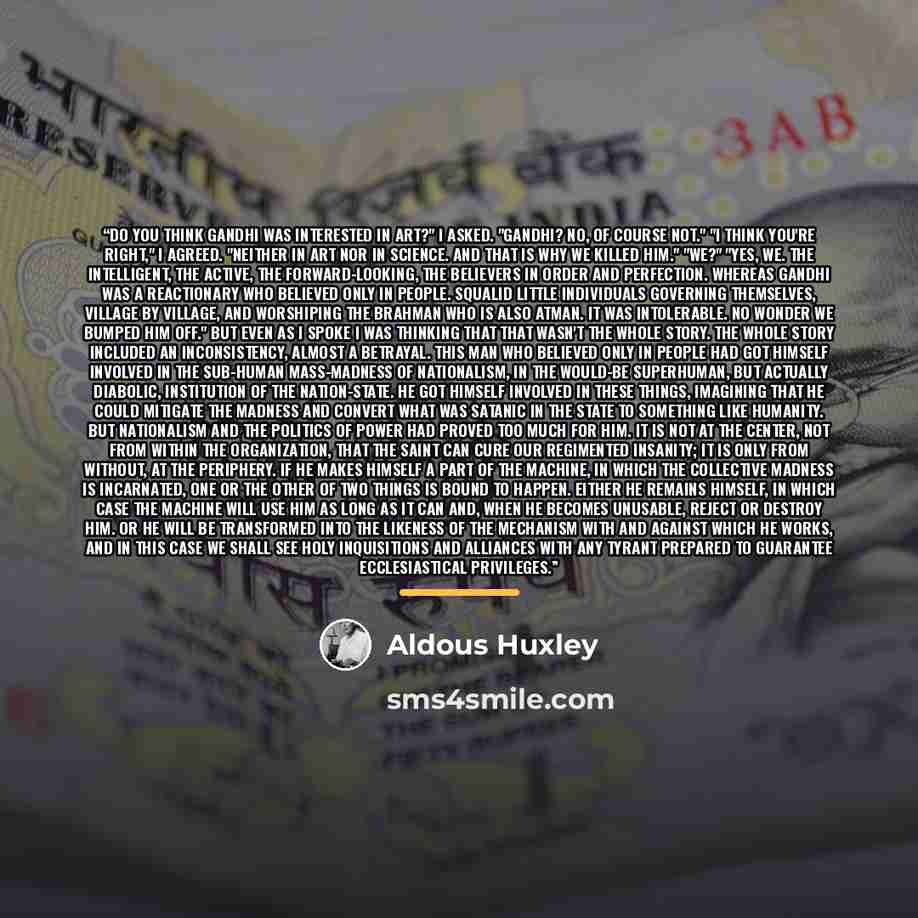
““Do you think Gandhi was interested in Art?" I asked. "Gandhi? No, of course not." "I think you're right," I agreed. "Neither in art nor in science. And that is why we killed him." "We?" "Yes, we. The intelligent, the active, the forward-looking, the believers in Order and Perfection. Whereas Gandhi was a reactionary who believed only in people. Squalid little individuals governing themselves, village by village, and worshiping the Brahman who is also Atman. It was intolerable. No wonder we bumped him off." But even as I spoke I was thinking that that wasn't the whole story. The whole story included an inconsistency, almost a betrayal. This man who believed only in people had got himself involved in the sub-human mass-madness of nationalism, in the would-be superhuman, but actually diabolic, institution of the nation-state. He got himself involved in these things, imagining that he could mitigate the madness and convert what was satanic in the state to something like humanity. But nationalism and the politics of power had proved too much for him. It is not at the center, not from within the organization, that the saint can cure our regimented insanity; it is only from without, at the periphery. If he makes himself a part of the machine, in which the collective madness is incarnated, one or the other of two things is bound to happen. Either he remains himself, in which case the machine will use him as long as it can and, when he becomes unusable, reject or destroy him. Or he will be transformed into the likeness of the mechanism with and against which he works, and in this case we shall see Holy Inquisitions and alliances with any tyrant prepared to guarantee ecclesiastical privileges.””
About This Quote
Source Novel: Brave New World, Aldous Huxley, 1932
The passage critiques the paradox of idealistic individuals being co-opted by oppressive nationalist systems, suggesting true moral authority must stay outside corrupt institutions.
In simple terms: Idealists are corrupted when they join oppressive powers.
Key Takeaway
Keep moral integrity outside corrupt systems.
Themes
politics
idealism
corruption
power
nationalism
Mood
reflective
critical
somber
Type
philosophical
political
When to use this quote
- activist movements
- political discourse
- academic analysis
- literary criticism
Key Concepts
ethical integrity
institutional critique
paradox
Questions to Reflect On
- Can moral purity survive within a corrupt system?
- What are the limits of external critique?
A Different Perspective
The narrative may oversimplify complex historical motivations of Gandhi and nationalism.