Our babies are like penguins; penguin babies can't exist unless more than one person is taking care of them. They just can't… — Alison Gopnik Copy Share Image
Imaginary friends are one of the weirder forms of pretend play in childhood. But the research shows that imaginary friends actually help… — Alison Gopnik Copy Share Image
We know what makes babies smart and happy and thrive. It's having human beings who are dedicated to caring for them -… — Alison Gopnik Copy Share Image
Being a developmental psychologist didn't make me any better at dealing with my own children, no. I muddled through, and, believe me,… — Alison Gopnik Copy Share Image
I'm the oldest of six children and I had my own first baby when I was 23. So I've always been interested… — Alison Gopnik Copy Share Image
Samuel Johnson called it the vanity of human wishes, and Buddhists talk about the endless cycle of desire. Social psychologists say we… — Alison Gopnik Copy Share Image
In most places and times in human history, babies have had not just one person but lots of people around who were… — Alison Gopnik Copy Share Image
We do nothing for children between the ages of zero and five. And we seem to be quite happy to have children… — Alison Gopnik Copy Share Image
The thing that is most important is having people who are involved and engaged with the kids and also are not stressed… — Alison Gopnik Copy Share Image
If you just, pretty much, take a random 15-month-old, just sit and watch them for 10 minutes and count out how many… — Alison Gopnik Copy Share Image
Philosophers and psychologists have long puzzled over the question of how we know as much as we do despite our limited experiences. One way… — Alison Gopnik Copy Share Image
Adults often assume that most learning is the result of teaching and that exploratory, spontaneous learning is unusual. But actually, spontaneous learning is more… — Alison Gopnik Copy Share Image
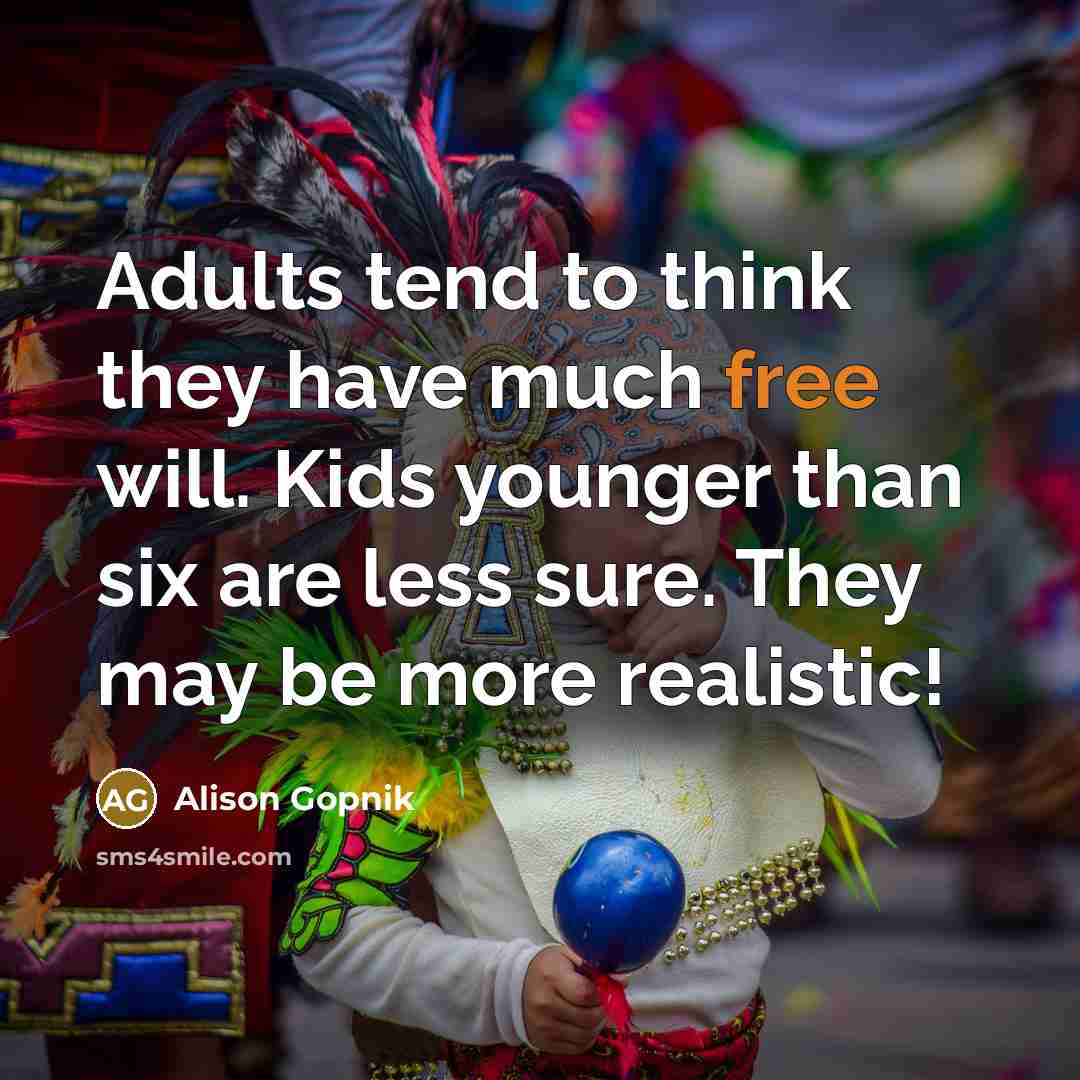
Adults tend to think they have much free will. Kids younger than six are less sure. They may be more realistic! — Alison Gopnik Copy Share Image
From an evolutionary perspective children are, literally, designed to learn. Childhood is a special period of protected immaturity. It gives the young breathing time… — Alison Gopnik Copy Share Image
There is a tension between our desire to get our kids to turn out a particular way versus letting them develop to be their… — Alison Gopnik Copy Share Image
“Instead, it may be that experience itself has changed our brains so that we perceive and interpret the world in a certain way. Once… — Alison Gopnik Copy Share Image
Caring for children has always been one of the deepest and most satisfying things that a human being does, and yet it is hard… — Alison Gopnik Copy Share Image
Imaginary friends are one of the weirder forms of pretend play in childhood. But the research shows that imaginary friends actually help children understand… — Alison Gopnik Copy Share Image
“Like their parents, the Korean children used more verbs than the English-speaking kids, while the English-speaking kids used more nouns. But in addition, the… — Alison Gopnik Copy Share Image
“We decided to become development psychologists and study children because there aren't any Martians. These brilliant beings with the little bodies and big heads… — Alison Gopnik Copy Share Image
Each new generation of children grows up in the new environment its parents have created, and each generation of brains becomes wired in a… — Alison Gopnik Copy Share Image