“Judaean Aramaic is in no sense a mixture of Hebrew and Syriac.” — James John Courtenay Copy Share Image
“Aramaic was spoken in certain regions of upper Egypt in the fifth century B.C.” — James John Courtenay Copy Share Image
“The Phoenician extends from the v cent B.C. to i cent. B.C ... The Aramaic extends from the viii cent. B.C. to… — James John Courtenay Copy Share Image
“Aramaic spoken in 500 B.C. from Babylon in the north to Assuan in the south of Egypt was identical with what has… — James John Courtenay Copy Share Image
“The likeness of Palmyrene to Biblical Aramaic are quite pronounced, and show that the two forms are essentially one.” — James John Courtenay Copy Share Image
“In Hebrew and Aramaic the vowels have undergone vast modifications, whilst in Arabic they have retained to a large extent their primitive… — James John Courtenay Copy Share Image
“For the character of Aramaic between the Exile and the Christian era we are indebted more to inscriptions than other writings.” — James John Courtenay Copy Share Image
“Galilaean must not be regarded as a later and more degenerate form of Judaean, any more than Aramaic itself must be regarded… — James John Courtenay Copy Share Image
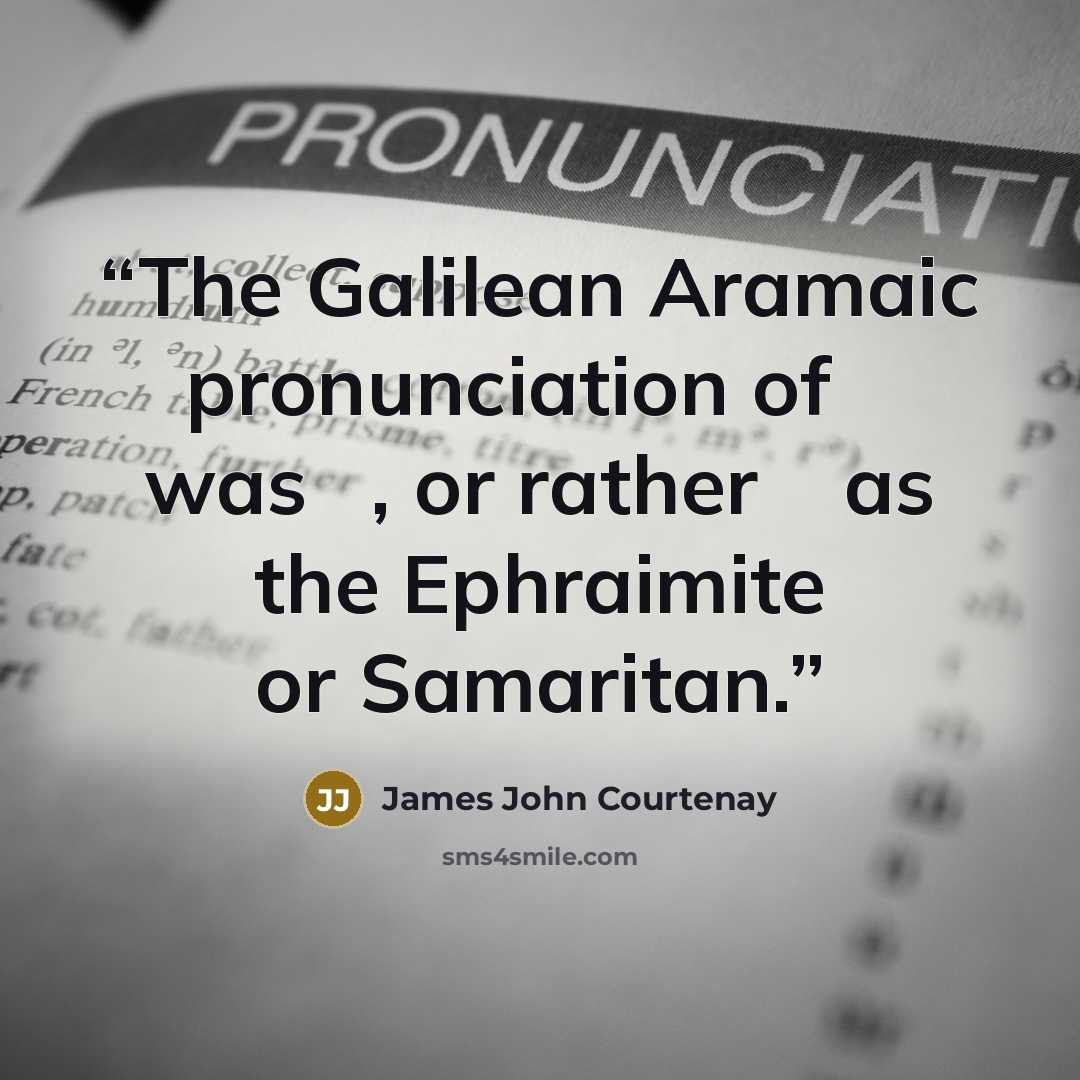
“The Galilean Aramaic pronunciation of שׁ was שׂ, or rather ס as the Ephraimite or Samaritan.” — James John Courtenay Copy Share Image
“Aramaic did not come into Palestine until after the Babylonian-Assyrian conquest of the country.” — James John Courtenay Copy Share Image
“Extra-canonical literature ... written in Aramaic have survived in another language, or in an Aramaic which is considerably removed from the original… — James John Courtenay Copy Share Image
“It is evident that at no period between the Exile and the Christian era was there one homogeneous language in Palestine. But… — James John Courtenay Copy Share Image
“Babylonian, Assyrian, Chaldaean ... tribes ... emerge on the scene with one language ... must be characterized “It is most probable that… — James John Courtenay Copy Share Image
“Samaritan Targum ... maybe compared with the Aramaic of the Jerusalem Talmud and with the Palestinian Syriac. On the whole it was… — James John Courtenay Copy Share Image
“Assyrian and Aramaic had long separate histories before the time of Nebuchadrezzar. But evidence shows that these languages came into contact with… — James John Courtenay Copy Share Image
“The Palestinian Aramaic in general is not to be distinguished from the Aramaic portions of Daniel, Ezra and the Targums in their… — James John Courtenay Copy Share Image
“The Zenjirli inscriptions supply far more suggestive criteria, and show how cautious we must be in coming to conclusions respecting the unity… — James John Courtenay Copy Share Image
“The Judaean dialect - This form of Palestinian Aramaic was akin to Nabataean and Palmyrene ... In its earliest form the language… — James John Courtenay Copy Share Image
“The inhabitants of Samaria seem to have perpetuated a form of Chaldee, hence their dialect had some likenesses to Babylonian Aramaic.” — James John Courtenay Copy Share Image
“The Arabic language has had a great history, and in many respects is more remarkable than any other Semitic speech.” — James John Courtenay Copy Share Image
“There was probably a larger admixture of Greek in Galilee than in any other Palestinian province.” — James John Courtenay Copy Share Image
“The Samaritans were conservative in the matter of script, preserving the Phoenician type after Judaea and Galilee had accepted the Aramaic character.” — James John Courtenay Copy Share Image
“There is some evidence that the Canaanites lived together with the Babylonians for a longer period than did the Aramaeans ... It is found… — James John Courtenay Copy Share Image
“In its classical form Arabic is of later date than Hebrew, but in its ancient form akin to Hebrew and Aramaic, certainly as old,… — James John Courtenay Copy Share Image
“It is doubtful whether the vernacular of Palestine admitted any Greek element prior to the Christian era. Even in the Greek form of the… — James John Courtenay Copy Share Image
“When Aramaeans became Christians, their name was often confounded with 'heathen', hence they called their land by the Greek name 'Syria', themselves by the… — James John Courtenay Copy Share Image
“The books of the Old Testament, as we know them, do not represent the language of Palestine as spoken at any one time or… — James John Courtenay Copy Share Image
“Mandaean ... letter-forms resemble the older Syriac ... Estrangelo character ... considerably coloured by Arabic ... likeness to Nabataean and the Babylonian Talmud.” — James John Courtenay Copy Share Image
“The Galilean Aramaic pronunciation of שׁ was שׂ, or rather ס as the Ephraimite or Samaritan.” — James John Courtenay Copy Share Image
“With the progress of the Greek arms cam the decline of the Greek language.” — James John Courtenay Copy Share Image