Hebrew Quote by James John Courtenay Download Open image ““Aramaic was spoken in certain regions of upper Egypt in the fifth century B.C.”” — James John Courtenay ★ ★ ★ ★ ★ 3.0 out of 5 (6 ratings) Copy quoteShare Aramaic Aramaic Spoken Egypt Fifth Fifth Century Hebrew Upper Egypt
“Aramaic spoken in 500 B.C. from Babylon in the north to Assuan in the south of Egypt was identical with what has been popularly… — James John Courtenay Copy Share Image
“... before the first millennium BCE one cannot speak of a contrast between Canaanite and Aramaic, but rather a group of languages with various… — Angel Sáenz-Badillos Copy Share Image
“It is evident that at no period between the Exile and the Christian era was there one homogeneous language in Palestine. But during practically… — James John Courtenay Copy Share Image
“Babylonian, Assyrian, Chaldaean ... tribes ... emerge on the scene with one language ... must be characterized “It is most probable that the Israelitish… — James John Courtenay Copy Share Image
“Aramaic did not come into Palestine until after the Babylonian-Assyrian conquest of the country.” — James John Courtenay Copy Share Image
“Yet even when such languages did not face direct official sanction, speakers of older tongues knew that they had little chance of getting on… — Philip Jenkins Copy Share Image
“every day conversation. When this happens the meanings behind many words become lost and its original intent may never be positively identified. It is… — Chaim Bentorah Copy Share Image
“Palmyrene and Nabataean dialects, which use an Aramaic script ... in the opinion of some experts might really be dialects of Arabic.” — Angel Sáenz-Badillos Copy Share Image
“... before the tenth century Hebrew writing, like Phoenician, was purely consonantal, and it was halfway though the ninth century BCE, under the influence… — Angel Sáenz-Badillos Copy Share Image
“The Palestinian Aramaic in general is not to be distinguished from the Aramaic portions of Daniel, Ezra and the Targums in their original form.… — James John Courtenay Copy Share Image
“Assyrian and Aramaic had long separate histories before the time of Nebuchadrezzar. But evidence shows that these languages came into contact with each other… — James John Courtenay Copy Share Image
“The Arabic language has had a great history, and in many respects is more remarkable than any other Semitic speech.” — James John Courtenay Copy Share Image
“There was probably a larger admixture of Greek in Galilee than in any other Palestinian province.” — James John Courtenay Copy Share Image
“The Samaritans were conservative in the matter of script, preserving the Phoenician type after Judaea and Galilee had accepted the Aramaic character.” — James John Courtenay Copy Share Image
“There is some evidence that the Canaanites lived together with the Babylonians for a longer period than did the Aramaeans ... It is found… — James John Courtenay Copy Share Image
“In its classical form Arabic is of later date than Hebrew, but in its ancient form akin to Hebrew and Aramaic, certainly as old,… — James John Courtenay Copy Share Image
“It is doubtful whether the vernacular of Palestine admitted any Greek element prior to the Christian era. Even in the Greek form of the… — James John Courtenay Copy Share Image
“When Aramaeans became Christians, their name was often confounded with 'heathen', hence they called their land by the Greek name 'Syria', themselves by the… — James John Courtenay Copy Share Image
“The books of the Old Testament, as we know them, do not represent the language of Palestine as spoken at any one time or… — James John Courtenay Copy Share Image
“Mandaean ... letter-forms resemble the older Syriac ... Estrangelo character ... considerably coloured by Arabic ... likeness to Nabataean and the Babylonian Talmud.” — James John Courtenay Copy Share Image
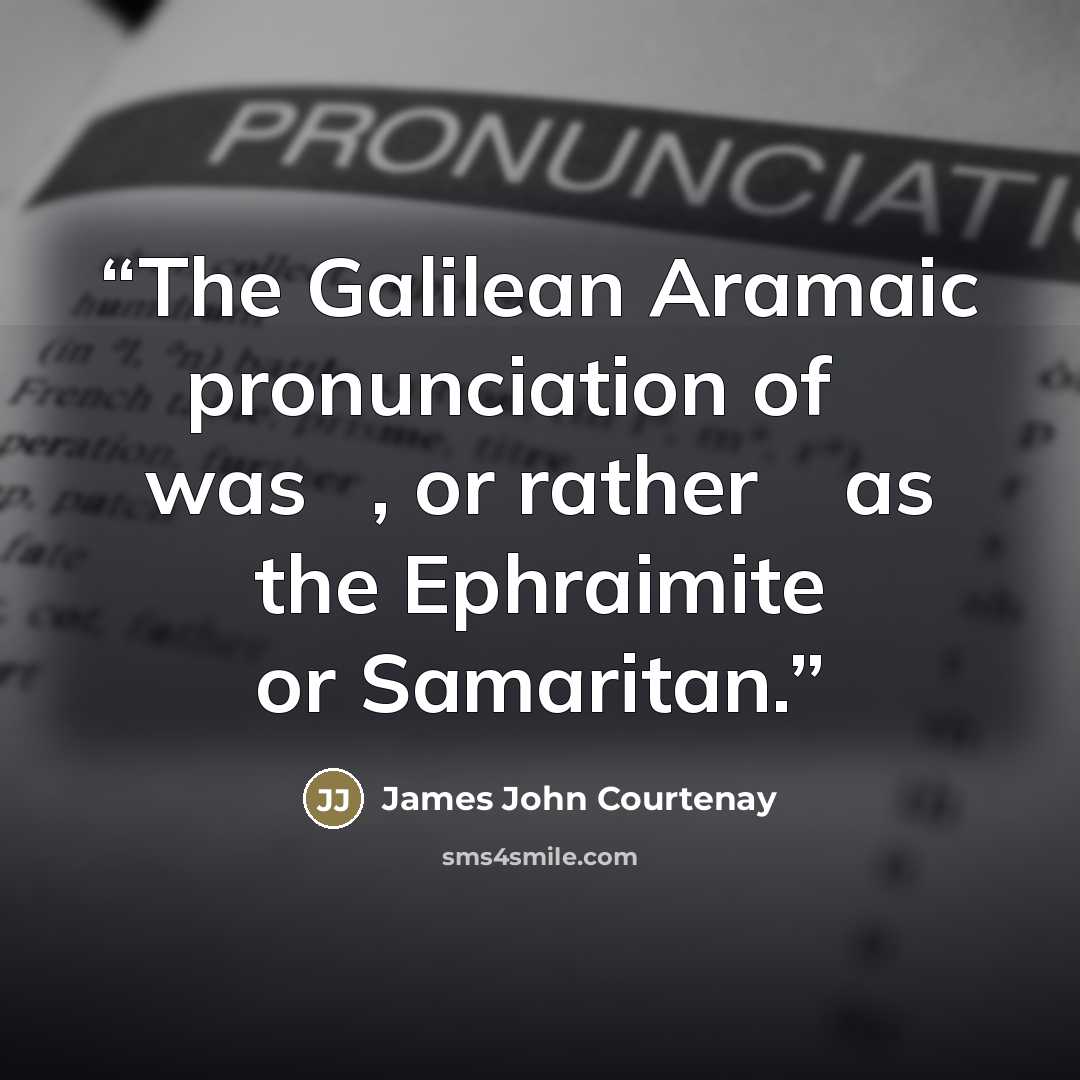
“The Galilean Aramaic pronunciation of שׁ was שׂ, or rather ס as the Ephraimite or Samaritan.” — James John Courtenay Copy Share Image
“With the progress of the Greek arms cam the decline of the Greek language.” — James John Courtenay Copy Share Image
“There have been various attempts to reconstruct the vocalization and pronunciation of classical biblical Hebrew, which certainly differs considerably from that established by the… — Angel Sáenz-Badillos Copy Share Image
When members unite with the church, they should not only make a profession of faith in Christ (that is essential), but in light of… — Jay Adams Copy Share Image
“... before the tenth century Hebrew writing, like Phoenician, was purely consonantal, and it was halfway though the ninth century BCE, under the influence… — Angel Sáenz-Badillos Copy Share Image
“The Arabic language has had a great history, and in many respects is more remarkable than any other Semitic speech.” — James John Courtenay Copy Share Image
The assets of the Jewish National Home must be created exclusively through our own work, for only the product of the Hebrew labor can… — David Ben-Gurion Copy Share Image
All the various component parts of the Hebrew worship subserve this great purpose, the bringing of man into communication with God. — Samson Raphael Hirsch Copy Share Image
“The number of vowel phonemes varies according to the different Masoretic traditions.” — Angel Sáenz-Badillos Copy Share Image
The Nazis played the same games against Jews that today’s left plays against 'Eurocentrism,' 'whiteness,' and 'logocentrism.' When you hear a campus radical denounce… — Anonymous Copy Share Image
Rest in the Lord; wait patiently for Him. In Hebrew, "Be silent in God, and let Him mould thee." Keep still, and He will… — Martin Luther Copy Share Image
In my prayers every day, which are a combination of Hebrew prayers and Shakespeare and Sondheim lyrics and things people have said to me… — Mandy Patinkin Copy Share Image