Matthew, Mark, Luke, and John are a bunch of practical…
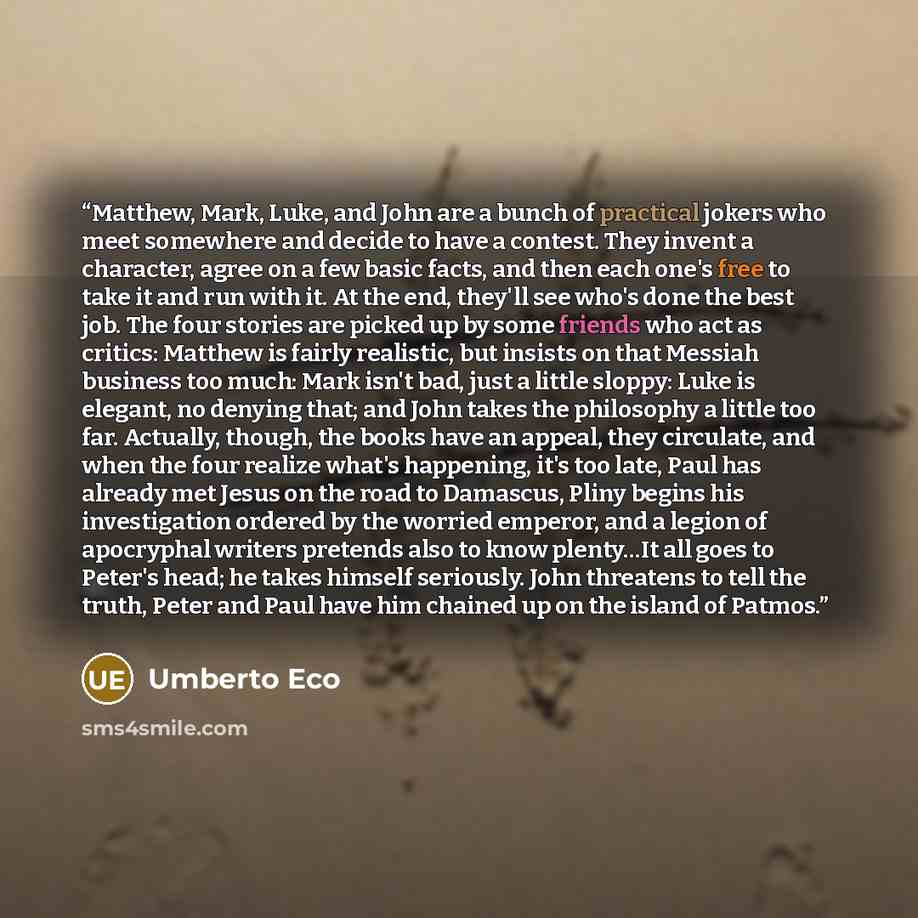
““Matthew, Mark, Luke, and John are a bunch of practical jokers who meet somewhere and decide to have a contest. They invent a character, agree on a few basic facts, and then each one's free to take it and run with it. At the end, they'll see who's done the best job. The four stories are picked up by some friends who act as critics: Matthew is fairly realistic, but insists on that Messiah business too much: Mark isn't bad, just a little sloppy: Luke is elegant, no denying that; and John takes the philosophy a little too far. Actually, though, the books have an appeal, they circulate, and when the four realize what's happening, it's too late, Paul has already met Jesus on the road to Damascus, Pliny begins his investigation ordered by the worried emperor, and a legion of apocryphal writers pretends also to know plenty…It all goes to Peter's head; he takes himself seriously. John threatens to tell the truth, Peter and Paul have him chained up on the island of Patmos.””
About This Quote
This interpretation was drafted with AI assistance. It is one reading of the quote, not the author's own explanation.
The four Gospels are portrayed as competing narratives, each shaped by its author’s perspective, leading to differing portrayals of Jesus and early Christianity.
In simple terms: Four Gospel writers each tell a version of Jesus’s story, reflecting their own biases.
Key Takeaway
Recognize how perspective shapes narrative truth.
Themes
religion
literature
interpretation
history
authority
Mood
thoughtful
critical
inquisitive
Type
philosophical
analytical
When to use this quote
- theological study
- literary analysis
- interfaith dialogue
- educational curricula
Key Concepts
narrative bias
authorial intent
canon formation
Questions to Reflect On
- How does authorial bias affect our understanding of history?
- What are the limits of comparing sacred texts to fictional stories?
A Different Perspective
The analogy oversimplifies complex historical development of early Christianity.