The “rising tide” theory rested on a notion of separate…
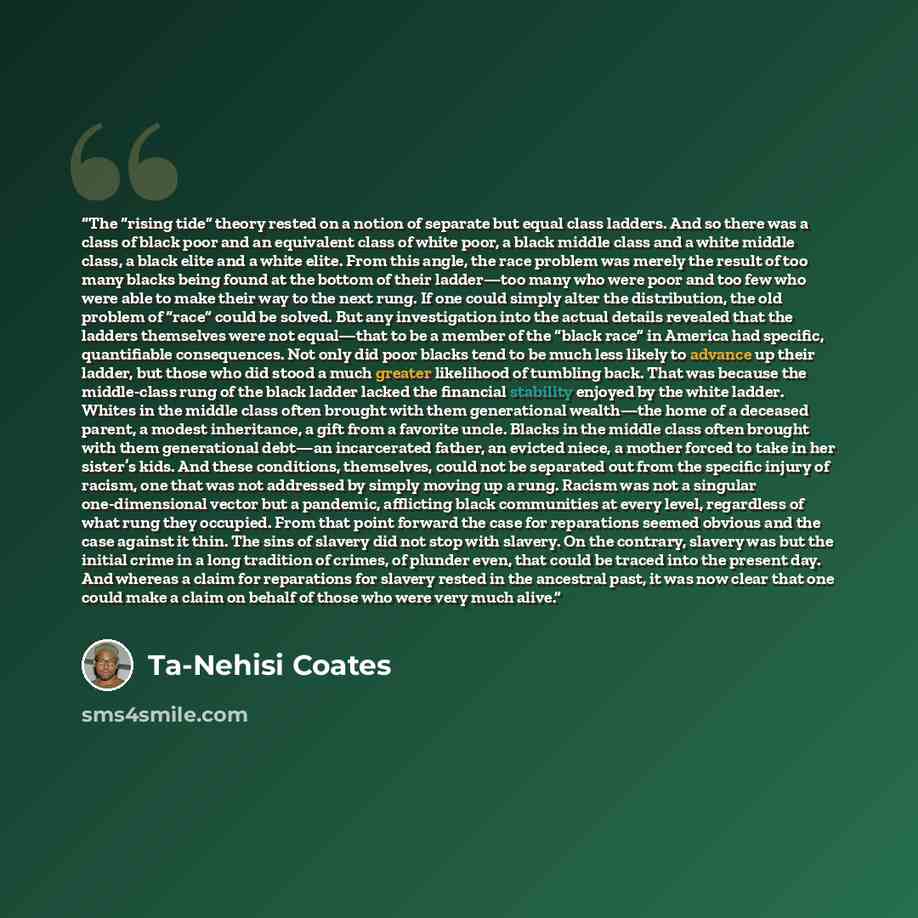
““The “rising tide” theory rested on a notion of separate but equal class ladders. And so there was a class of black poor and an equivalent class of white poor, a black middle class and a white middle class, a black elite and a white elite. From this angle, the race problem was merely the result of too many blacks being found at the bottom of their ladder—too many who were poor and too few who were able to make their way to the next rung. If one could simply alter the distribution, the old problem of “race” could be solved. But any investigation into the actual details revealed that the ladders themselves were not equal—that to be a member of the “black race” in America had specific, quantifiable consequences. Not only did poor blacks tend to be much less likely to advance up their ladder, but those who did stood a much greater likelihood of tumbling back. That was because the middle-class rung of the black ladder lacked the financial stability enjoyed by the white ladder. Whites in the middle class often brought with them generational wealth—the home of a deceased parent, a modest inheritance, a gift from a favorite uncle. Blacks in the middle class often brought with them generational debt—an incarcerated father, an evicted niece, a mother forced to take in her sister’s kids. And these conditions, themselves, could not be separated out from the specific injury of racism, one that was not addressed by simply moving up a rung. Racism was not a singular one-dimensional vector but a pandemic, afflicting black communities at every level, regardless of what rung they occupied. From that point forward the case for reparations seemed obvious and the case against it thin. The sins of slavery did not stop with slavery. On the contrary, slavery was but the initial crime in a long tradition of crimes, of plunder even, that could be traced into the present day. And whereas a claim for reparations for slavery rested in the ancestral past, it was now clear that one could make a claim on behalf of those who were very much alive.””
About This Quote
This interpretation was drafted with AI assistance. It is one reading of the quote, not the author's own explanation.
The quote argues that racial inequality cannot be fixed by merely improving economic status because systemic racism creates unequal ladders and generational burdens that persist across all social levels.
In simple terms: Economic uplift alone won’t erase deep, structural racism.
Key Takeaway
Address systemic barriers, not just income gaps.
Themes
inequality
systemic racism
generational wealth
reparations
social justice
Mood
critical
reflective
urgent
Type
analytical
inspirational
policy‑oriented
When to use this quote
- Housing policy
- education reform
- criminal justice reform
- wealth building programs
Key Concepts
Structural inequality
intergenerational trauma
economic mobility
policy reform
Questions to Reflect On
- How can policies target structural racism beyond income?
- What role does generational debt play in current disparities?
A Different Perspective
Raising income without dismantling discriminatory structures may reinforce inequities.