The educational environment of children should encourage…
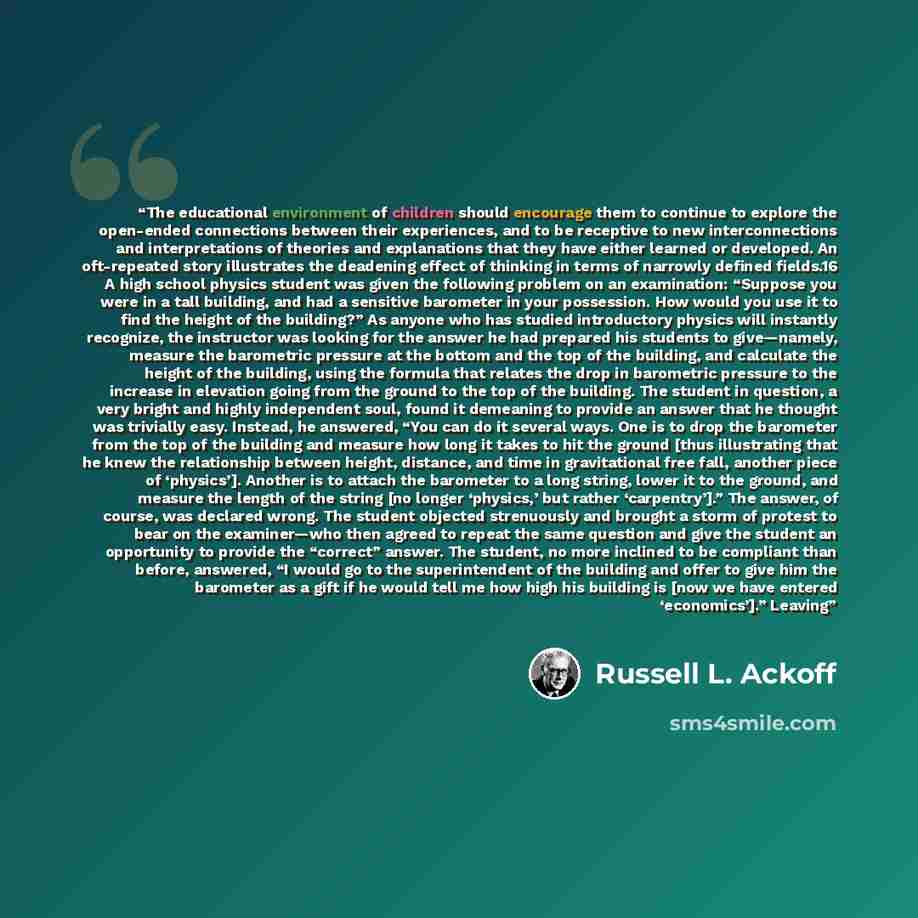
““The educational environment of children should encourage them to continue to explore the open-ended connections between their experiences, and to be receptive to new interconnections and interpretations of theories and explanations that they have either learned or developed. An oft-repeated story illustrates the deadening effect of thinking in terms of narrowly defined fields.16 A high school physics student was given the following problem on an examination: “Suppose you were in a tall building, and had a sensitive barometer in your possession. How would you use it to find the height of the building?” As anyone who has studied introductory physics will instantly recognize, the instructor was looking for the answer he had prepared his students to give—namely, measure the barometric pressure at the bottom and the top of the building, and calculate the height of the building, using the formula that relates the drop in barometric pressure to the increase in elevation going from the ground to the top of the building. The student in question, a very bright and highly independent soul, found it demeaning to provide an answer that he thought was trivially easy. Instead, he answered, “You can do it several ways. One is to drop the barometer from the top of the building and measure how long it takes to hit the ground [thus illustrating that he knew the relationship between height, distance, and time in gravitational free fall, another piece of ‘physics’]. Another is to attach the barometer to a long string, lower it to the ground, and measure the length of the string [no longer ‘physics,’ but rather ‘carpentry’].” The answer, of course, was declared wrong. The student objected strenuously and brought a storm of protest to bear on the examiner—who then agreed to repeat the same question and give the student an opportunity to provide the “correct” answer. The student, no more inclined to be compliant than before, answered, “I would go to the superintendent of the building and offer to give him the barometer as a gift if he would tell me how high his building is [now we have entered ‘economics’].” Leaving””
About This Quote
This interpretation was drafted with AI assistance. It is one reading of the quote, not the author's own explanation.
Ackoff critiques rigid problem‑solving in education, urging openness to multiple methods and creative thinking beyond textbook answers.
In simple terms: Encourage flexible, creative problem solving.
Key Takeaway
Value diverse approaches over single correct answers.
Themes
education
creativity
critical thinking
problem solving
disciplinary boundaries
Mood
reflective
motivational
Type
educational
philosophical
When to use this quote
- classroom teaching
- curriculum design
- student projects
- interdisciplinary research
Key Concepts
constructivism
innovation
systems thinking
Questions to Reflect On
- What alternative method would you apply to a familiar problem?
- How can you balance creativity with accuracy?
A Different Perspective
Some contexts demand precise, standard solutions.