We saw in the discussion of the law of small numbers that…
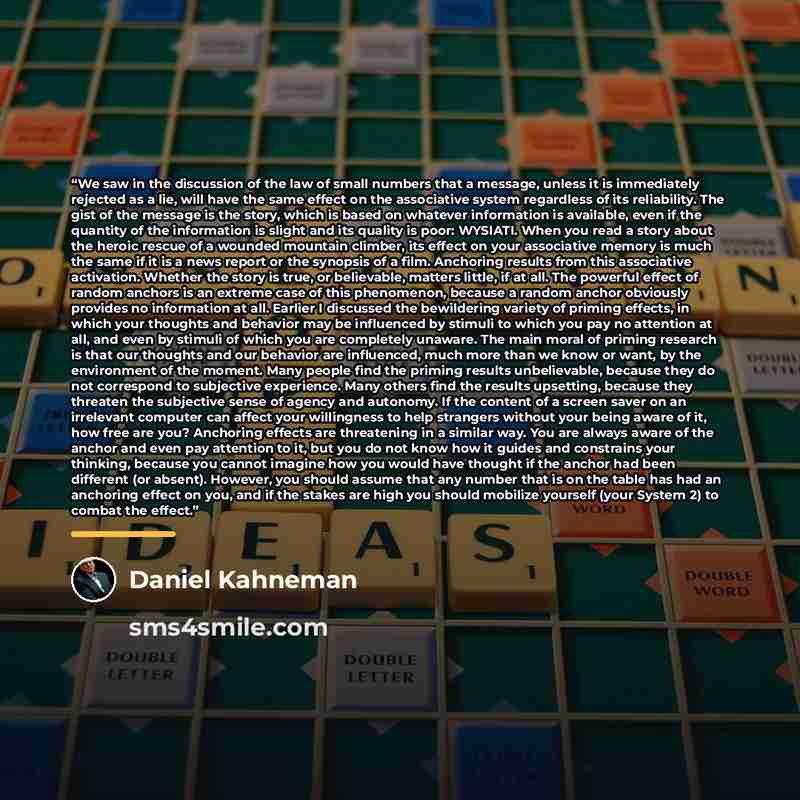
““We saw in the discussion of the law of small numbers that a message, unless it is immediately rejected as a lie, will have the same effect on the associative system regardless of its reliability. The gist of the message is the story, which is based on whatever information is available, even if the quantity of the information is slight and its quality is poor: WYSIATI. When you read a story about the heroic rescue of a wounded mountain climber, its effect on your associative memory is much the same if it is a news report or the synopsis of a film. Anchoring results from this associative activation. Whether the story is true, or believable, matters little, if at all. The powerful effect of random anchors is an extreme case of this phenomenon, because a random anchor obviously provides no information at all. Earlier I discussed the bewildering variety of priming effects, in which your thoughts and behavior may be influenced by stimuli to which you pay no attention at all, and even by stimuli of which you are completely unaware. The main moral of priming research is that our thoughts and our behavior are influenced, much more than we know or want, by the environment of the moment. Many people find the priming results unbelievable, because they do not correspond to subjective experience. Many others find the results upsetting, because they threaten the subjective sense of agency and autonomy. If the content of a screen saver on an irrelevant computer can affect your willingness to help strangers without your being aware of it, how free are you? Anchoring effects are threatening in a similar way. You are always aware of the anchor and even pay attention to it, but you do not know how it guides and constrains your thinking, because you cannot imagine how you would have thought if the anchor had been different (or absent). However, you should assume that any number that is on the table has had an anchoring effect on you, and if the stakes are high you should mobilize yourself (your System 2) to combat the effect.””
About This Quote
This interpretation was drafted with AI assistance. It is one reading of the quote, not the author's own explanation.
Describes how brief, often ignored information (anchors) shapes thoughts and actions more than we realize.
In simple terms: Small cues heavily influence our decisions.
Key Takeaway
Recognize and question hidden cues.
Themes
cognition
bias
decision‑making
priming
anchoring
Mood
analytical
cautious
Type
educational
psychological
When to use this quote
- marketing
- legal judgments
- personal relationships
- policy design
Key Concepts
heuristics
environmental influence
memory
agency
Questions to Reflect On
- What unnoticed cues affect your daily choices?
- How can you protect your autonomy from subtle influences?
A Different Perspective
Anchors can be manipulated, leading to unethical influence.