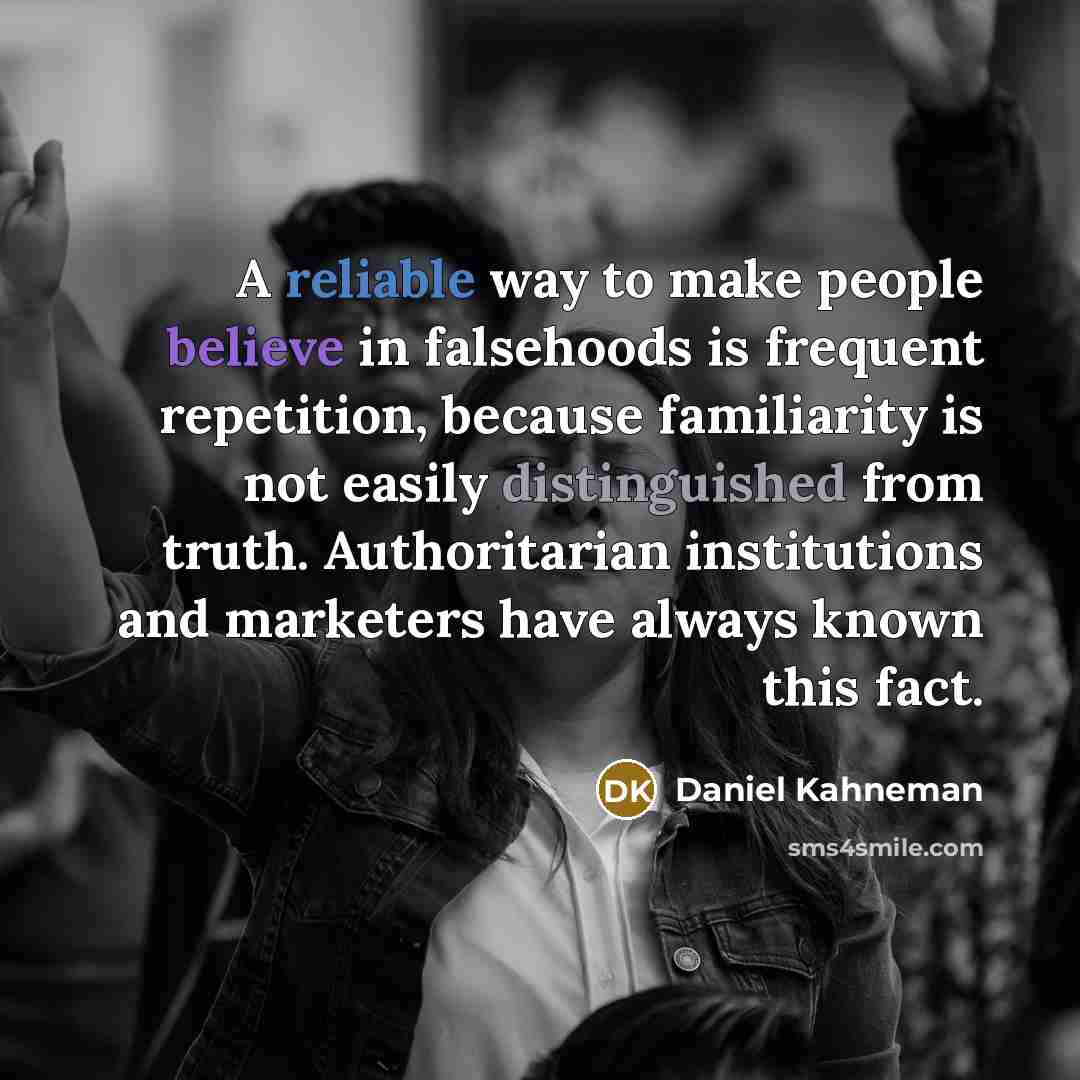
A reliable way to make people believe in falsehoods is frequent repetition, because familiarity is not easily distinguished from truth. Authoritarian institutions… — Daniel Kahneman Copy Share Image
People are very complex. And for a psychologist, you get fascinated by the complexity of human beings, and that is what I… — Daniel Kahneman Copy Share Image
Negotiations over a shrinking pie are especially difficult because they require an allocation of losses. People tend to be much more easygoing… — Daniel Kahneman Copy Share Image
Intuitive diagnosis is reliable when people have a lot of relevant feedback. But people are very often willing to make intuitive diagnoses… — Daniel Kahneman Copy Share Image
The confidence people have in their beliefs is not a measure of the quality of evidence but of the coherence of the… — Daniel Kahneman Copy Share Image
To better avoid errors, you should talk to people who disagree with you and you should talk to people who are not… — Daniel Kahneman Copy Share Image
I think one of the major results of the psychology of decision making is that people's attitudes and feelings about losses and… — Daniel Kahneman Copy Share Image
“people believe a conclusion is true, they are also very likely to believe arguments that appear to support it, even when these… — Daniel Kahneman Copy Share Image
People like leaders who look like they are dominant, optimistic, friendly to their friends, and quick on the trigger when it comes… — Daniel Kahneman Copy Share Image
My interest in well-being evolved from my interest in decision making - from raising the question of whether people know what they… — Daniel Kahneman Copy Share Image
There is research on the effects of 9/11, and you know, compared to the enormity of it, it didn't have a huge… — Daniel Kahneman Copy Share Image
People should be conscious of the large contribution made by anything that gets people together easily in the reduction of loneliness and… — Daniel Kahneman Copy Share Image
There is a huge wave of interest in happiness among researchers. There is a lot of happiness coaching. Everybody would like to… — Daniel Kahneman Copy Share Image
People just hate the idea of losing. Any loss, even a small one, is just so terrible to contemplate that they compensate… — Daniel Kahneman Copy Share Image
We're not aware of changing our minds even when we do change our minds. And most people, after they change their minds,… — Daniel Kahneman Copy Share Image
One emphasis of my research has been on the question of how people spend their time. Time is the ultimate finite resource,… — Daniel Kahneman Copy Share Image
Below an income of ... $60,000 a year, people are unhappy, and they get progressively unhappier the poorer they get. Above that,… — Daniel Kahneman Copy Share Image
Many people will admit that they made a mistake [putting money in dot-coms or telecoms at their peak] But that doesn’t mean… — Daniel Kahneman Copy Share Image
There's a very good reason for why economics developed the way it did, and that is that in many situations, the assumption… — Daniel Kahneman Copy Share Image
We associate leadership with decisiveness. That perception of leadership pushes people to make decisions fairly quickly, lest they be seen as dithering… — Daniel Kahneman Copy Share Image
People who know math understand what other mortals understand, but other mortals do not understand them. This asymmetry gives them a presumption… — Daniel Kahneman Copy Share Image
Facts that challenge basic assumptions-and thereby threaten people's livelihood and self-esteem-are simply not absorbed. The mind does not digest them. — Daniel Kahneman Copy Share Image
Most successful pundits are selected for being opinionated, because it's interesting, and the penalties for incorrect predictions are negligible. You can make… — Daniel Kahneman Copy Share Image
People exaggerate their confidence in their plans - something we call the planning fallacy... The existence of the plan tends to induce… — Daniel Kahneman Copy Share Image
Economists think about what people ought to do. Psychologists watch what they actually do. — Daniel Kahneman Copy Share
“People who are poor think like traders, but the dynamics are quite different. Unlike traders, the poor are not indifferent to the differences between… — Daniel Kahneman Copy Share
“Mood evidently affects the operation of System 1: when we are uncomfortable and unhappy, we lose touch with our intuition.” — Daniel Kahneman Copy Share
The confidence that individuals have in their beliefs depends mostly on the quality of the story they can tell about what they see, even… — Daniel Kahneman Copy Share
“So this is my aim for watercooler conversations: improve the ability to identify and understand errors of judgment and choice, in others and eventually… — Daniel Kahneman Copy Share
“For example, I recently came to doubt my long-held impression that adultery is more common among politicians than among physicians or lawyers.” — Daniel Kahneman Copy Share
Survival prospects are poor for an animal that is not suspicious of novelty. — Daniel Kahneman Copy Share
“the idea of money primes individualism: a reluctance to be involved with others, to depend on others, or to accept demands from others.” — Daniel Kahneman Copy Share
Most of the moments of our life - and I calculated, you know, the psychological present is said to be about three seconds long;… — Daniel Kahneman Copy Share
“knowing little makes it easier to fit everything you know into a coherent pattern.” — Daniel Kahneman Copy Share
“The best we can do is a compromise: learn to recognize situations in which mistakes are likely and try harder to avoid significant mistakes… — Daniel Kahneman Copy Share
“A happy mood loosens the control of System 2 over performance: when in a good mood, people become more intuitive and more creative but… — Daniel Kahneman Copy Share
![“Many people will admit that they made a mistake [putting money in dot-coms or telecoms at their peak] But that doesn’t mean that they’ve changed their mind about anything in particular. It doesn’t mean that they are now able to avoid that mistake.” quote by Daniel Kahneman](https://sms4smile.com/q/img-quotes/725/daniel-kahneman-431_able_many-people-will-admit-that-they-made-a_2199209.jpg)