Faith Quote by William James
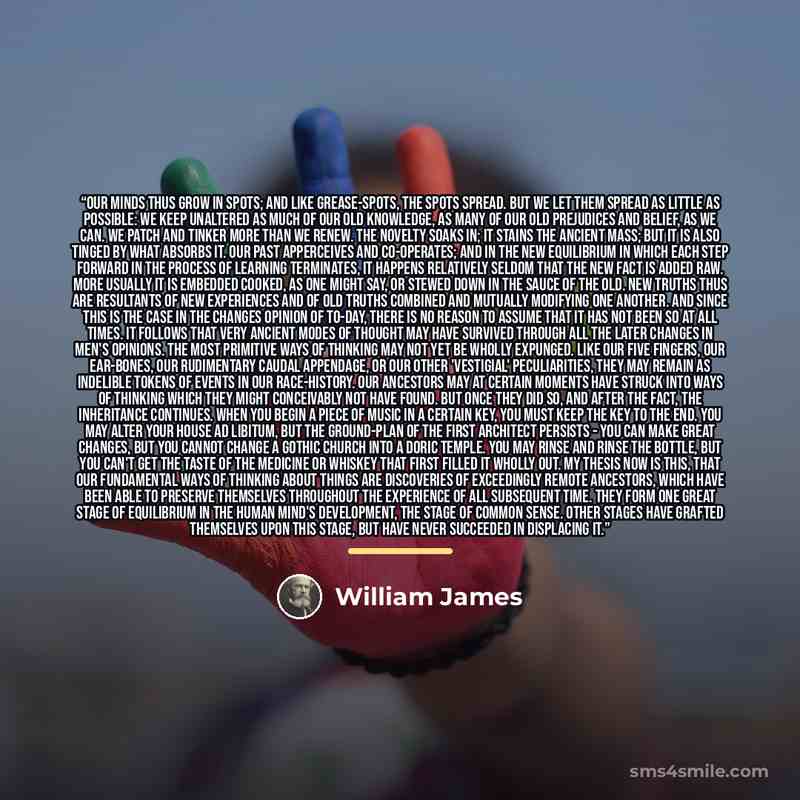
““Our minds thus grow in spots; and like grease-spots, the spots spread. But we let them spread as little as possible: we keep unaltered as much of our old knowledge, as many of our old prejudices and belief, as we can. We patch and tinker more than we renew. The novelty soaks in; it stains the ancient mass; but it is also tinged by what absorbs it. Our past apperceives and co-operates; and in the new equilibrium in which each step forward in the process of learning terminates, it happens relatively seldom that the new fact is added raw. More usually it is embedded cooked, as one might say, or stewed down in the sauce of the old. New truths thus are resultants of new experiences and of old truths combined and mutually modifying one another. And since this is the case in the changes opinion of to-day, there is no reason to assume that it has not been so at all times. It follows that very ancient modes of thought may have survived through all the later changes in men's opinions. The most primitive ways of thinking may not yet be wholly expunged. Like our five fingers, our ear-bones, our rudimentary caudal appendage, or our other 'vestigial' peculiarities, they may remain as indelible tokens of events in our race-history. Our ancestors may at certain moments have struck into ways of thinking which they might conceivably not have found. But once they did so, and after the fact, the inheritance continues. When you begin a piece of music in a certain key, you must keep the key to the end. You may alter your house ad libitum, but the ground-plan of the first architect persists - you can make great changes, but you cannot change a Gothic church into a Doric temple. You may rinse and rinse the bottle, but you can't get the taste of the medicine or whiskey that first filled it wholly out. My thesis now is this, that our fundamental ways of thinking about things are discoveries of exceedingly remote ancestors, which have been able to preserve themselves throughout the experience of all subsequent time. They form one great stage of equilibrium in the human mind's development, the stage of common sense. Other stages have grafted themselves upon this stage, but have never succeeded in displacing it.””
About This Quote
Human cognition builds on existing mental structures, integrating new information into entrenched frameworks rather than replacing them outright.
In simple terms: Ideas evolve incrementally, not by sudden overhaul.
Key Takeaway
Old beliefs shape how new facts are understood.
Themes
cognitive continuity
cultural inheritance
knowledge integration
psychological inertia
historical persistence
Mood
reflective
analytical
skeptical
Type
philosophical
observational
When to use this quote
- teaching complex concepts
- revising organizational policies
- adapting scientific theories
- personal belief revision
Key Concepts
mental models
learning processes
cognitive bias
cultural evolution
Practical Applications
- designing curricula that link new material to prior knowledge
- crafting change-management strategies that respect existing mindsets
Questions to Reflect On
- How do entrenched beliefs limit innovation?
- In what ways can we deliberately reshape foundational assumptions?
A Different Perspective
Some breakthroughs fundamentally overturn previous paradigms, showing that not all knowledge is merely a layered accumulation.