Abuse Quote by Warwick Middleton
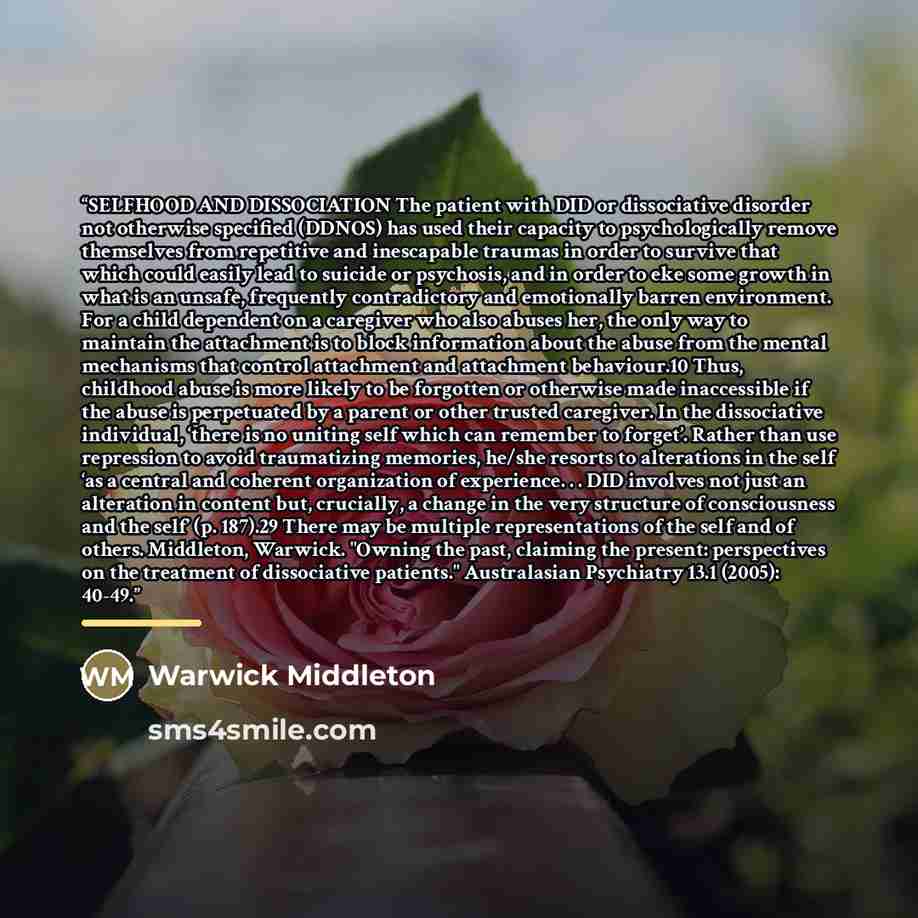
““SELFHOOD AND DISSOCIATION The patient with DID or dissociative disorder not otherwise specified (DDNOS) has used their capacity to psychologically remove themselves from repetitive and inescapable traumas in order to survive that which could easily lead to suicide or psychosis, and in order to eke some growth in what is an unsafe, frequently contradictory and emotionally barren environment. For a child dependent on a caregiver who also abuses her, the only way to maintain the attachment is to block information about the abuse from the mental mechanisms that control attachment and attachment behaviour.10 Thus, childhood abuse is more likely to be forgotten or otherwise made inaccessible if the abuse is perpetuated by a parent or other trusted caregiver. In the dissociative individual, ‘there is no uniting self which can remember to forget’. Rather than use repression to avoid traumatizing memories, he/she resorts to alterations in the self ‘as a central and coherent organization of experience. . . DID involves not just an alteration in content but, crucially, a change in the very structure of consciousness and the self’ (p. 187).29 There may be multiple representations of the self and of others. Middleton, Warwick. "Owning the past, claiming the present: perspectives on the treatment of dissociative patients." Australasian Psychiatry 13.1 (2005): 40-49.””
About This Quote
Source Journal Article: “Owning the past, claiming the present”, Australasian Psychiatry, 2005
Dissociative identity disorder lets individuals detach from trauma, altering self‑structure to survive, but may hinder integration.
In simple terms: DID splits consciousness to cope with abuse, changing how the self is organized.
Key Takeaway
Recognize dissociation as a survival strategy, not just pathology.
Themes
trauma
identity
survival
psychology
Mood
empathetic
analytical
Type
clinical
educational
When to use this quote
- therapy sessions
- clinical assessment
- support groups
- educational seminars
Key Concepts
self‑integration
memory repression
attachment theory
Questions to Reflect On
- What safe methods support reintegration?
- How can caregivers avoid reinforcing dissociation?
A Different Perspective
Therapeutic integration can be painful and may trigger distress.
![“Sadly, psychiatric training still includes far too little on the very serious psychiatric sequelae of childhood trauma, especially CSA [child sexual abuse]. There is inadequate recognition within mental health services of the prevalence and importance of Dissociative Disorders, sufferers of which…” quote by Joan Coleman](https://sms4smile.com/quotes/img-quotes/b8c/joan-coleman-72352_borderline-personali_sadly-psychiatric-training-still-include_2412907.jpg)