Habits Quote by Walter Lippmann
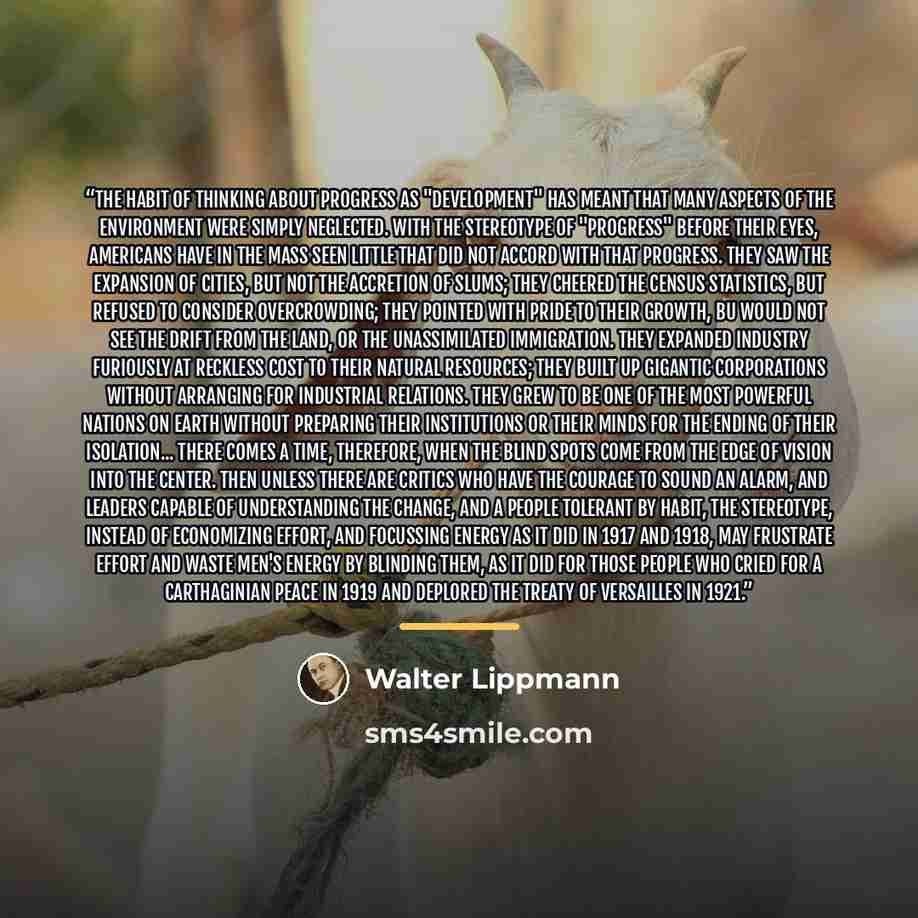
““The habit of thinking about progress as "development" has meant that many aspects of the environment were simply neglected. With the stereotype of "progress" before their eyes, Americans have in the mass seen little that did not accord with that progress. They saw the expansion of cities, but not the accretion of slums; they cheered the census statistics, but refused to consider overcrowding; they pointed with pride to their growth, bu would not see the drift from the land, or the unassimilated immigration. They expanded industry furiously at reckless cost to their natural resources; they built up gigantic corporations without arranging for industrial relations. They grew to be one of the most powerful nations on earth without preparing their institutions or their minds for the ending of their isolation... There comes a time, therefore, when the blind spots come from the edge of vision into the center. Then unless there are critics who have the courage to sound an alarm, and leaders capable of understanding the change, and a people tolerant by habit, the stereotype, instead of economizing effort, and focussing energy as it did in 1917 and 1918, may frustrate effort and waste men's energy by blinding them, as it did for those people who cried for a Carthaginian peace in 1919 and deplored the Treaty of Versailles in 1921.””
About This Quote
Source Essay: The Myth of Progress, 1925
Societal focus on economic development blinds us to environmental and social costs, requiring critical voices and adaptive leadership.
In simple terms: Progress can hide negative impacts.
Key Takeaway
Cultivate critical awareness of growth.
Themes
progress
environment
society
criticism
leadership
history
Mood
cautionary
reflective
Type
analytical
philosophical
When to use this quote
- policy making
- urban planning
- environmental advocacy
- public discourse
Key Concepts
developmental myopia
institutional blind spots
social responsibility
Questions to Reflect On
- Who should challenge prevailing narratives of progress?
- How can societies integrate environmental safeguards into development?
A Different Perspective
Economic growth alone cannot sustain long‑term wellbeing.