Artist Quote by Walter Isaacson
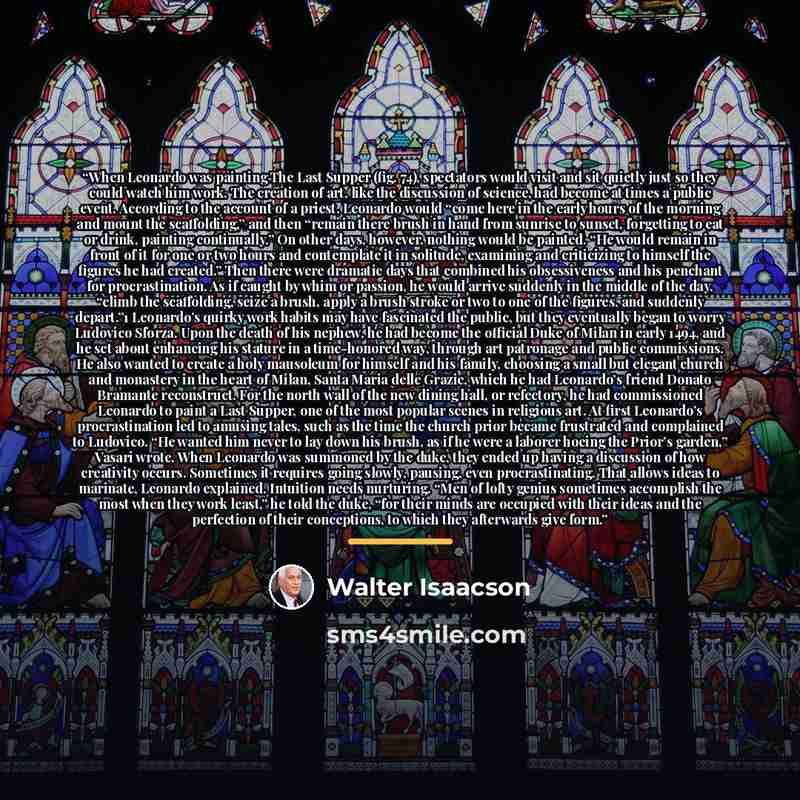
““When Leonardo was painting The Last Supper (fig. 74), spectators would visit and sit quietly just so they could watch him work. The creation of art, like the discussion of science, had become at times a public event. According to the account of a priest, Leonardo would “come here in the early hours of the morning and mount the scaffolding,” and then “remain there brush in hand from sunrise to sunset, forgetting to eat or drink, painting continually.” On other days, however, nothing would be painted. “He would remain in front of it for one or two hours and contemplate it in solitude, examining and criticizing to himself the figures he had created.” Then there were dramatic days that combined his obsessiveness and his penchant for procrastination. As if caught by whim or passion, he would arrive suddenly in the middle of the day, “climb the scaffolding, seize a brush, apply a brush stroke or two to one of the figures, and suddenly depart.”1 Leonardo’s quirky work habits may have fascinated the public, but they eventually began to worry Ludovico Sforza. Upon the death of his nephew, he had become the official Duke of Milan in early 1494, and he set about enhancing his stature in a time-honored way, through art patronage and public commissions. He also wanted to create a holy mausoleum for himself and his family, choosing a small but elegant church and monastery in the heart of Milan, Santa Maria delle Grazie, which he had Leonardo’s friend Donato Bramante reconstruct. For the north wall of the new dining hall, or refectory, he had commissioned Leonardo to paint a Last Supper, one of the most popular scenes in religious art. At first Leonardo’s procrastination led to amusing tales, such as the time the church prior became frustrated and complained to Ludovico. “He wanted him never to lay down his brush, as if he were a laborer hoeing the Prior’s garden,” Vasari wrote. When Leonardo was summoned by the duke, they ended up having a discussion of how creativity occurs. Sometimes it requires going slowly, pausing, even procrastinating. That allows ideas to marinate, Leonardo explained. Intuition needs nurturing. “Men of lofty genius sometimes accomplish the most when they work least,” he told the duke, “for their minds are occupied with their ideas and the perfection of their conceptions, to which they afterwards give form.””
About This Quote
Source Book: Leonardo da Vinci, by Walter Isaacson, 2017
Leonardo’s work habits swung between intense focus and idle contemplation, showing that creativity can be both disciplined and erratic.
In simple terms: His art was made by long, varied work patterns.
Key Takeaway
Balance deep focus with occasional breaks.
Themes
creativity
work habits
discipline
procrastination
public art
Mood
reflective
inquisitive
Type
observational
historical
inspirational
When to use this quote
- artist studios
- public commissions
- patronage discussions
- creative blocks
Key Concepts
flow state
mindful observation
creative bursts
Questions to Reflect On
- How do you manage periods of high focus and low output?
- What rituals help you sustain creative momentum?
A Different Perspective
Even intense focus can stall progress without structure.