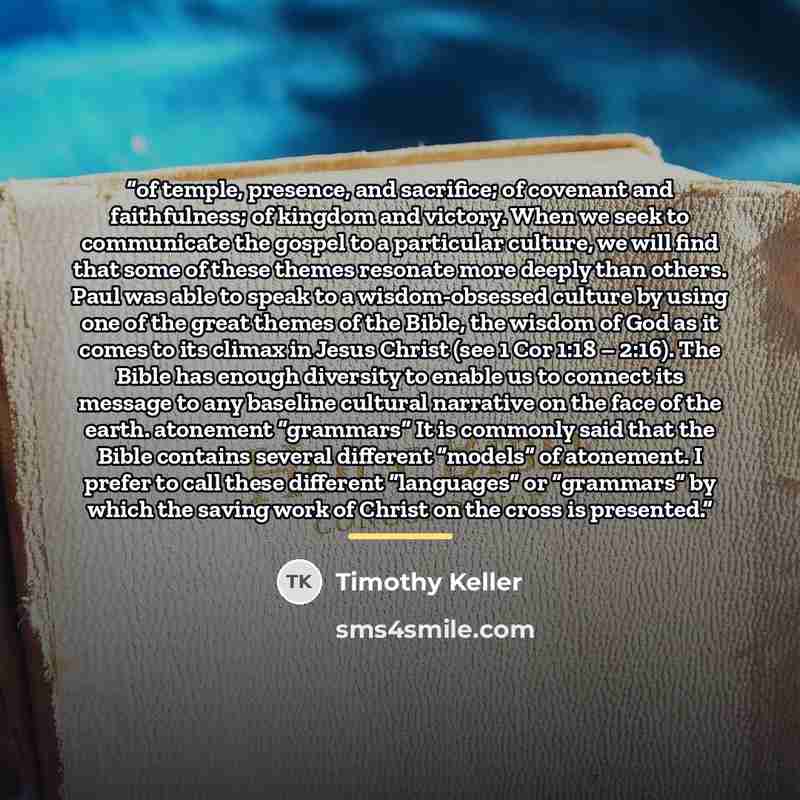
““battlefield. Christ fought against the powers of sin and death for us. He defeated the powers of evil for us. 2. The language of the marketplace. Christ paid the ransom price, the purchase price, to buy us out of our indebtedness. He frees us from enslavement. 3. The language of exile. Christ was exiled and cast out of the community so we who deserve to be banished could be brought in. He brings us home. 4. The language of the temple. Christ is the sacrifice that purifies us and makes us acceptable to draw near to the holy God. He makes us clean and beautiful. 5. The language of the law court. Christ stands before the judge and takes the punishment we deserve. He removes our guilt and makes us righteous. It is sometimes implied we can choose which of these models we prefer and ignore the others, but this is misleading. Each way of communicating the atonement reflects a piece of inspired Scripture, and each tells us great things about our salvation that the others do not bring out as clearly. Each will have special resonance with certain temperaments and cultures. People who are fighting oppression or even enslavement and long for freedom will be helped by the first two grammars (the battlefield and the marketplace). People seeking relief for guilt and a sense of shame will be especially moved by the last two — the temple and the law court. People who feel alienated, rootless, and rejected will find the exile grammar intensely engaging. But perhaps the single most consoling and appealing theme is what theologian Roger Nicole has called the one, irreducible theme that runs through every single one of these models — the idea of substitution.28 Dr. Nicole taught that, regardless of the grammar being used, the essence of the atonement is always Jesus acting as our substitute. Jesus fights the powers, pays the price, bears the exile, makes the sacrifice, and bears the punishment for us, in our place, on our behalf. In every grammar, Jesus does for us what we cannot do for ourselves. He accomplishes salvation; we do nothing at all. And therefore the substitutionary sacrifice of Jesus is at the heart of everything. This act — giving one’s life””





![“24 A few pages later, Delbanco writes the following: [Alexis de] Tocqueville’s detection of a “strange melancholy in the midst of abundance” has a special salience today — because while we have gotten very good at deconstructing old stories (the religion that was the subject of my first chapter…” quote by Timothy Keller](https://sms4smile.com/quotes/img-quotes/85a/timothy-keller-240_sad_24-a-few-pages-later-delbanco-writes-the_25320.jpg)