Death Quote by Thomas Pynchon
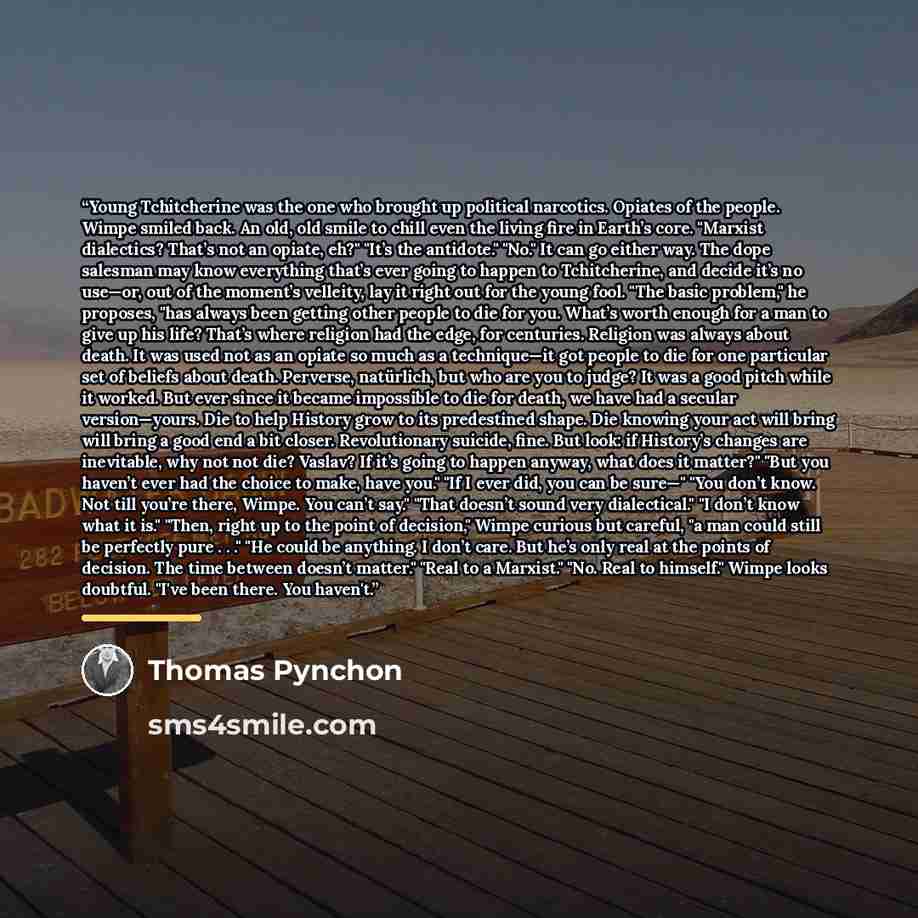
““Young Tchitcherine was the one who brought up political narcotics. Opiates of the people. Wimpe smiled back. An old, old smile to chill even the living fire in Earth’s core. "Marxist dialectics? That’s not an opiate, eh?" "It’s the antidote." "No." It can go either way. The dope salesman may know everything that’s ever going to happen to Tchitcherine, and decide it’s no use—or, out of the moment’s velleity, lay it right out for the young fool. "The basic problem," he proposes, "has always been getting other people to die for you. What’s worth enough for a man to give up his life? That’s where religion had the edge, for centuries. Religion was always about death. It was used not as an opiate so much as a technique—it got people to die for one particular set of beliefs about death. Perverse, natürlich, but who are you to judge? It was a good pitch while it worked. But ever since it became impossible to die for death, we have had a secular version—yours. Die to help History grow to its predestined shape. Die knowing your act will bring will bring a good end a bit closer. Revolutionary suicide, fine. But look: if History’s changes are inevitable, why not not die? Vaslav? If it’s going to happen anyway, what does it matter?" "But you haven’t ever had the choice to make, have you." "If I ever did, you can be sure—" "You don’t know. Not till you’re there, Wimpe. You can’t say." "That doesn’t sound very dialectical." "I don’t know what it is." "Then, right up to the point of decision," Wimpe curious but careful, "a man could still be perfectly pure . . ." "He could be anything. I don’t care. But he’s only real at the points of decision. The time between doesn’t matter." "Real to a Marxist." "No. Real to himself." Wimpe looks doubtful. "I've been there. You haven't.””
About This Quote
Source Novel: Gravity's Rainbow, 1973
Religion and ideology act as opiates, promising meaning but also demanding sacrifice; the line between belief and manipulation blurs.
In simple terms: Beliefs can both comfort and control.
Key Takeaway
Question the motives behind your convictions.
Themes
belief
sacrifice
power
history
Mood
skeptical
provocative
Type
literary
philosophical
When to use this quote
- political activism
- religious practice
- personal moral decisions
Key Concepts
ideology
opiate
revolutionary
existential
Questions to Reflect On
- What beliefs do you accept without scrutiny?
- How can one balance commitment with critical thought?
A Different Perspective
Blind devotion can lead to self-destruction.