Abraham Quote by Steven Pinker
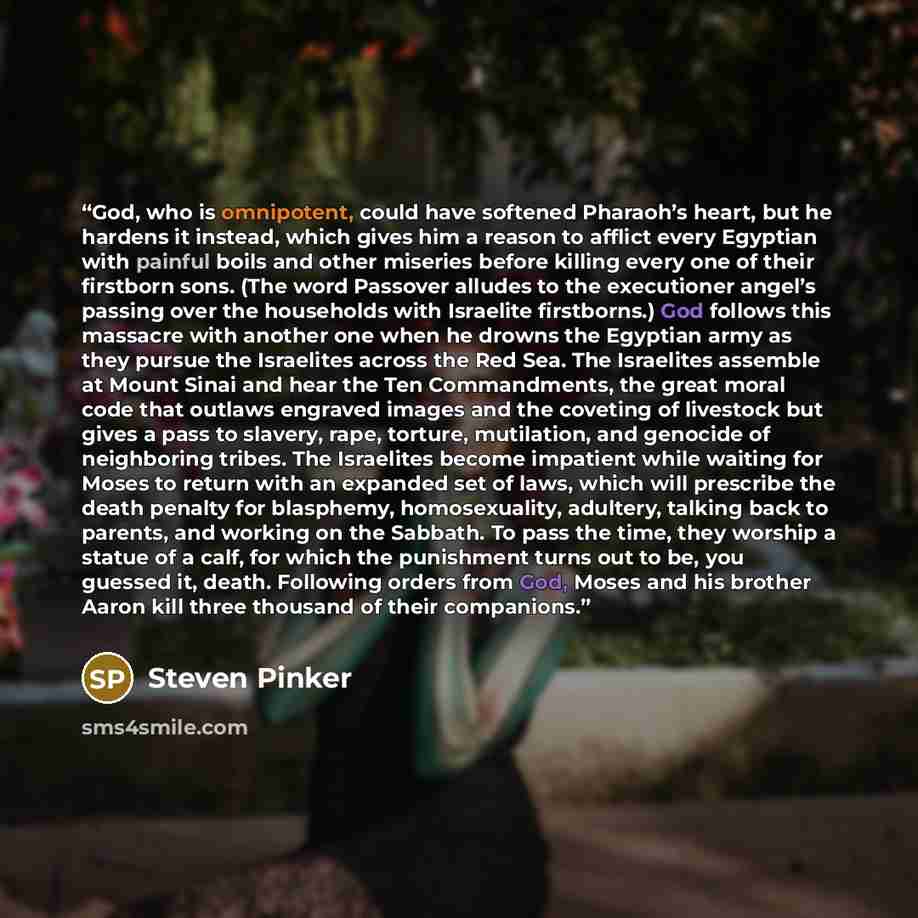
““God, who is omnipotent, could have softened Pharaoh’s heart, but he hardens it instead, which gives him a reason to afflict every Egyptian with painful boils and other miseries before killing every one of their firstborn sons. (The word Passover alludes to the executioner angel’s passing over the households with Israelite firstborns.) God follows this massacre with another one when he drowns the Egyptian army as they pursue the Israelites across the Red Sea. The Israelites assemble at Mount Sinai and hear the Ten Commandments, the great moral code that outlaws engraved images and the coveting of livestock but gives a pass to slavery, rape, torture, mutilation, and genocide of neighboring tribes. The Israelites become impatient while waiting for Moses to return with an expanded set of laws, which will prescribe the death penalty for blasphemy, homosexuality, adultery, talking back to parents, and working on the Sabbath. To pass the time, they worship a statue of a calf, for which the punishment turns out to be, you guessed it, death. Following orders from God, Moses and his brother Aaron kill three thousand of their companions.””
About This Quote
Source Book: The Better Angels of Our Nature by Steven Pinker, 2011
The passage critiques how religious narratives can justify extreme violence and moral contradictions, highlighting the tension between divine authority and ethical standards.
In simple terms: Religious stories often justify harsh actions and moral inconsistencies.
Key Takeaway
Question the moral claims of authority.
Themes
religion
violence
ethics
Mood
critical
reflective
Type
analytical
philosophical
historical
When to use this quote
- theological study
- ethical debates
- historical analysis
- interfaith dialogue
- legal reform
Key Concepts
theodicy
moral relativism
authority
scriptural interpretation
Questions to Reflect On
- How do we reconcile faith with modern human rights?
- What role should historical context play in interpreting sacred texts?
A Different Perspective
Religious texts are interpreted in diverse ways, not always leading to violence.

![“Donald Trump is not going to be the nominee, because we are not going to allow - people will wake up and we're not going to allow a con artist to take over the party of [Abraham] Lincoln and [Ronald] Reagan.” quote by Marco Rubio](https://sms4smile.com/quotes/img-quotes/c6a/marco-rubio-355_abraham_donald-trump-is-not-going-to-be-the-nomi_14750.jpg)