Discovery Quote by Stephen Jay Gould
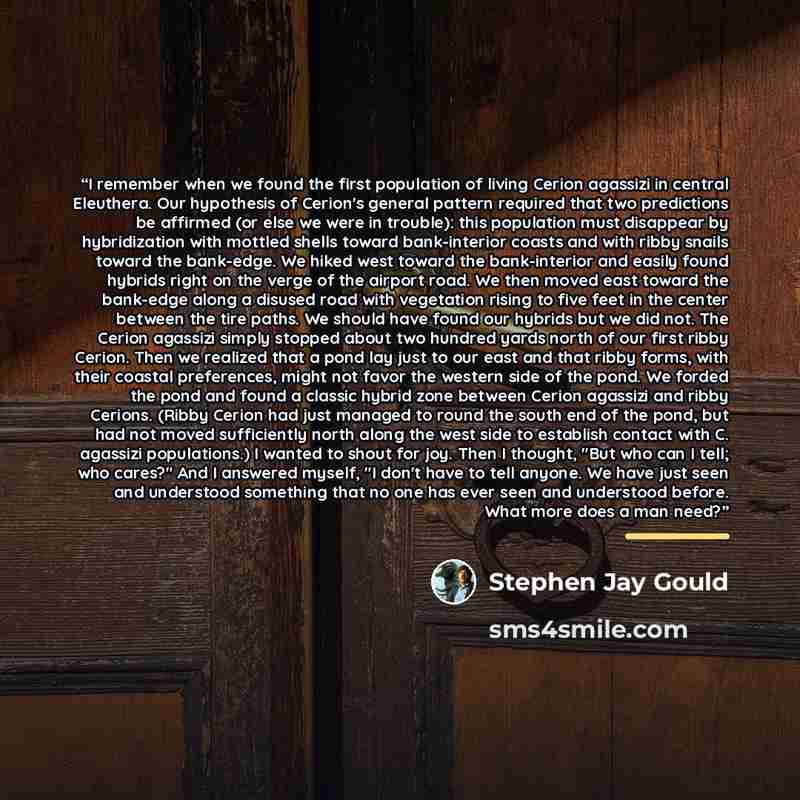
““I remember when we found the first population of living Cerion agassizi in central Eleuthera. Our hypothesis of Cerion's general pattern required that two predictions be affirmed (or else we were in trouble): this population must disappear by hybridization with mottled shells toward bank-interior coasts and with ribby snails toward the bank-edge. We hiked west toward the bank-interior and easily found hybrids right on the verge of the airport road. We then moved east toward the bank-edge along a disused road with vegetation rising to five feet in the center between the tire paths. We should have found our hybrids but we did not. The Cerion agassizi simply stopped about two hundred yards north of our first ribby Cerion. Then we realized that a pond lay just to our east and that ribby forms, with their coastal preferences, might not favor the western side of the pond. We forded the pond and found a classic hybrid zone between Cerion agassizi and ribby Cerions. (Ribby Cerion had just managed to round the south end of the pond, but had not moved sufficiently north along the west side to establish contact with C. agassizi populations.) I wanted to shout for joy. Then I thought, "But who can I tell; who cares?" And I answered myself, "I don't have to tell anyone. We have just seen and understood something that no one has ever seen and understood before. What more does a man need?””
About This Quote
Source Article: The Structure of Evolutionary Theory (excerpt), 2002
Scientific discovery can be profound yet feel solitary; understanding unique patterns can be its own reward.
In simple terms: Discovery is rewarding even without external validation.
Key Takeaway
Value personal insight over external applause.
Themes
science
discovery
humility
Mood
reflective
curious
Type
scientific
philosophical
When to use this quote
- academic conferences
- peer review
- public outreach
- personal reflection
Key Concepts
evolutionary biology
field research
Questions to Reflect On
- What drives you to share findings?
- How do you handle solitary breakthroughs?
A Different Perspective
Finding others who share the insight can be challenging.










![“Next came the Patent laws. These began in England in 1624; and, in this country, with the adoption of our constitution. Before then [these?], any man might instantly use what another had invented; so that the inventor had no special advantage from his own invention. The patent system changed this…” quote by Abraham Lincoln](https://sms4smile.com/quotes/img-quotes/449/abraham-lincoln-88_adoption_next-came-the-patent-laws-these-began-in_1828.jpg)
![“[W]e must learn to accommodate ourselves to the discovery that some of those cunningly-fashioned instruments called human souls have only a very limited range of music, and will not vibrate in the least under a touch that fills others with tremulous rapture or quivering agony.” quote by George Eliot](https://sms4smile.com/quotes/img-quotes/9be/george-eliot-84_agony_w-e-must-learn-to-accommodate-ourselves_12409.jpg)
![“That has been another interesting discovery: that basically a city [Lagos] could recover from a really deep, deep, deep pit.” quote by Rem Koolhaas](https://sms4smile.com/quotes/img-quotes/61e/rem-koolhaas-5371_cities_that-has-been-another-interesting-discov_15915.jpg)